
Vandaag of morgen in huis

Kwaliteit gegarandeerd

Welkomstaanbiedingen ontgrendelen: GRATIS bezorging | Tot 80% korting | Gratis 30 dagen JoyPlus-proefperiode
Download de app
An LED light with a motion sensor can be useful in a hallway, bedroom, wardrobe, bathroom, garden or by the front door. It switches on automatically when it detects movement, so you don’t have to look for a switch. However, not every model is suitable for every space.
Many disappointing purchases come down to three common pitfalls:
Read on to find out which specifications matter and what type of light is right for your needs.
A PIR sensor detects movement through changes in infrared radiation. That makes the stated range an important specification. Product details might list a range of 3 to 5 metres for various wardrobe and night lights. This is practical for a hallway, wardrobe or small room.
Also check whether the sensor only works in the dark. Some models combine motion detection with a light sensor, so they only switch on when the ambient light falls below a certain level. This helps prevent the light from coming on unnecessarily during the day. On a motion-sensor night light, this feature is useful beside the bed, in a nursery or on the way to the bathroom.
A rechargeable LED light with a USB connection is easy to position. You don’t need a nearby socket, but you will need to charge it regularly. A model with a built-in 500 mAh battery is compact, while a version with 1100 mAh is generally designed to last longer between charges. Actual battery life depends on brightness, how often the sensor is triggered and the mode selected.
A mains-powered light is suitable for a permanent location, but installation may require wiring and a professional. A solar-powered LED light works without a connection to the electricity supply. However, its solar panel needs enough direct daylight. A shaded north-facing wall or a spot beneath a canopy may limit its performance.
Lumens indicate how much light a lamp produces, according to its product specifications. A lower light output is often enough for a wardrobe or walkway. For a driveway or garden, you may want a brighter light.
Also consider the colour temperature:
A dimmable LED light or a model with several light settings gives you more control. Check whether it offers stepless dimming or a set number of levels. Some night lights have five brightness settings, while others feature touch controls or a memory function.
For a kitchen shelf, wardrobe or dark drawer, a slim LED wardrobe light is often more practical than a standard wall light. A profile of around 10 millimetres takes up little space and can be attached with adhesive tape. Make sure the surface is clean, flat and suitable for mounting.
A cordless wall light with magnetic mounting can be handy for renters or anywhere you’d rather not drill. If you’re using a magnet, make sure the mounting plate is secure. Don’t install the light above an area where falling parts could cause damage or injury.
Take extra care with moisture in the bathroom. A product description that only mentions indoor use doesn’t automatically mean the light is suitable for a damp area. Keep it away from splashes unless its stated protection rating is suitable.
An outdoor light with a motion sensor needs to be suitable for its exposure to rain, splashes and dust. The IP code has two digits. The first indicates protection against solid particles; the second indicates protection against water.
A product with an IP44 rating is classified as protected against splashing water, but not direct jets of water or immersion. A version with an IP65 rating offers a higher level of protection against dust and water jets, according to the product specifications. Always check the installation instructions too.
Position a solar outdoor light with a sensor so that its panel receives enough sunlight during the day. Clean the panel and sensor window regularly with a soft cloth. Installing a fixed 230 V outdoor LED wall light may require a qualified electrician.

Why it suits this type of shopper: This set is designed for bedrooms, nurseries and hallways where a socket isn’t always conveniently placed. The lights charge via USB and offer three colour temperatures.
The product details state a motion-sensing range of 3–5 metres and a light sensor that activates when ambient light is low. This makes its capabilities clearer than those of lights with no stated range.
Built-in 500 mAh battery, USB charging, 30 lumens, five brightness settings and three colour temperatures.
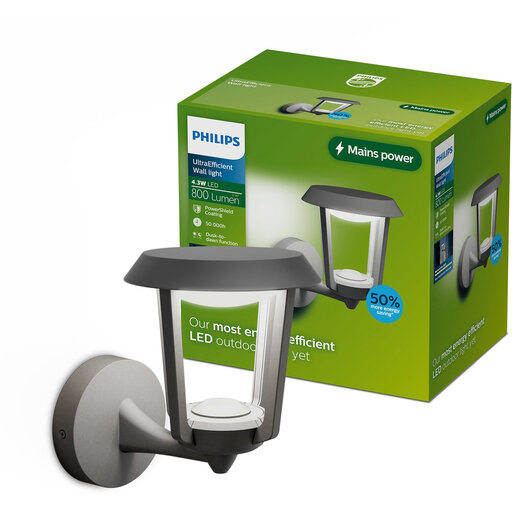
Why it suits this type of shopper: For anyone looking for a fixed outdoor LED wall light with an integrated light source and a warm feel by the entrance, balcony or garden.
The product specifications state 230 V, IP44 and an integrated LED module. This means you can see straight away that it isn’t cordless or completely waterproof.
800 lumens, 2700 K warm white light, integrated LED and an aluminium housing with PowerShield coating, according to the product information.

Why it suits this type of shopper: This solar outdoor light with a sensor is designed for larger outdoor spaces, such as a driveway, garden, garage or patio where broad light coverage is desirable.
According to the product information, this model has three lighting modes, a sensor range of 60 feet and an IP65 rating. Make sure your chosen installation spot gets enough direct sunlight.
302 LEDs, stated light output of 3000 lumens, three adjustable heads, a 180-degree detection angle and solar power.
We’ve put together a complete, up-to-date list of products that meet these strict selection criteria and the applicable European safety regulations.
Clean the surface, decide which direction you want the sensor to face and install the light according to the instructions. If using adhesive mounting, use a suitable, flat surface. Then test the range before choosing its final position.
It depends on the battery, brightness and how often the light switches on. According to the product information, a light with a 500 mAh battery can run for up to 10 hours in sensor mode. Treat this as a stated guide; more frequent use may reduce battery life.
LED lights generally use little power, but consumption depends on the wattage and how long the light stays on. A motion and light sensor can reduce the time it stays on by only activating the light when it detects movement and ambient light is low. With solar lighting, the battery charges from the panel during the day, but performance still depends on the amount of sunlight.
