Who is this guide for?

Photographing prints behind glass

You want the print to remain clearly visible, without lamps or room reflections getting in the way. A movable light source and test shots can help you find the right position. Nikon describes a polarising filter as a tool that can sometimes reduce unwanted reflections.

Creating faithful print reproductions

You want to light the whole print evenly and assess the colour of the light. If you have room for two lamps, a setup with diffused light sources may be worth considering. Artwork Archive describes placing two lamps at an angle on either side as a starting point for photographing two-dimensional artwork.

Photographing with limited setup space

You need to fit the lamp, frame and camera around a small table. So check the dimensions, the mounting options and the power supply for the model you’re considering.

What should you look for when buying?

What to consider What should you look for? Who is this important for?
Reflections in the glass Move the lamp and check with the actual frame and camera that reflections stay out of shot. A diffuser changes the light, but does not guarantee a reflection-free photo. If I’m photographing a print behind glass, I want to be able to move the light source and check what the camera sees in test shots. Around 36% of consumers prioritise controlling reflections in glass.
Even lighting and colour Use test shots to assess whether one panel lights the whole print or whether two diffused light sources would better suit your setup. Compare the adjustable white-light settings for each model. When reproducing a full print, I want to look for even lighting and a light colour I can assess with the camera. Around 29% of consumers give even lighting and colour top priority.
Space and mounting Check the panel dimensions, the type of stand or mount, and whether the lamp can be positioned outside the frame and away from reflective areas. With a small table, I want to leave enough room for the frame and camera without the lamp getting in the way. Around 21% of consumers prioritise the space needed for setup.
Power and what’s included Check whether the power supply, battery, adapter and any required mount are included with the specific model. If cables around the table would be awkward or I’m planning longer sessions, I want to know what power supply and components the model needs. Around 14% of consumers give portability and power top priority.

Common mistakes

  • Assuming a diffuser will automatically prevent reflections in the glass

    Diffusion and lamp positioning address different aspects of lighting. A diffuser does not guarantee that the light source won’t be reflected in the frame glass.

    Take test shots with the framed print, camera and table you actually plan to use. If the reflection is still visible, move the lamp.

    Trying a different position may take extra time, as you’ll need to reposition the light and camera.

  • Comparing a standalone lamp with a complete kit

    What’s included varies by model: a stand, diffuser, adapter or battery may or may not be included.

    Compare the contents list for the exact model and version you want to order, not just the lamp’s name.

  • Taking a stated CRI rating as proof of colour accuracy in your photo

    A CRI rating is a manufacturer’s specification for the lamp; it is not a measurement of how your framed print’s colours will appear under your shooting conditions.

    Use a neutral white-light setting and assess test shots of your own print.

Brands to consider

NEEWER

The NL-116AI kit is designed for a compact setup, while the two-panel NL660 kit needs more room for the light sources.

  • NEEWER lists a built-in battery, adjustable white light and a mini tripod for the NL-116AI kit.
  • The NL660 kit includes two diffusers and stands; NP-F batteries are sold separately.

Godox

The LEDP260C is an option if you’re looking for a larger panel with adjustable white light and can use mains power or batteries sold separately.

  • The Godox manual gives a colour temperature range of 3300–5600 K and lists a mains adapter as standard.
  • The manual notes that the dimming range at intermediate colour temperatures differs from that at the end points. A stand is not listed among the stated standard contents.

SmallRig

SmallRig describes the P96 as a small, rechargeable light for a compact or supplementary lighting setup.

  • SmallRig lists 5 W, 150 lux at 1 m and a cold shoe mount.
  • These specifications don’t show that the P96 can replace two larger panels when lighting a full framed print. A stand is not listed in the stated contents.

amaran

amaran says the P60x is designed for a more spacious setup and comes with a softbox.

  • amaran lists a 60 W light output, a softbox and mains power in the box.
  • The stand shown is sold separately. The stated lux value applies to the specified measuring distance and setting; it doesn’t predict how a print behind glass will be lit.

Ulanzi

The VL49 RGB is a portable mini RGB light for anyone who wants to use coloured mood lighting as well as neutral lighting for photos.

  • Ulanzi lists a built-in battery and an adjustable white-light mode.
  • The official Ulanzi specifications and a Joybuy product title give different upper limits for colour temperature. Check which version is being offered.

Joybuy products

This selection focuses on a compact, portable LED light for a small table.
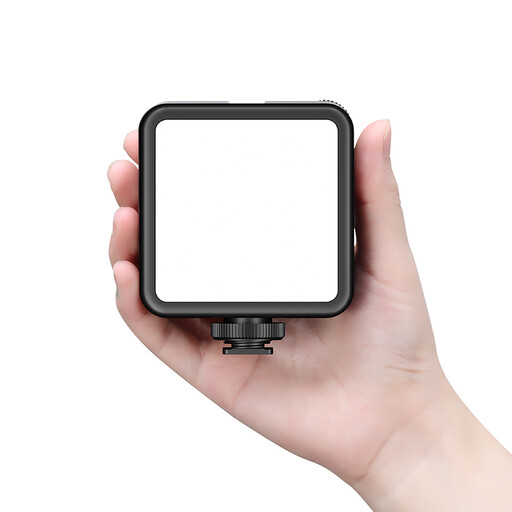
Ulanzi VL81 Rechargeable LED Video Light Black

Ulanzi VL81 Rechargeable LED Video Light Black

May suit you if you’re short on space around the table and want a compact, portable light. Take test shots to assess the light position, reflections in the glass and lighting across the full print.

Before buying, check the applicable conformity information for this version and which components are included.

View at Joybuy

Frequently asked questions

Will reflections disappear if I buy a brighter panel?

Not necessarily. First, move the light source and take test shots with the actual frame. Nikon describes a polarising filter as a tool that can sometimes reduce unwanted reflections.

Do two lamps have to be positioned at exactly 45 degrees?

Not necessarily. Artwork Archive suggests two angled lamps as a starting point for flat artwork. Adjust their position to suit the frame and camera, then check with test shots whether the lamps are creating distracting reflections in the glass.

Are batteries and stands included with a panel as standard?

It depends on the version. The NEEWER NL660 kit includes stands and mains adapters, but no separate NP-F batteries. For the NL-116AI kit, NEEWER lists a built-in battery and a mini tripod. Always check the contents list for the specific version.

What rights do I have when buying online in the Netherlands?

ACM ConsuWijzer states that for a typical online product purchase, the statutory cooling-off period ends 14 days after delivery, subject to exceptions. You’re also covered by the statutory guarantee if a product doesn’t perform as you could reasonably expect under normal use. ACM ConsuWijzer does not specify a fixed, general two-year period for this.

Is a CE mark an assessment of photographic quality?

No. According to Business.gov.nl, CE relates to applicable product rules and is not a quality mark. Check which conformity information applies to the version on offer; the CE mark alone says nothing about reflections or how your print will appear.
