
Vandaag of morgen in huis

Kwaliteit gegarandeerd

Welkomstaanbiedingen ontgrendelen: GRATIS bezorging | Tot 80% korting | Gratis 30 dagen JoyPlus-proefperiode
Download de app
LED lighting can reduce a household’s energy consumption while offering plenty of choice in terms of ambience, control and design. However, an attractive product photo is no guarantee that a lamp will suit your space. The wrong fitting, insufficient light output or a low IP rating can lead to extra costs and unnecessary replacement.
This guide helps you compare LED ceiling lights, GU10 LED spotlights, Philips Hue smart bulbs, E27 LED bulbs and other lighting solutions based on verifiable specifications.
Wattage indicates energy consumption, not directly how much light a lamp produces. That is why you should also check the lumen output. For example, a 7-watt E27 LED bulb may produce 850 lumens according to the product specification. This makes it easier to compare than simply looking at a statement such as “equivalent to 60 watts”.
Also pay attention to the energy rating. LED lighting is generally more energy-efficient than traditional bulbs, but the energy label varies from product to product.
Colour temperature is measured in kelvin (K):
RGB LED lighting adds coloured light. This is useful for creating ambience, but check that the lamp also provides enough white light for everyday use.
A lamp with a dimming function does not automatically work with every existing dimmer. Check that the specification explicitly states dimmable, and confirm whether it is controlled via a wall switch, remote control, app or voice assistant.
With smart home lighting, a bridge is not always included. Philips Hue smart bulbs, for example, can be controlled via Bluetooth. According to the product information, a Hue Bridge may be required for additional features and larger installations.
First check the fitting on your light fixture:
Also measure the available space. A spotlight with a diameter of 5 cm may not fit in a compact light fixture if height is also limited. With an LED ceiling light, height is particularly important in rooms with low ceilings.
Use lumens as a guide. A ceiling light producing 2700 or 3000 lumens is intended to provide general lighting in a larger room. A standalone spotlight producing 255 to 400 lumens is more suitable for accent or supplementary lighting.
The IP code indicates how well a product is protected against dust and water. IP20 is intended for dry indoor areas. IP44 offers protection against splashing water and is often used for bathroom lighting, but this does not mean that the lamp is suitable for direct water jets or immersion.
Always check the installation instructions and the position of the lamp. For example, an LED bathroom mirror with IP44 should be mounted on a suitable, stable wall and not directly beside a water jet.
A stated lifespan is a manufacturer’s product specification, not a guarantee that every lamp will last exactly that long. According to its own product information, Philips gives a lifespan of 15,000 or 25,000 hours for various LED lamps. Also check whether the LED light source can be replaced.
The products shown come with at least the statutory two-year warranty under European consumer law. Keep your purchase details and check the safety instructions before installation. For permanently installed fixtures, switch off the electricity before you begin.
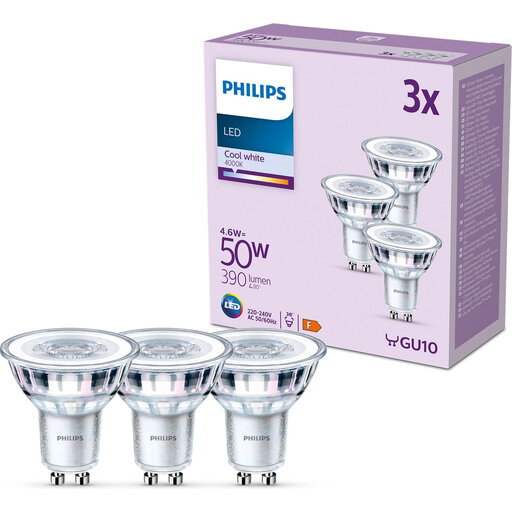
Why it suits this profile: This set of three GU10 spotlights is a practical choice when replacing existing spotlights. The 4000K colour temperature is suitable for a kitchen, hallway or home office.
The fitting, diameter, colour temperature and number of bulbs are clearly stated. The lamp is not dimmable, so you do not need to pair it with an unsuitable dimmer.
GU10 fitting, 390 lumens per light point and 4.6 watts per lamp. According to Philips’ own information, energy consumption is around 80% lower than with traditional bulbs.
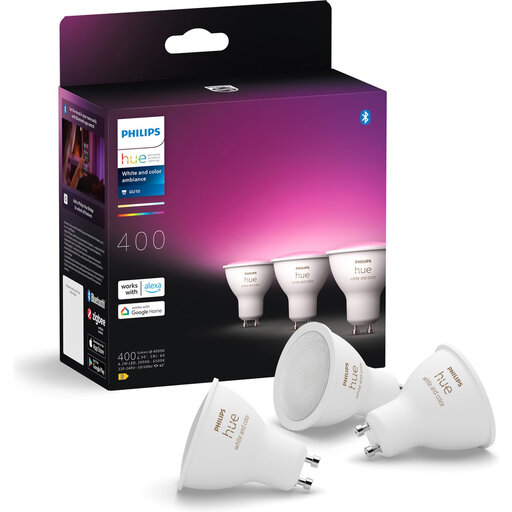
Why it suits this profile: Suitable for households that want to combine ambience, dimming and app or voice-assistant control with a GU10 fitting.
The control options and compatibility are clearly described. Bear in mind that Bluetooth supports up to 10 lamps and that a Hue Bridge is available separately.
Dimmable RGBW lighting, app control and support for multiple smart home platforms. The lamp has a GU10 fitting.
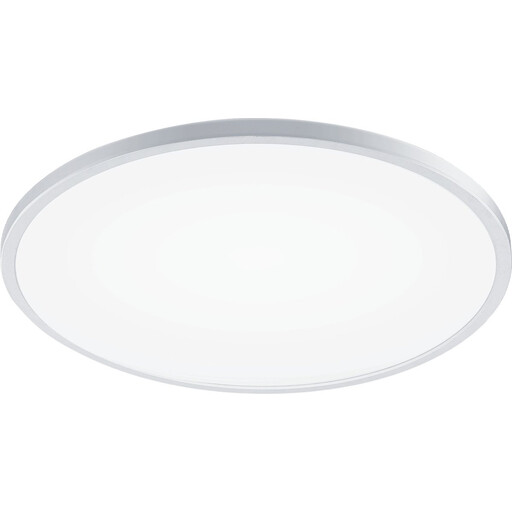
Why it suits this profile: This slim LED ceiling light is designed to provide general lighting in living areas or other indoor spaces where adjustable colour temperature and splash protection are desirable.
The light output, dimensions and IP rating are stated. IP44 is suitable for damp conditions, but not for direct water jets.
2700 lumens, a 120-degree beam angle and RGB+CCT from 3000K to 6500K. The lamp measures 420 mm in diameter and 26 mm in height.
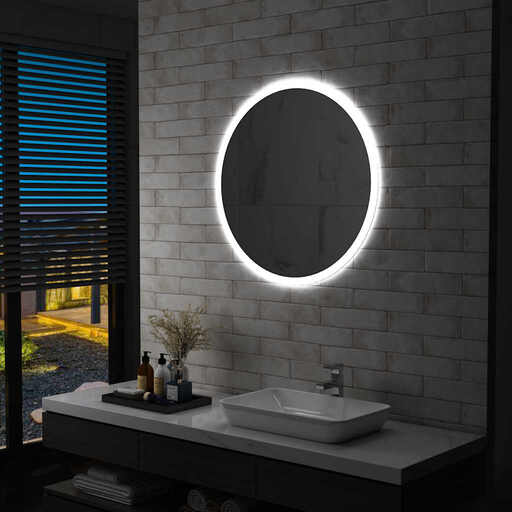
Why it suits this profile: A practical choice if you want to combine a mirror with bathroom lighting. The round mirror has LED lighting around the edge and is designed for wall mounting.
The IP44 rating and mounting requirements are stated. The mirror is not intended for direct water jets and must be secured to a sturdy wall.
80 cm diameter, 12-watt power rating and an aluminium frame. According to the product information, an adapter and mounting materials are included.
We have put together a complete, up-to-date list of products that fully meet these strict selection criteria and the applicable European safety regulations.
Consumption depends on wattage, the number of hours the light is on and the electricity price. Compare the power rating and the value in kWh per 1000 hours. According to Philips’ own information, some of the LED lamps mentioned use around 80% less energy than traditional lamps with a similar light output. The actual amount on your energy bill will vary from household to household.
For a calm atmosphere, many households choose warm white light of around 2700K to 3000K. If you want to use one lamp for reading, working and relaxing, CCT lighting from 3000K to 6500K may be more practical. Check whether the lamp is also dimmable if you want to adjust the brightness.
Lifespan varies depending on the type and operating conditions. The product information for the Philips lamps mentioned gives figures of 15,000 to 25,000 hours. With integrated LED lighting, the entire fitting often needs to be replaced when the light source reaches the end of its lifespan. Before buying, therefore, check the warranty, replaceability and installation method.
