
Vandaag of morgen in huis

Kwaliteit gegarandeerd

Welkomstaanbiedingen ontgrendelen: GRATIS bezorging | Tot 80% korting | Gratis 30 dagen JoyPlus-proefperiode
Download de app
LED lighting is available for virtually every room, from a small LED night light in a child’s bedroom to an LED ceiling light for the living room. However, a low price or a long list of features does not tell you everything. A lamp may, for example, display RGB colours but still not provide enough light to illuminate a room effectively. Terms such as “water-resistant” also do not necessarily mean that a product is suitable for prolonged exposure to rain.
Use these checkpoints to compare LED lamps based on verifiable specifications and choose more confidently for your bedroom, kitchen, hallway, balcony or garden.
A dimmable LED lamp can be controlled in several ways. Some models have three fixed brightness levels, while others work with a touch dimmer, remote control or app. Therefore, check:
A lamp with three fixed levels may be perfectly adequate as an LED night light. For a living room or workspace, a broader dimming range is often more practical.
An RGB LED lamp can combine red, green and blue to create mood lighting. This makes such a lamp suitable for a child’s bedroom, living room or balcony, but RGB does not automatically mean it is intended to be the main light source. Also check the number of lumens and the colour temperature in kelvin.
A lamp with only a colour function may be less suitable as a bedroom lamp if you also want to read comfortably.
For a balcony, patio or garden, you should check the IP rating. IP44 means protection against splashing water, but not against immersion or all weather conditions. Therefore, place such a lamp in a sheltered spot and do not use it in a pond or anywhere water can collect.
A model with IP20 is intended for dry indoor spaces. This applies, for example, to many smart lamps and ceiling lights. Also check whether the product has an integrated LED light source or uses a replaceable bulb fitting.
Wattage indicates how much electrical power the lamp uses; the number of lumens tells you more about the amount of light it produces. A 1 W LED lamp with 140 lumens is mainly suitable as a mood light or for accent lighting. A ceiling light with 2000 lumens is better suited to illuminating an entire room.
To calculate consumption, you can compare the wattage and operating time. A 4.2 W lamp that is switched on for 1,000 hours uses approximately 4.2 kWh. The actual cost depends on your energy tariff.
A lamp with a remote control is useful when you do not want to keep walking over to the switch. A smart LED lamp often offers additional features, but check compatibility first:
The Philips Hue GU10 in the selection works via the Hue app according to the product description, supports Matter and can be controlled with compatible voice assistants. A Hue Bridge is required separately for functions via a Hue Bridge.
A rechargeable lamp offers flexible positioning, but the battery has a limited capacity. Pay attention to the battery type, charging port and included cable. With an integrated LED light source, you also cannot replace the bulb yourself.
Installation is more important for ceiling lighting than for a table lamp. Switch off the power, use suitable fixing materials and check that the surface is appropriate. A lamp for a bedroom or child’s bedroom should stand securely and must not be within reach of young children if any parts could come loose.
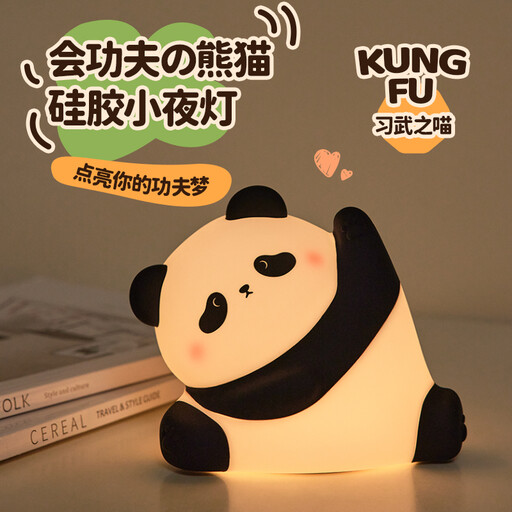
Why it suits this profile: This compact LED night light requires no permanent installation and can be controlled by touch. It fits beside a bed, in a child’s bedroom or as a soft light for nighttime care routines.
The specifications state that it has three dimming levels and touch control. This means you know in advance that it is not continuously dimmable. The lamp is intended for indoor use and must be kept away from water and high temperatures.
1200mAh rechargeable battery, three brightness levels and a housing made from silicone, ABS and PP according to the product description.
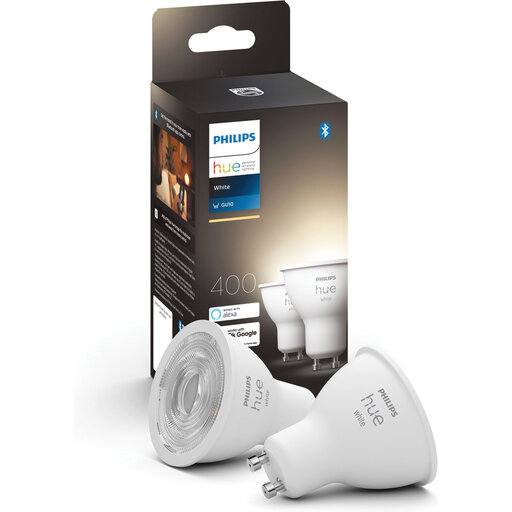
Why it suits this profile: This set is designed for anyone who wants smart control with an existing GU10 fitting. The bulbs are suitable for dry indoor spaces and can be controlled via the app and, according to the product description, with compatible voice assistants.
The fitting, colour temperature, IP20 rating and wattage are clearly stated. Bear in mind that additional Hue features require a Bridge, which is available separately.
GU10 fitting, 4.2 W per light point, 400 lumens per bulb and a stated lifespan of 25,000 hours.
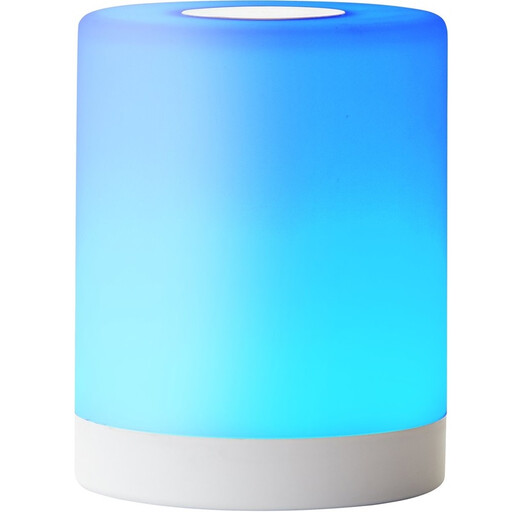
Why it suits this profile: This wireless table lamp is designed for flexible placement on a balcony, patio, in the garden or indoors. Touch control, RGB and warm white light make it suitable for a range of uses.
The IP44 rating makes it clear that this is protection against splashing water. The lamp must not be immersed and is not intended for exposure to severe weather conditions.
Rechargeable 18650 lithium-ion battery, 1 W integrated LED, 140 lumens, RGB function and touch dimmer.
For general lighting, an LED ceiling light may be a more logical choice than several small lamps. According to the product information, the Philips SuperSlim All-In-One offers 2000 lumens, 16 W, a diameter of approximately 29 cm and five lighting settings via a remote control. Its stated IP20 rating means that this lamp is suitable only for dry indoor spaces. Installing a ceiling light requires the power supply to be switched off and the fitting to be securely mounted.
A ceiling light with an RGB remote control is particularly appealing if you want colour accents as well as basic lighting. However, check that the light output, dimensions and installation method are suitable for the room.
We have put together a complete, up-to-date list of products that fully meet these strict selection criteria and the applicable European safety regulations.
This depends on the wattage and the number of hours the light is switched on. Multiply the power in watts by the number of hours and divide by 1000 to calculate consumption in kWh. A 4.2 W lamp that is switched on for 1,000 hours uses approximately 4.2 kWh.
The lifespan varies by model and operating conditions. Check the stated lifespan in hours. With integrated LED lighting, the entire lamp is generally replaced when the light source stops working. With a GU10 lamp, you can usually replace the light source separately, depending on the fitting and the light fixture.
No. Check the IP rating and the safety instructions. IP44 provides protection against splashing water, but does not make a lamp suitable for immersion or heavy rain. An IP20 lamp should be installed in a dry indoor space.
