
Vandaag of morgen in huis

Kwaliteit gegarandeerd

Welkomstaanbiedingen ontgrendelen: GRATIS bezorging | Tot 80% korting | Gratis 30 dagen JoyPlus-proefperiode
Download de app
LED lighting for your home can make a room more practical while adding atmosphere. However, lamps, wall panels and illuminated home accessories can vary considerably in how they’re used. A lamp that works well in a bedroom won’t necessarily be suitable for task lighting in the kitchen. An RGB panel for a gaming room also has different considerations from an LED ceiling panel for the living room.
Look out for these three common pitfalls:
Brightness is measured in lumens (lm). A small bedroom generally needs less light than a kitchen or home office. Check the Kelvin (K) rating too:
With a dimmable LED ceiling light, it’s useful to be able to adjust both the brightness and colour temperature. For example, the Brilliant LED panel measuring 96 × 25 cm is listed as producing 3000 lumens, with an adjustable range of 3000-6500 K. According to the product information, it can be operated using the remote control or a conventional wall switch.
Think about how you want to use the lighting before you buy. A remote control is convenient for a ceiling light, while an app can be useful for RGB wall panels. For smart lighting, check:
With RGB wall lighting, gaming lights, hexagon LED panels and triangular LED lighting, music synchronisation is often a key feature. Treat this as a function described by the product, not a guarantee that it will respond in the same way to every music source or app. Also check whether the panels are powered via USB, a plug socket or a fixed connection.
Measure the wall or ceiling before ordering. A panel that’s 96 cm wide won’t necessarily fit above every table, and a dressing table with a mirror may need extra clearance because of its height.
When installing, it’s important to:
A kitchen extractor hood isn’t an ordinary decorative light. For a model with external extraction, check that it can be connected to an exhaust duct. Recirculating models need suitable carbon filters.
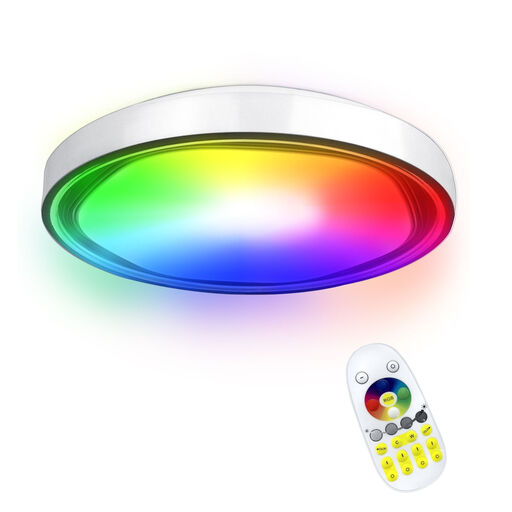
Why it suits this profile: This round ceiling light combines dimming, RGB lighting and remote control. It’s a practical choice if you’re looking for one fitting to provide both general and ambient lighting.
The product name specifies dimming, RGB and a range of 2800-6500 K. Before buying, check the included instructions and the exact control functions.
50 cm round design; dimmable; RGB function; remote control, according to the product listing.
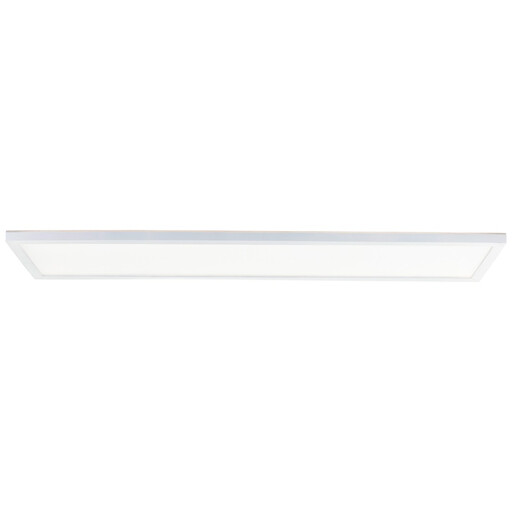
Why it suits this profile: This slim panel is designed to provide even general lighting in spaces such as a kitchen, hallway, living room or home office. Its 4.2 cm height can be useful where ceiling clearance is limited.
The listing gives precise dimensions, light output, colour temperature and energy consumption. This makes it easier to compare with other lights than relying on design photos alone.
3000 lumens; dimmable; CCT of 3000-6500 K; IP44 according to the product information; remote control included.
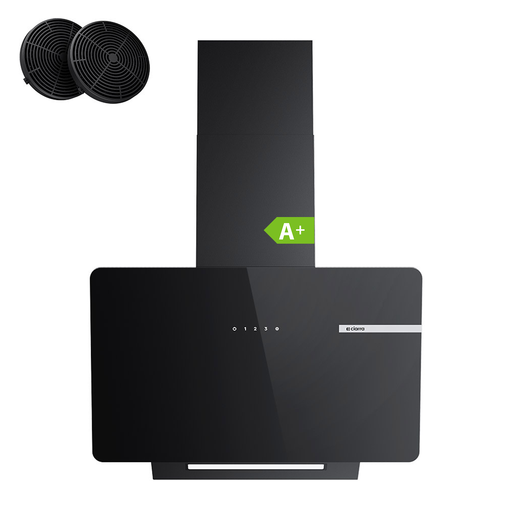
Why it suits this profile: In a busy kitchen, ventilation matters just as much as lighting. According to the product details, this wall-mounted model has a maximum airflow of 580 m³/u, touch controls and a built-in LED light.
The specifications list both external extraction and recirculation. Check in advance which option is suitable for your kitchen, and remember that the metal grease filter needs regular cleaning.
60 cm wide; maximum airflow of 580 m³/u; washable aluminium filter; LED lighting; 24-month guarantee, according to the product listing.
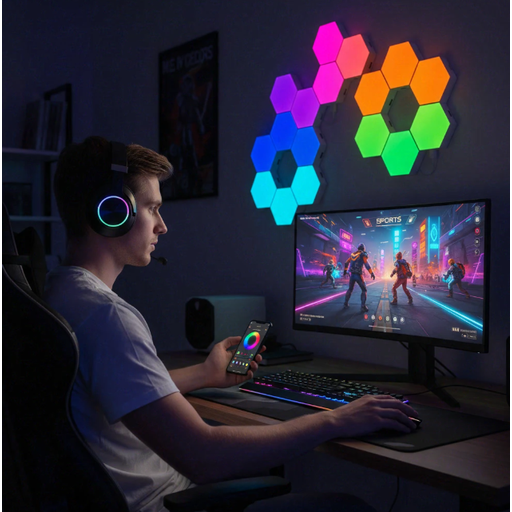
Why it suits this profile: These eight separate RGB panels are designed for a gaming room, TV wall or bedroom. The product description says they offer app control, a remote control and music synchronisation.
The number of panels, their dimensions of 11,5 × 10 × 2,6 cm and the USB connection are clearly listed. Measure your wall and check how many panels can be connected.
8 RGB panels; USB power; app and remote control; music mode; mounting accessories, according to the product information.
We’ve put together a comprehensive, up-to-date list of products that meet these strict selection criteria and current European safety regulations.
It depends on the size and ceiling height of the room, as well as how you use it. A living room often needs a combination of general and accent lighting. In a kitchen, a higher light output is useful, particularly above worktops. Compare the lumen ratings and consider using several light sources rather than one very bright lamp.
Lifespan varies by product and conditions of use. Check the stated lifespan and guarantee, and whether you can replace the light source or driver. Replacing an integrated LED light is often less straightforward than changing a bulb in a fitting with a separate socket. Good ventilation around the light and following the instructions can help it work reliably.
A dimmed light generally uses less power than the same light at maximum brightness, but the exact amount depends on its design and setting. Check the stated wattage and energy consumption per 1000 hours. For a fair comparison, compare lights at the same brightness rather than looking only at the lowest wattage value.
