
Vandaag of morgen in huis

Kwaliteit gegarandeerd

Welkomstaanbiedingen ontgrendelen: GRATIS bezorging | Tot 80% korting | Gratis 30 dagen JoyPlus-proefperiode
Download de app
LED lighting is available as smart bulbs, solar outdoor lights, spotlights, wall lights, table lamps and cabinet lighting. This wide choice is useful, but it also makes comparisons more difficult. A lamp may look appealing and still be unsuitable for the fitting, room or way you intend to use it.
So don’t just look at the price or the number of lumens. Above all, check the following points before placing your order.
A lamp is only safe to use when its fitting matches the light fitting. Common variants include:
Also check the maximum dimensions of the light fitting. A lamp may have the correct fitting technically, but still be too wide or too tall.
The IP rating is important for outdoor LED lights. IP44 means that the lamp is protected against splashing water and solid particles above a certain size. This makes a product suitable for sheltered outdoor areas, but not for submersion or exposure to direct jets of water.
For an exposed façade, garden path or location that receives a lot of rain, a higher level of protection, such as IP65, may be more practical. Also consider the installation location: an approved outdoor light does not automatically become suitable simply because you hang it in an unprotected spot.
Wattage indicates energy consumption, while lumens indicate the amount of light produced. For example, a 5 W LED bulb may produce 470 lumens, while a traditional bulb with a higher wattage does not necessarily produce more light.
First decide what you need the light for:
Colour temperature is measured in kelvin:
A dimmable LED bulb offers extra flexibility, but check that your existing dimmer is suitable for LED lighting. With smart lighting, dimming is often controlled via an app or remote control.
A smart LED bulb can work via Bluetooth, Wi-Fi or a bridge. A Wi-Fi bulb such as the Alecto SMARTLIGHT30 connects directly to your Wi-Fi network according to the product description and works via the Smart Life app. According to the manufacturer, the bulb also supports connection with Amazon Alexa and Google Home.
Be aware of the difference between:
Always check that your app, voice assistant and home network are supported.
Under the current EU label, energy efficiency ratings range from A to G. According to the standardised scale, a higher rating means lower energy consumption for the stated performance. Also compare the number of lumens and the wattage, rather than looking only at the letter on the label.
The stated lifespan, for example 15,000 or 25,000 hours, is a product specification provided by the manufacturer. The actual lifespan depends on factors including heat, switching frequency, ventilation and conditions of use.
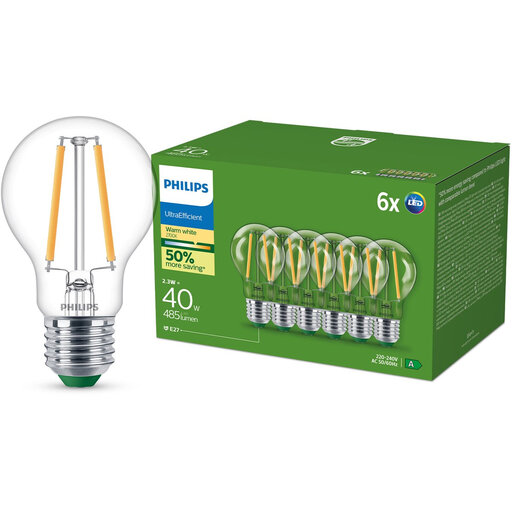
Why it suits this profile: If you want to replace your existing bulbs easily, this pack contains six E27 bulbs for indoor fittings. The warm white colour of 2700 K is well suited to living rooms and bedrooms.
The fitting, colour temperature, light output and energy efficiency rating are clearly stated. Bear in mind that this bulb is not dimmable.
E27 fitting, 2700 K, 485 lumens per light point, energy efficiency rating A according to the product information, and a set of six bulbs.
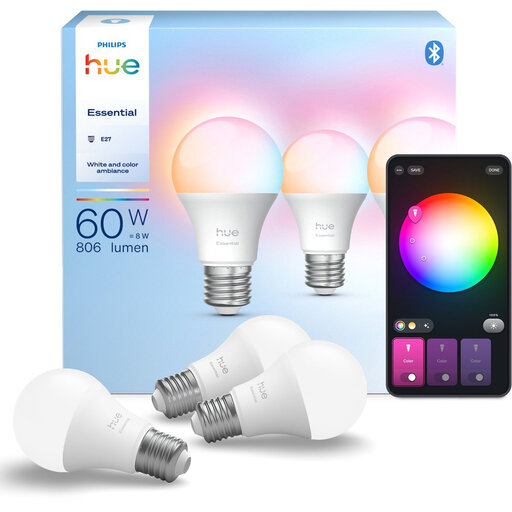
Why it suits this profile: This set is intended for anyone looking to build smart lighting across several rooms and who values control via an app, remote control or compatible voice assistant.
The E27 fitting and IP20 rating make it clear that this bulb is intended for dry indoor areas, not outdoor use.
RGBW light, dimming function, 806 lumens per bulb, three bulbs per pack and a stated lifespan of 25,000 hours.

Why it suits this profile: For kitchen cabinets, wardrobes and dark passageways, this cabinet light with motion sensor offers wireless installation and three light colours.
The 40 cm length, 3–5 metre PIR range and USB-rechargeable battery are clearly specified. However, the product must be protected from moisture.
Two lights, 61 LEDs per light, three colour temperatures and drill-free installation using the adhesive mounting provided.

Why it suits this profile: This solar outdoor lighting is designed for driveways, garages, patios and larger garden areas where broad light distribution and motion detection are desirable.
The IP65 rating, three lighting modes and stated 180-degree detection angle provide more useful information than simply describing the product as ‘waterproof’.
According to the product description: 302 LEDs, 3000 lumens, three adjustable heads, solar power and an 1800 mAh lithium-ion battery.
We’ve compiled a complete, up-to-date list of products that fully meet these strict selection criteria and the applicable European safety regulations.
For a living room or bedroom, warm white lighting of around 2700 to 3000 K is often a natural choice. In a kitchen, 4000 K can help with task lighting. For a reading area, both the light output and positioning are important, as well as the colour temperature.
An LED outdoor table lamp is useful on a balcony or patio when you don’t want to run a cable. Choose a model with solar and USB charging if cloudy days in the Netherlands are a consideration. An LED wall light with sensor is practical by an entrance, but check the sensor’s range and make sure the lamp will not be triggered constantly by people walking past.
For fixed spotlights, you could consider a GU10 LED spotlight. Check that the dimming function, IP rating and the cut-out size of the fitting are compatible. A smart ceiling light or Wi-Fi bulb is particularly useful when you actually use schedules, app control or voice control.
Lifespan varies from one model to another. The product specifications provided include examples of 15,000, 25,000 and 50,000 hours. These are figures stated by the manufacturer and do not guarantee that every lamp will last exactly that long. Heat dissipation, voltage and usage all affect real-world performance.
LED bulbs generally use little power for the amount of light they produce. Always compare wattage and lumens. A smart bulb may use a small amount of electricity in standby when it remains connected to Wi-Fi. With solar outdoor lighting, the battery is charged via the solar panel, but operating time depends on sunlight and charging conditions.
No. Check that the product page explicitly states that the bulb is dimmable. With smart LED bulbs, dimming is usually controlled via the app. For a bulb connected to a wall dimmer, the dimmer itself must also be suitable for LED lighting; otherwise, flickering or a limited dimming range may occur.
