
Vandaag of morgen in huis

Kwaliteit gegarandeerd

Welkomstaanbiedingen ontgrendelen: GRATIS bezorging | Tot 80% korting | Gratis 30 dagen JoyPlus-proefperiode
Download de app
LED lighting can be energy-efficient, easy to install and suitable for almost any room. However, products vary greatly in terms of fitting, light output, colour temperature, smart features and moisture protection. A bulb that looks good in the product photo might not fit your fixture, or could deliver less light outdoors than you expected.
As a Joybuy Product Recommendation Officer, I therefore start by looking at the verifiable specifications. Below, you’ll find out what to look for when choosing lighting for your home, garden, cupboard, bedroom and car.
Lumens indicate how much light a source produces according to its specification. They don’t automatically tell you how well the light is distributed. A ceiling light with a wide beam angle can illuminate a room more evenly than a bright spotlight with a narrow beam.
Also watch out for contradictory information. Some car bulbs boast very high lumen values in the marketing text. According to the manufacturer’s own information, for example, certain H4 LED headlights claim up to 26,000 lumens per set. The actual light distribution also depends on the reflector, lens, installation and vehicle compatibility.
An E27 LED bulb won’t fit a GU10 fitting. An H7 LED headlight is equally not interchangeable with an H4, HIR2 or D3S LED bulb. So check before you buy:
An IP20 product is intended for dry indoor spaces. An IP44 bulb is better suited to sheltered outdoor locations, but should not be submerged. With solar outdoor lighting, the panel also needs enough direct daylight. So don’t automatically place a bulb under a canopy or in a permanently shaded spot.
Colour temperature is expressed in kelvin:
A smart LED bulb or smart lamp sometimes offers an adjustable range. According to the product specifications, the Nedis SmartLife ceiling spotlight can be set from 2700 to 6500 K. This means you can use warm light in the evening and cooler light during household tasks.
Wattage indicates electricity consumption; lumens indicate light output. For energy-efficient lighting, look at both values. The energy label runs on the European scale from A to G. According to the product information, a Philips UltraEfficient E27 LED bulb is listed with energy label A, 485 lumens and 2700 K.
Be aware of discrepancies in product titles. The name of this model says “40W”, while the specifications state 2.3 W per light point. If in doubt, always check the technical table and packaging before ordering.
For an LED ceiling light or LED recessed spotlight in dry rooms, IP20 is standard. For a bathroom, balcony or garden, check whether the IP rating is suitable for the location. Switch off the power for fixed installations. When fitting into a suspended ceiling, the cut-out size and diameter must match; a 52 mm spotlight won’t simply fit into every opening.
For cupboard lighting, ease of installation and power supply are important. A rechargeable LED lamp with a USB connection can be handy if you don’t want to drill or hide cables. An LED lamp with a motion sensor switches on automatically, but check the detection range and battery capacity.
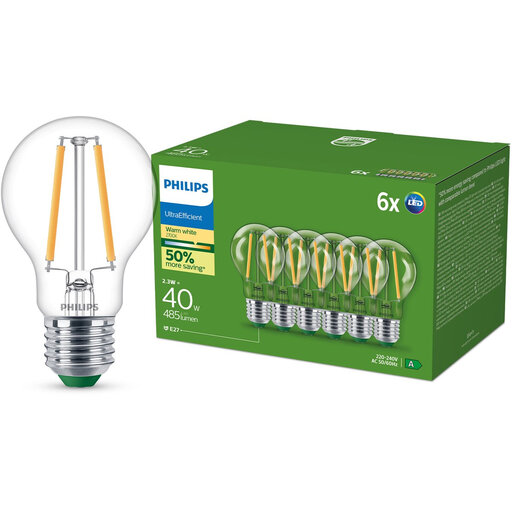
Why this fits the profile: A set of six E27 bulbs is practical if you want to replace several old bulbs at once. The warm 2700K colour suits many living spaces.
The fitting, light colour, light output and energy label are clearly stated. Do check the discrepancy between the product name and the stated wattage.
E27 fitting, 485 lm per bulb, 2700 K, six pieces and, according to the product information, energy label A.
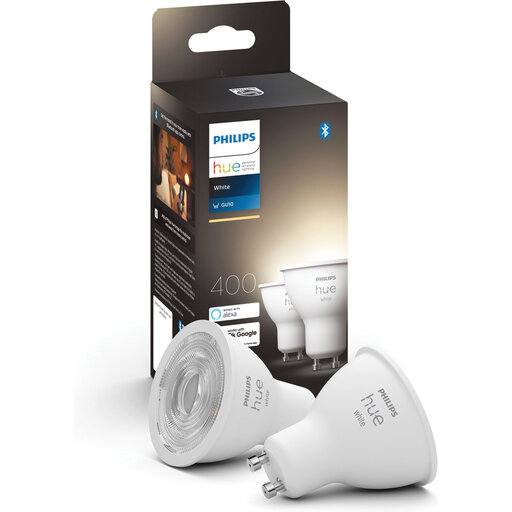
Why this fits the profile: Ideal for anyone who wants to control GU10 spotlights via an app, dim them and possibly expand with a Hue Bridge.
The GU10 fitting and indoor use are specified. No mandatory hub is needed for Bluetooth, but according to the product description, extra features require a Bridge.
4.2 W, 400 lm per spotlight, dimming function, Bluetooth control, Matter support and two bulbs per pack.

Why this fits the profile: The 40 cm long LED cupboard light is designed for kitchen cabinets, wardrobes and shelves where there is no fixed wiring.
The sensor, battery, dimensions and installation are clearly described. The light is not intended for damp locations; keep it dry.
61 LEDs, PIR detection up to 3-5 metres, three colour temperatures, USB charging and tape mounting without drilling.
For cars, extra checks are needed. An H4 LED headlight often combines main and dipped beam, while H7 usually uses one light function. An HIR2 LED bulb has fitting 9012. A D3S LED bulb is only intended as a replacement in a headlight unit originally made for HID. So check the vehicle model, the fitting, the available space and any error messages. Claims such as “99% compatibility” or “300% brighter” come from the brand’s product information and are not a guarantee for every car.
We’ve put together a full, up-to-date list of products that fully meet these strict selection criteria and comply with current European safety regulations.
The lifespan varies by model, usage time, heat dissipation and ambient temperature. Manufacturers may state, for example, 15,000, 25,000 or 50,000 burning hours. This is a stated product specification, not a guarantee that every bulb will last exactly that long. Good ventilation and use within the stated conditions help prevent overheating.
LED lighting typically uses fewer watts for a comparable light output than older incandescent or halogen bulbs. Calculate consumption using: wattage × burning hours ÷ 1,000. Multiply this by your electricity rate. A bulb with a lower wattage isn’t automatically more suitable if it doesn’t provide enough lumens for the room.
No. Check the IP rating and the manufacturer’s instructions. A solar outdoor light with IP44 is intended for outdoor use in normal weather conditions, but not for submersion. A product with IP20, such as many ceiling lights and smart lamps for indoors, belongs in a dry room.
