
Vandaag of morgen in huis

Kwaliteit gegarandeerd

Welkomstaanbiedingen ontgrendelen: GRATIS bezorging | Tot 80% korting | Gratis 30 dagen JoyPlus-proefperiode
Download de app
LED lighting is energy-efficient, often lasts a long time and is available in almost every style. Even so, choosing the right option isn’t always straightforward. A lamp may have plenty of features on paper, yet disappoint in your hallway, garden or living room. Light colour, fitting, moisture protection and installation are often checked too late.
As a Joybuy Product Recommendation Officer, I filter product information to focus on specifications you can verify. This helps you see which features really matter and which popular marketing claims are worth checking first.
Wattage tells you how much energy a lamp uses, but not how much light it produces. For that, look at the number of lumens. For example, a Philips Ultra Efficient LED bulb is listed as producing 840 lumens at 4 watts, with an E27 fitting. That tells you more about its light output than the label ‘60W replacement’ alone.
Also check the energy rating. An energy-efficient LED bulb with an A energy label could be a good choice for rooms where the light is on for long periods each day. However, check whether the bulb is dimmable: according to the product information, the Philips Ultra Efficient bulbs mentioned here are not dimmable.
A light for the bathroom, exterior wall or garden needs to be suitable for the conditions where you plan to install it. The IP code indicates how well a product is protected against solid particles and moisture.
An IP44 outdoor light is protected against splashing water, but isn’t designed to be submerged or sprayed directly with a powerful jet of water. Several Philips outdoor lights in the range, including the Nayl, Capricorn and Zyra, have an IP44 rating. This may be suitable for a sheltered exterior wall, balcony or garden path. For a very exposed location, assess the installation site particularly carefully.
Warm white lighting at around 2700K usually creates a softer feel in living rooms, bedrooms, on exterior walls and on patios. Cooler light can be more practical for a home office or kitchen. According to its product specifications, a ceiling light with a remote control, such as the Philips All-In-One, offers adjustable light from 2700K to 6500K and adjustable brightness.
Also consider the type of controls:
Use lumens to compare bulbs. A bedroom usually needs less light than a workspace or kitchen. Also check the colour temperature in kelvin:
An integrated LED module can create a sleek design, but it isn’t always replaceable. With a separate E27 or GU10 bulb, you can replace the light source or change the colour temperature more easily later.
Check the fitting and dimensions before buying. An E27 LED bulb won’t fit an E14 socket. For directional outdoor lighting, GU10 outdoor lights can be a practical choice; the Philips Cylr ground spotlight comes with a GU10 LED spotlight and a 150 cm cable.
For ceiling lights, check whether the fitting is surface-mounted or recessed. A surface-mounted panel, such as the Brilliant 25 cm LED ceiling panel, is 2.1 cm high and designed to be mounted on the ceiling. Its stated IP20 rating means it’s intended for dry indoor spaces.
A motion sensor is useful by a front door, shed or garden path. A dusk sensor stops an outdoor light from staying on unnecessarily during the day. For solar outdoor lighting, positioning and maintenance are important: keep the solar panel clean and choose a spot that receives enough daylight.
According to its product description, a Nedis SmartLife bulb can be dimmed, scheduled and controlled via the app, as well as with compatible voice assistants. Check whether you need a 2.4GHz Wi-Fi network and whether the bulb must not be used with a traditional dimmer.
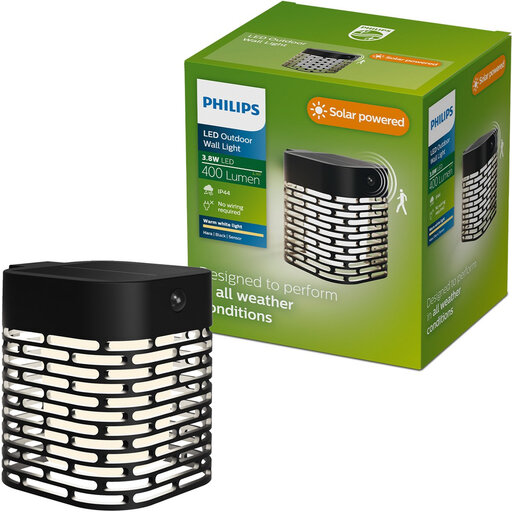
Why it suits this profile: This solar outdoor light is a good choice if you want to add outdoor lighting without installing new power cables. It provides warm white light at 2700K and is designed for places such as gardens and balconies.
The IP44 rating makes it clear that the light is splash-resistant, but must not be submerged. The specifications also list two lighting modes, plus motion and dusk sensors.
400 lumens, 3.8 watts, IP44 rating and installation without fixed wiring.

Why it suits this profile: If you want to replace several indoor bulbs at once, this set is a practical starting point, with warm white light and a standard E27 fitting.
The fitting, light colour, light output and non-dimmable design are all clearly stated. This makes it easier to check in advance whether the bulb is right for your light fitting and controls.
E27, 840 lumens per bulb, 4 watts and a pack of six.
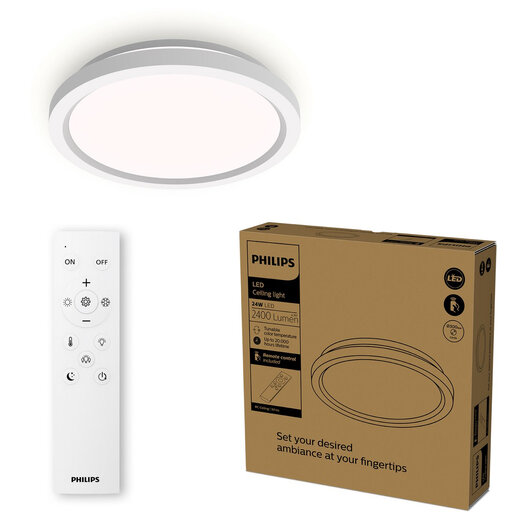
Why it suits this profile: This LED ceiling light is suitable for living rooms, bedrooms and home offices where you want one light to offer different settings.
The product information lists both the adjustable colour temperature and the dimming function. This means you’re not limited to one fixed light colour.
2,400 lumens, 24 watts, 30 cm diameter and remote control.
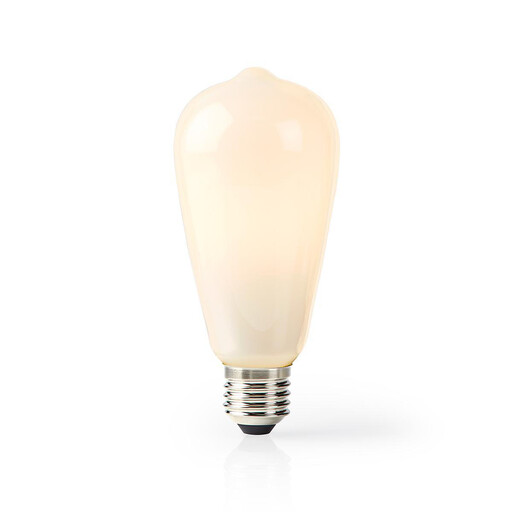
Why it suits this profile: This smart LED bulb is a good fit if you want to control your lighting via a smartphone, schedules or compatible voice assistants.
The bulb clearly states that it can be controlled via Wi-Fi, the app and a voice assistant. It’s also clear that dimming isn’t done using a traditional dimmer.
E27 fitting, 500 lumens, 5 watts, 2700K and support for automatic schedules.
We’ve put together a complete, up-to-date list of products that meet these strict selection criteria and the applicable European safety regulations.
Lifespan varies by product and conditions of use. The product information for the Philips Ultra Efficient bulbs gives a lifespan of 50,000 hours. The Philips Hara solar outdoor light is listed as lasting 25,000 hours. Treat figures like these as product specifications, not a guarantee of a set number of calendar years. Heat, moisture, switching frequency and the quality of the light fitting can all have an effect.
LED bulbs generally use fewer watts than older incandescent or halogen bulbs to produce a similar amount of light. The actual savings depend on the wattage, how many hours the light is on and your electricity tariff. So compare wattage and lumens, and don’t choose a bulb that’s much brighter than you need.
Choose a product that is specified for outdoor use and check its IP rating. An IP44 outdoor light is protected against splashing water, but isn’t suitable for submersion. Place solar outdoor lights somewhere with enough daylight, and make sure a qualified electrician carries out the electrical connection for fixed outdoor lights.
