
Vandaag of morgen in huis

Kwaliteit gegarandeerd

Welkomstaanbiedingen ontgrendelen: GRATIS bezorging | Tot 80% korting | Gratis 30 dagen JoyPlus-proefperiode
Download de app
LED lighting can illuminate your home, workplace, garden or gaming room in a targeted way while using relatively little energy. However, a low price is not the only thing you should consider. The wrong fitting, an unsuitable IP rating or light that is too cool can make a lamp less useful than expected.
This buying guide helps you compare LED lamps based on verifiable specifications. That way, you can better judge whether an E27 LED lamp, GU10 LED spotlight, smart LED lighting or LED strip is right for your needs.
Wattage tells you how much power a lamp uses, not how much light it produces. So you should also check the number of lumens. For example, the product information for a Philips E27 LED lamp lists 1,521 lumens at 13 watts. That tells you more about the light output than the “100 W equivalent” description.
Also consider the difference between a lamp for general lighting and an accent lamp. A 255-lumen GU10 LED spotlight is suitable for targeted lighting, but it will not illuminate the same area as a powerful ceiling lamp.
A lamp may be technically suitable but still not fit. Check the following before buying:
When buying a new fitting, you should also check whether the light source is included. For example, the vidaXL floor lamp in the range is supplied without a light source. According to the product information, it has two light points and mentions E27 and E14 lamps, while the technical specification also lists “G4”. Whenever you find conflicting information like this, always check the current product page or manual before ordering.
An RGB lamp is not automatically a fully featured smart lamp with app control. Check whether the product connects via Wi-Fi, Bluetooth or a hub, and which functions are actually available.
According to its product specification, the TP-Link Tapo L530E works via Wi-Fi and the Tapo app. The lamp offers adjustable brightness, a colour temperature range of 2,500 to 6,500 K, scheduling and voice control through compatible platforms. A Philips Hue Essential lamp can be controlled via Bluetooth; according to the product description, a Hue Bridge is required for features such as control when you are away from home.
Colour temperature is measured in Kelvin (K):
Warm white light is a practical choice for living spaces. Neutraler light may be more comfortable at a desk. Coloured mood lighting, such as RGBW lamps or an RGBIC LED strip, is mainly used as an addition rather than as the main lighting.
Lumens indicate light output. Wattage indicates energy consumption. An LED lamp with a low wattage can therefore still provide enough light if its lumen rating is high enough.
Under the current EU scale, the energy label ranges from A to G. The product details list the Philips UltraEfficient E27 lamp with energy label A, 2.3 watts and 485 lumens. The 13-watt Philips matt E27 lamps are listed with energy label E and 1,521 lumens. So compare lamps based on both light output and energy consumption, not just the letter on the energy label.
The IP rating indicates how well a product is protected against dust and moisture. IP20 is intended for dry indoor areas. An outdoor LED wall lamp requires a higher level of protection.
According to its product details, the Brilliant portable outdoor lamp has IP44, a motion sensor, 300 lumens and a rechargeable battery. IP44 does not mean that the lamp is completely waterproof. The product information states that it is splash-resistant and must not be immersed or exposed to direct jets of water.
Always switch off the power when replacing or installing a lamp. For fixed ceiling lighting, it is sensible to follow the installation instructions and, if in doubt, contact a qualified installer.
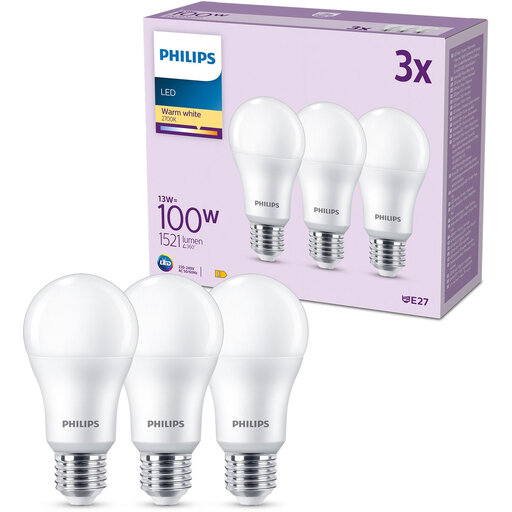
Why it suits this profile: This set is ideal if you want to replace existing E27-fitting lamps with energy-efficient LED lamps that produce warm white light.
The product details list both the 13-watt power consumption and the light output of 1,521 lumens, so you do not have to rely on a wattage comparison alone.
E27 fitting, 2,700 K warm white light, three lamps per pack and a stated lifespan of 15,000 hours.
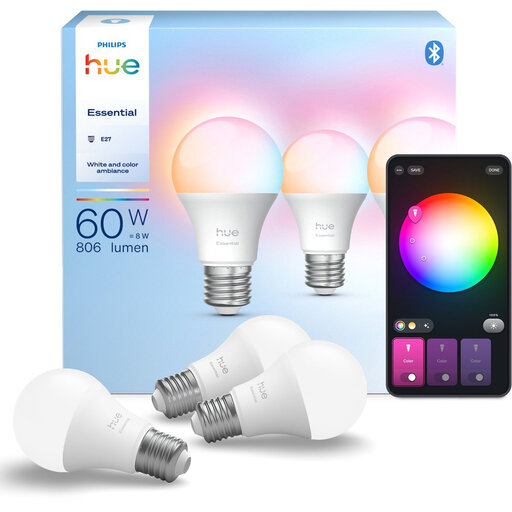
Why it suits this profile: A natural choice for households that want to set warm white light, dimming and coloured scenes from one lighting system.
The product description distinguishes between control via Bluetooth and additional functions that require a Hue Bridge.
E27 fitting, RGBW light, 806 lumens per light point, dimming function and control via app, remote control or compatible voice assistant.
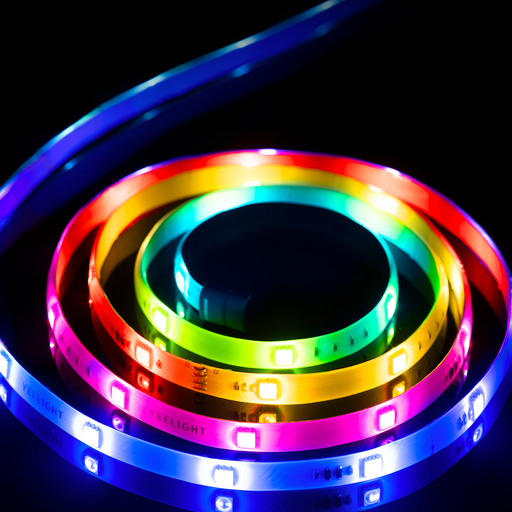
Why it suits this profile: This extension strip is ideal for a TV, desk or gaming setup where indirect, coloured mood lighting is wanted.
This is a 1-metre extendable component. Check its compatibility with your existing Yeelight installation and the total length you require before buying.
RGBIC technology according to the product name, support for app and voice control, and suitable for TVs, desks and gaming rooms.
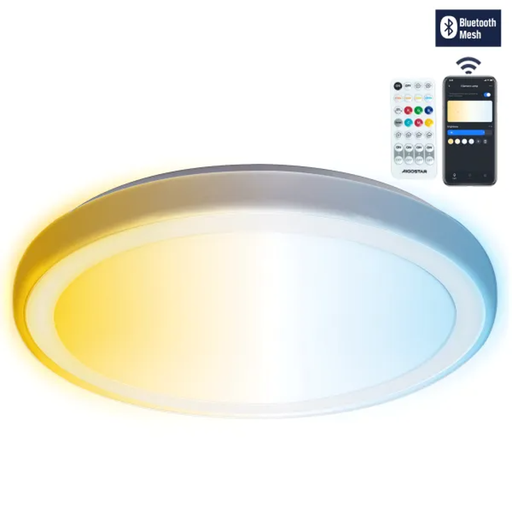
Why it suits this profile: This LED ceiling light is designed for dry indoor areas where broad, powerful lighting and Bluetooth Mesh control are required.
The specifications list 3,960 lumens, a beam angle of 120 degrees and IP20. This makes it clear that the lamp is intended for broad indoor lighting, not damp outdoor areas.
36 watts, 3,960 lumens, adjustable colour temperature from 3,000 to 6,500 K and control via Bluetooth Mesh.
We have put together a complete, up-to-date list of products that fully meet these strict selection criteria and the applicable European safety regulations.
Lifespan varies by product and conditions of use. The product details for several Philips lamps state an average lifespan of 15,000 hours. The Philips UltraEfficient E27 lamp is listed with 50,000 hours. Treat this as a product specification under certain conditions, not as a guarantee for every type of use. Heat, ventilation and the correct fitting can all affect lifespan.
LED lamps generally use less power than comparable traditional light sources. Calculate actual consumption using this formula:
wattage ÷ 1,000 × hours of use × electricity price = running cost
An 8-watt lamp switched on for five hours a day uses less electricity than a traditional lamp with a higher wattage used for the same number of hours. The final saving depends on your electricity tariff, usage and purchase price.
No. Check explicitly whether the specifications state dimmable and whether the dimmer is suitable for LED lighting. According to the product information, several Philips GU10 and G9 models in this range are not dimmable. Smart lamps can sometimes be dimmed via an app, but that does not automatically mean they are suitable for a conventional wall dimmer.
