
Vandaag of morgen in huis

Kwaliteit gegarandeerd

Welkomstaanbiedingen ontgrendelen: GRATIS bezorging | Tot 80% korting | Gratis 30 dagen JoyPlus-proefperiode
Download de app
LED lighting can help reduce a home's electricity consumption and maintenance needs, but not every lamp is suitable for every situation. An E14 LED bulb for a table lamp needs different features from an outdoor wall light for a façade. Terms such as “extra bright”, “weather-resistant” and “long lifespan” also mean little without the technical specifications to back them up.
With this practical guide, you can focus on the points most likely to cause disappointment after purchase: the fitting, light output, colour temperature, IP protection and installation.
A round bulb will not automatically fit every light fitting. Always check the fitting:
Also check the maximum wattage of the light fitting. A bulb with the correct fitting may still be unsuitable if its power exceeds the permitted value.
With traditional incandescent bulbs, wattage gave a rough indication of brightness. For LED light sources, you should look at lumens instead. An LED bulb with a low wattage can still provide plenty of light.
Examples from the product specifications:
The right light output depends on the room. A cosy corner needs less light than a workspace, driveway or entrance.
For outdoor lighting, the IP rating is important. IP44 outdoor lighting is protected against solid objects and splashing water. This makes IP44 suitable for a sheltered façade, balcony or patio, for example, but not for immersion or powerful water jets.
IP65 outdoor lighting offers greater protection against dust and water jets. You should also check the installation location, cable entry and the manufacturer’s instructions. According to the product description, the Philips Zyren has an IP65 rating; the Philips Juli and Brilliant Iseo are specified as IP44.
Colour temperature is expressed in kelvins:
A 3,000 K bulb, such as the Aigostar E14 9W, is designed to provide a warm light. According to the product specifications, the Philips Capricorn uses 2,700 K. The Philips Zyren is specified as 5,000 K. So choose the atmosphere you want first, and the design afterwards.
A light fitting may be supplied without a light source, with a separate fitting or with integrated LED technology.
The Philips Juli is supplied without an E27 LED bulb. The Philips Fylx uses a GU10 fitting and is also supplied without a spotlight bulb. Before buying, therefore, check whether you already have the right LED bulb or would prefer to order one separately.
A mains-powered lamp requires careful attention to safe installation. Switch off the electricity before installation, and have fixed electrical connections carried out by a qualified installer if you are unsure about the connection.
Portable models work differently. The Brilliant Iseo uses a rechargeable battery and can be mounted magnetically or placed freestanding. A solar outdoor light needs direct sunlight to charge its panel. Keep the solar panel free from shade and clean it regularly with a soft cloth.
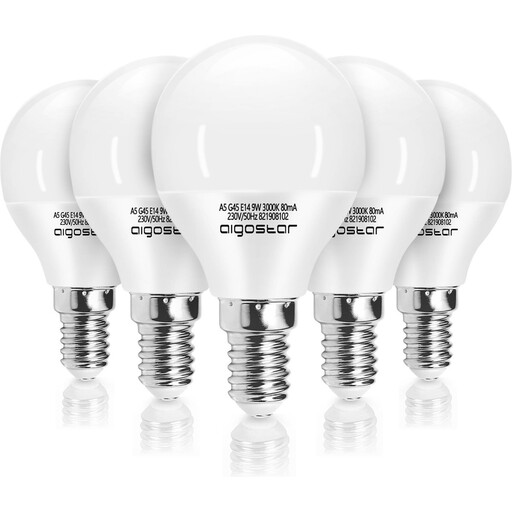
Why it suits this profile: This E14 LED bulb is designed for indoor use and combines 840 lumens with a colour temperature of 3,000 K. It is well suited to smaller fittings in living rooms and bedrooms.
The fitting, colour temperature, light output and indoor use are clearly stated. This means you do not have to use wattage as your only point of comparison.
E14 fitting, 840 lumens, 175-degree beam angle and warm 3,000 K light.
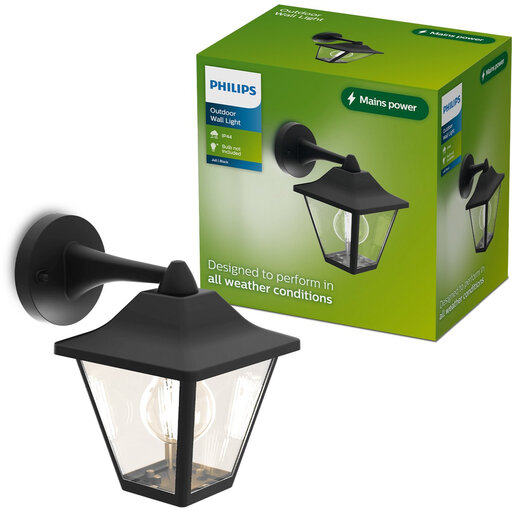
Why it suits this profile: This outdoor wall light has an E27 fitting and IP44 protection. You can choose a suitable LED bulb yourself, including its colour temperature and brightness.
The lamp is not presented as including a complete light source: the E27 LED bulb must be selected separately. The IP44 rating clearly indicates the limits of its weather resistance.
E27 fitting, aluminium housing, IP44 and freedom to choose your light source.

Why it suits this profile: This solar outdoor light has integrated LED technology, 4,000 lumens, IP65 protection and a motion sensor. It is therefore designed for functional lighting around areas such as driveways or entrances.
The IP65 rating, solar power supply and integrated design are all clearly described. Positioning the light in direct sunlight is still essential for charging.
4,000 lumens, 5,000 K, IP65, adjustable light head and motion detection.
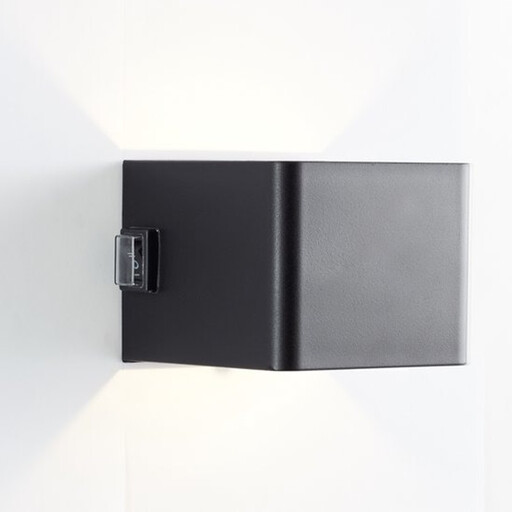
Why it suits this profile: This wireless LED wall light runs on a rechargeable battery and has a magnet and motion sensor. It is ideal for a balcony, patio, hallway or any other location without a fixed connection.
The lamp does not require fixed wiring, but it does need regular charging. IP44 means protection against splashing water, not complete waterproofing.
300 lumens, 3,000 K, IP44, integrated LED and magnetic mounting.
A floor lamp with reading light combines indirect light with focused illumination. The Brilliant Spari is 1.8 metres tall, has an adjustable reading arm and a cord switch. The uplighter uses an E27 fitting up to 60 watts, while the reading arm uses an E14 fitting up to 40 watts. This means you can choose energy-efficient lighting with separate E27 and E14 LED bulbs.
The lamp has IP20 and is therefore suitable only for dry indoor spaces. Place it on a flat, stable surface and keep the cable out of walkways.
We have put together a complete, up-to-date list of products that fully meet these strict selection criteria and the applicable European safety regulations.
That depends on the size of the room, the number of light sources and how you use the space. A lower light output is often sufficient for ambient lighting. For reading, working or lighting an entrance, you will need more lumens. Look at the total light output of all the lamps, not just the wattage.
The stated lifespan varies from product to product. The product specifications may list 15,000 hours for certain Aigostar LED bulbs and 25,000 hours for an Aigostar E27 model, for example. This is a product specification, not a guarantee of a fixed operating life. Switching frequency, heat and usage conditions can all have an effect.
LED bulbs generally use fewer watts than traditional light sources to produce a similar light output. You should therefore compare wattage, lumens and energy consumption per 1,000 hours. A lamp that is switched on frequently can be particularly economical when its energy consumption is low. Also check whether dimming, a sensor or a timer suits the way you intend to use it.
