
Vandaag of morgen in huis

Kwaliteit gegarandeerd

Welkomstaanbiedingen ontgrendelen: GRATIS bezorging | Tot 80% korting | Gratis 30 dagen JoyPlus-proefperiode
Download de app
LED lighting is available as individual bulbs, smart LED bulbs, ceiling lights, floor lamps, table lamps and light strips. With so much choice, it’s not always easy to compare your options. A low price tells you little about how much light a bulb gives off, while terms such as “smart” or “energy-efficient” don’t automatically mean it’s right for your home.
Look out for these three common pitfalls:
Lumens (lm) tell you how much light a bulb produces. Watts (W) show how much electrical power it uses. For a practical comparison, look at both figures.
According to the product information, a Philips Hue Essential smart bulb uses 8 W per light point and produces 806 lumens. The Alecto SMARTLIGHT30 uses 5 W and has a stated light output of 470 lumens. So the two bulbs aren’t directly comparable: the Alecto uses less energy, but it also produces less light.
A lower light output is often enough for a bedside table. For a kitchen, workspace or living room, you’ll usually need more lumens. Also check whether the lumen figure applies to one bulb, one light point or the entire fitting.
Colour temperature is measured in Kelvin (K):
According to its product specifications, the Brilliant Bow LED floor lamp has an adjustable range of 3000 to 6500 K. You can also adjust the brightness using a touch dimmer. With a bulb that has a fixed colour temperature, such as a 3000 K table lamp, you can dim the light but can’t change the shade of white.
An RGB bulb adds coloured light. Check whether it also produces white light. Some RGB bulbs are mainly designed for mood lighting and are less suitable as a main light source.
Before you buy, check:
With integrated LED fittings, the light source often can’t be replaced. This is stated, for example, for several ceiling and floor lamps. You can replace a separate LED bulb with a fitting more easily later, while an integrated LED fitting may call for a different decision when it reaches the end of its usable life.
A smart LED bulb can be controlled using an app, voice assistant or schedule. Don’t just look at the number of colours; check how it connects too:
The Alecto SMARTLIGHT30 uses Wi-Fi and, according to the product description, works with the Smart Life app. Philips Hue Essential bulbs can be controlled via Bluetooth; according to the product information, a Hue Bridge offers extra features, including out-of-home control. These features are based on the stated product specifications and, where mentioned, the brand’s product description. Always check that your phone, router and voice assistant platform are compatible.
Also consider how the bulb works with your wall switch. With some smart LED bulbs, repeatedly cutting the power can affect the settings. For everyday use, an app, remote control or dedicated smart switch may be more practical.
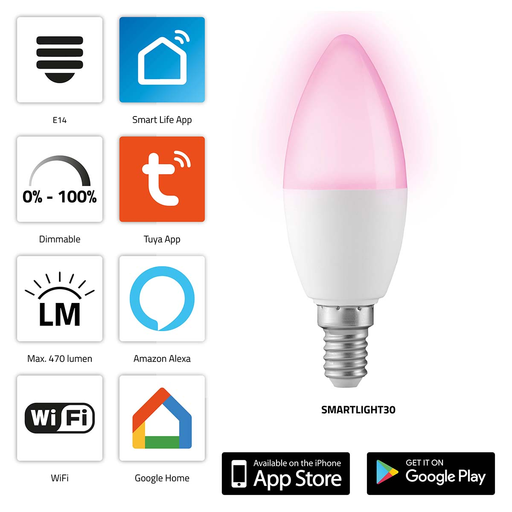
Why it suits this profile: This E14 bulb offers app control without a separate bridge and has a stated power consumption of 5 W. It’s a practical choice if you want to try smart lighting.
The fitting, 5 W power consumption and 470 lumens are clearly stated. Just check that E14 fits your light fitting.
Wi-Fi control, adjustable colours and shades of white from 2000 to 4000 K, according to the product information.
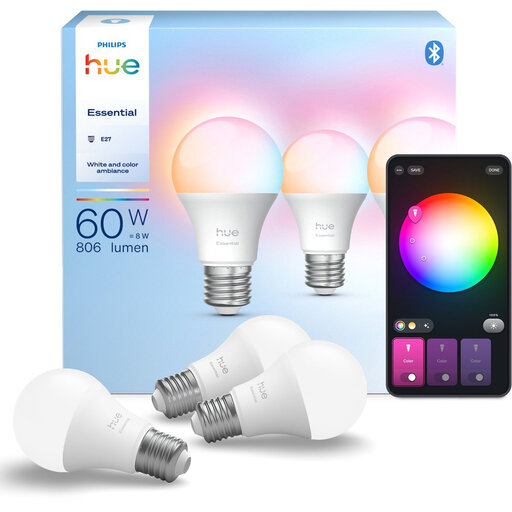
Why it suits this profile: The three E27 bulbs are ideal for households that want to control lighting in several rooms using one system.
The E27 fitting, 806 lumens per light point and RGBW light are specified. A Hue Bridge is required separately for certain features.
App control, voice assistant support and a stated lifespan of 25,000 hours, according to the product information.
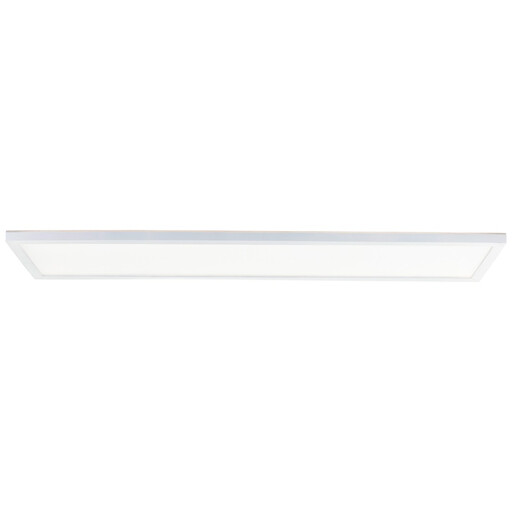
Why it suits this profile: This LED ceiling light is designed for larger spaces, kitchens, hallways and home offices where broad light coverage is needed.
The dimensions, 3000 lumens, dimming function and IP44 rating are listed in the product details. Check that it’s suitable for your ceiling before fitting it.
Adjustable colour temperature from 3000 to 6500 K, remote control and a low profile of 4,2 cm.
We’ve put together a complete, up-to-date list of products that meet these strict selection criteria and the applicable European safety regulations.
It depends on the wattage, how many hours the bulb is on and the cost of electricity. Compare the power in watts with the light output in lumens. A bulb with lower wattage uses less electricity per hour, but may also produce less light. So don’t just look for “low energy use”; consider the balance between light output and power.
The stated lifespan varies from product to product. The product information supplied gives a figure of 25,000 hours for some Philips Hue bulbs and the Hue Flux light strip. This is a product specification, not a guarantee that the bulb will last exactly that number of hours in every home. Heat, how often it’s switched on and off, damp and use in an unsuitable fitting can all affect its lifespan.
No. Check that the specifications explicitly say dimmable and that your dimmer is suitable for LED. Smart LED bulbs are often dimmed using an app, remote control or voice assistant. A standard wall dimmer may not always work well with them.
