
Vandaag of morgen in huis

Kwaliteit gegarandeerd

Welkomstaanbiedingen ontgrendelen: GRATIS bezorging | Tot 80% korting | Gratis 30 dagen JoyPlus-proefperiode
Download de app
Choosing a new LED bulb might seem straightforward – until you get home and find the fitting doesn't match, the light is too harsh, or your dimmer starts flickering. Decorative lighting can also disappoint: a large filament bulb might not fit your fixture, and a smart bulb may not work with your existing system.
The most common pitfalls with LED lighting are:
As a Joybuy Product Recommendation Officer, I filter product information by verifiable specifications. This helps you separate marketing claims from features you can actually check before you buy.
First, check the fitting of your fixture:
Also measure the space inside your lampshade. An Atmosphera G95 amber bulb, for example, has a diameter of 9.5 cm and a height of 14.5 cm. A large Atmosphera Pear bulb is 27.2 cm tall. So don't just check the fitting – check the available height and diameter too.
Lumens tell you how much light a bulb produces. As a practical guide:
Colour temperature is measured in Kelvin (K):
Be aware of the difference between a decorative LED bulb and a bulb for general lighting. An amber filament bulb with 175 lumens can look lovely in an open fixture, but it gives out far less light than an E27 bulb with 1,200 or 2,100 lumens.
A dimmable LED bulb must be compatible with the dimmer you're using. According to the product information, the Philips Hue Filament Globe G93 is dimmable via the Hue app and can be controlled directly via Bluetooth. That's different from working with an existing wall dimmer.
With a smart LED bulb, check:
For dry indoor spaces, IP20 is usually sufficient. Don't use an indoor bulb outside or in a damp room unless a suitable IP rating is stated. Also check the CE marking, voltage and maximum wattage of your fixture.
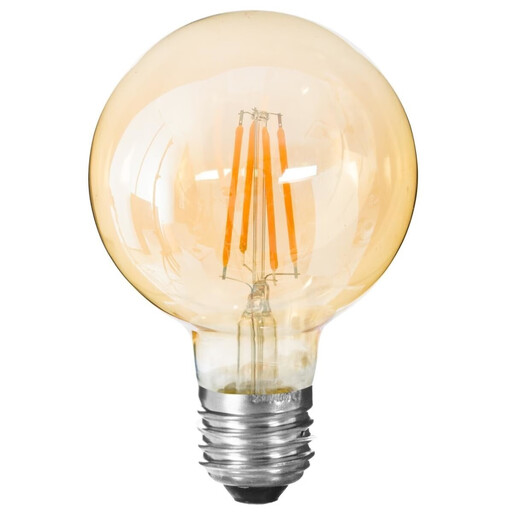
Why this fits the profile: This E27 filament bulb is designed for anyone who wants a simple replacement for an existing fixture and is mainly looking for warm decorative lighting.
The product information states the E27 fitting, 175 lumens and 2,200 K. This means you can tell in advance that it's mainly mood lighting, not a main light source.
E27 fitting, amber-coloured glass, 2,200 K and a decorative spiral design. Suitable for indoor use.
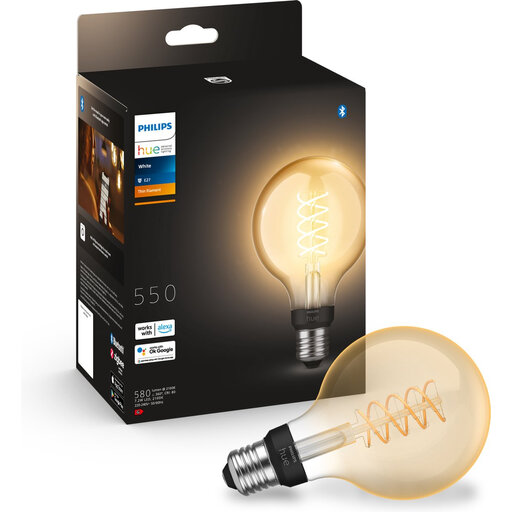
Why this fits the profile: Ideal for anyone who wants to combine decorative design with app control, dimming and voice control.
The product information clearly states E27, 550 lumens, 2,700 K and dimmability. According to the description, full Hue functionality requires a bridge.
Dimmable, Bluetooth control, Matter support and warm white light at 2,700 K.
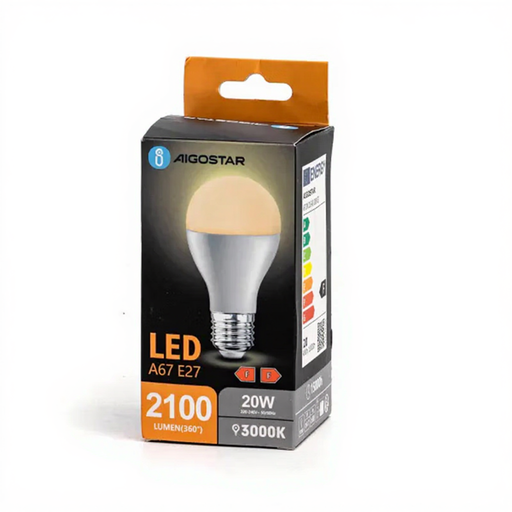
Why this fits the profile: A practical choice for a living room, study area or any other space where high light output matters more than a decorative shape.
The listed specifications include 2,100 lumens, 20 W, 3,000 K and an E27 fitting. This makes the light output clearer upfront than with bulbs that only mention wattage.
2,100 lumens, a wide 150-degree light distribution according to the product information, and 220–240 V connection.
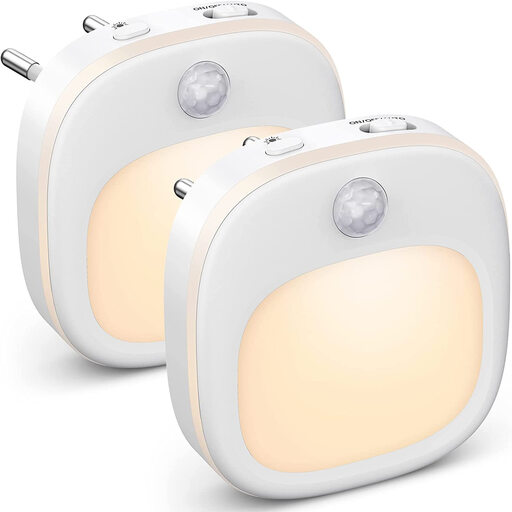
Why this fits the profile: Handy for a hallway, bedroom or nursery where soft light and automatic activation are desirable.
The description mentions motion detection, three colour temperatures and five dimming levels. This means you don't automatically have to use a bright main light.
Set of two, five dimming levels and a choice of three colour temperatures according to the product information.
We've put together a full, up-to-date list of products that fully meet these strict selection criteria and comply with current European safety regulations.
That depends on the size of the room and the number of light points. For general lighting, around 1,000 lumens or more is often practical. Use multiple bulbs if you want to avoid dark corners. For mood lighting, models with fewer lumens, such as a decorative filament bulb, are sufficient.
No. Check whether the packaging or product page explicitly states that the bulb is dimmable. A smart LED bulb can dim via an app, whereas a GU10 LED spot or standard E27 bulb needs a compatible LED dimmer for that. A conventional dimmer can cause flickering or damage the bulb.
LED bulbs generally use less electricity than traditional incandescent or halogen bulbs for a comparable light output. To compare, look at both the wattage and the number of lumens. According to Philips's own information, the GU10 series mentioned uses around 80% less energy than traditional bulbs. This is a brand claim; always check the energy label and official product specifications of the model you choose.
