
Vandaag of morgen in huis

Kwaliteit gegarandeerd

Welkomstaanbiedingen ontgrendelen: GRATIS bezorging | Tot 80% korting | Gratis 30 dagen JoyPlus-proefperiode
Download de app
LED lighting is available as individual bulbs, spotlights, ceiling fittings and car bulbs. This wide selection does not always make comparing products easy. A bulb may look powerful on paper, yet still be unsuitable for the fitting, colour temperature or light fitting. Terms such as “extra bright” and “long lifespan” also mean little if the underlying specifications are missing.
For Dutch households, energy-efficient LED bulbs, LED spotlights and smart lighting are particularly popular. Drivers also look at H4 LED headlight bulbs, 9005 HB3 LED bulbs and 9006 HB4 LED bulbs as replacements for halogen bulbs. In both cases, making the right choice starts with checking a few key points.
A bulb with a GU10 fitting will not fit a light fitting designed for GU5.3 or E27, for example. The same applies to cars: an H4 bulb is not automatically suitable for a fitting of type 9005/HB3 or 9006/HB4.
Always check the following before buying:
Colour temperature is expressed in kelvin (K). A lower value produces warmer, yellower light, while a higher value produces cooler, whiter light.
The amount of light is indicated in lumens (lm). A bulb with a higher kelvin value is therefore not automatically brighter. Look at lumens for brightness and kelvin for colour.
According to Philips’ own product information, certain GU10 LED spotlights use around 80% less energy than traditional spotlights with a similar light output. The stated lifespan of the Philips models in this overview is 15,000 hours. These are product specifications and brand claims; the actual lifespan depends, among other things, on usage, heat dissipation and the quality of the light fitting.
For automotive LED bulbs, Roadsun and Bullvision state a lifespan of up to 50,000 hours and high brightness. According to these brands’ own product information, the bulbs are fitted with fans and have IP68 protection. When choosing vehicle lighting, always check vehicle compatibility, beam pattern and local approval requirements too. “Plug-and-play” does not mean that every bulb is suitable for every vehicle without checking.
A GU10 LED spotlight is usually twisted directly into a 230V light fitting. The Philips LED spotlights in this overview have a diameter of 5 cm and a height of 54 mm. Check that the recessed spotlight or ceiling spotlight provides enough space.
With a recessed light fitting, the cut-out size and mounting method are also important. The Nedis SmartLife Ceiling Light has a diameter of 52 mm and is designed for installation in a suspended ceiling. The manufacturer specifies spring clips for mounting and recommends checking the ceiling opening in advance.
Lumens indicate light output; watts indicate energy consumption. According to the product specification, the Philips GU10 spotlights produce 390 lumens per light point at 4.6 watts. The 3-pack is suitable if you are replacing a few spotlights, while the 6-pack may be more convenient for a ceiling with multiple light points.
Also check the energy label. The Philips models mentioned have an F energy rating under the new scale. A lower wattage does not automatically mean a particular energy rating, so always check the label for the specific product.
A dimmable LED spotlight will not always work with an existing wall dimmer. The bulb and dimmer must be technically compatible. According to the product information, the Philips LED spotlights in packs of 3 and 6 are not dimmable. The Philips Hue GU10 spotlights are dimmable and can be controlled via the app, remote control or voice assistant.
For bathrooms and outdoor areas, the IP rating is relevant. IP20 is intended for dry indoor areas and does not provide protection against splashing water. Automotive models with a stated IP68 rating are described as dust- and water-resistant, but you should still check the installation and sealing of the headlight housing.
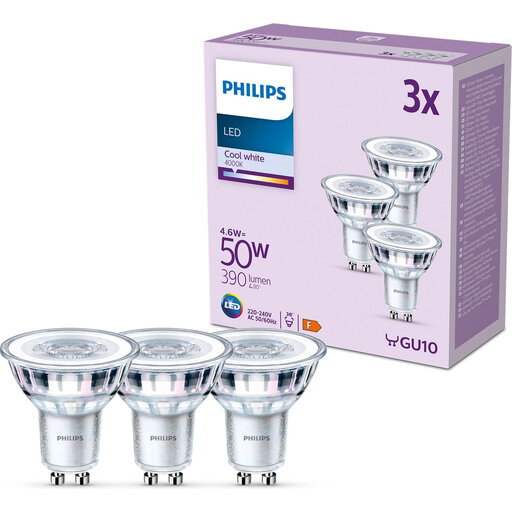
Why it suits this profile: A practical set for anyone looking to replace a few GU10 spotlights at home without smart features or complicated installation.
The fitting, dimensions, light output and lack of dimmability are clearly stated. This helps you avoid an incompatible combination with a dimmer.
GU10 fitting, 390 lumens per light point, 4000 K and available as a 3-pack.

Why it suits this profile: For households looking to combine smart LED lighting with dimming, scenes and control via an app or voice.
The bulb works via Bluetooth; according to the product information, a Hue Bridge is required to expand the system to up to 50 bulbs. This makes the required infrastructure clear in advance.
GU10, dimmable, 400 lumens per bulb, Matter support and adjustable warm to cool white light.
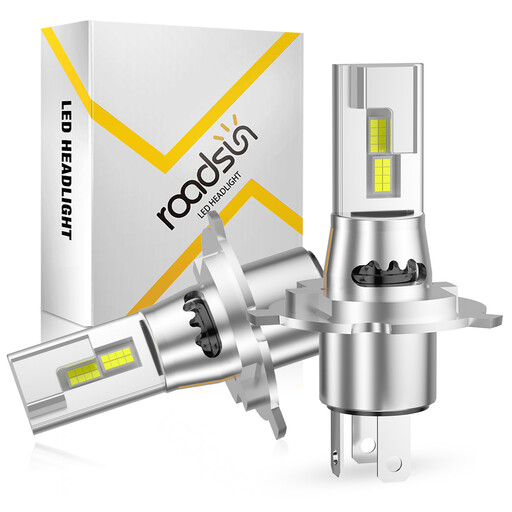
Why it suits this profile: Designed for drivers who want to replace their H4 halogen bulb and check the fitting and vehicle compatibility beforehand.
The H4/9003/HB2 designation, 6500 K, IP68 rating and built-in fan are listed. However, check that the beam pattern and application are approved for your vehicle.
High and low beam in one H4 bulb, 1:1 size, fan for heat dissipation and plug-and-play connection according to the product description.
We have put together a complete, up-to-date list of products that fully meet these strict selection criteria and the applicable European safety regulations.
Before replacing indoor lighting, switch off the power. Only use an LED ceiling spotlight or recessed spotlight in a light fitting suitable for the bulb’s heat dissipation requirements and dimensions. An IP20 bulb should not be installed in a damp area where it may be exposed to splashing water.
For vehicle lighting, first check the manual or the existing bulb. Pay attention to:
Often, yes, because LED bulbs can use fewer watts for a similar light output. The saving depends on the wattage, number of hours used and electricity price. Therefore, compare both the power in watts and the lumen value, rather than relying on the marketing copy alone.
Lifespan varies by model and operating environment. The product specifications for the Philips spotlights mentioned state 15,000 hours; according to Roadsun and Bullvision’s own product information, some automotive models are rated for up to 50,000 hours. Heat, ventilation, switching frequency and installation can affect the actual lifespan.
No. Check whether the packaging or product page explicitly states “dimmable”. The Philips Hue GU10 spotlights are dimmable. According to the product information, the Philips LED spotlights with 4000 K are not dimmable and are therefore unsuitable for use with a standard dimmer.
