
Vandaag of morgen in huis

Kwaliteit gegarandeerd

Welkomstaanbiedingen ontgrendelen: GRATIS bezorging | Tot 80% korting | Gratis 30 dagen JoyPlus-proefperiode
Download de app
LED lamps are available as individual light sources, spotlights, ceiling lamps, floor lamps and smart lighting. This wide range does not always make choosing easy. A lamp may be technically compatible, yet still unsuitable because of the wrong fitting, insufficient light or a colour temperature that does not suit the room.
Joybuy Product Recommendation Officer helps you compare the most important specifications without taking marketing claims as the starting point.
A lamp with an E27 fitting will not fit a light fitting designed for an E14 lamp. The same applies to GU10 LED spotlights and G9 lamps. So first check the old light source or the fitting in the light fitting. Also pay attention to the maximum dimensions: a large A67 lamp may touch the shade.
Energy consumption is measured in watts, but light output is measured in lumens. For example, a 5-watt LED lamp may produce 470 lumens, while another lamp with a higher wattage may give off much more light. If you only look at wattage, you could buy a living room lamp that is too dim in practice.
A standard wall dimmer will not automatically work with every LED lamp. Check specifically whether “dimmable” is stated in the product specifications and whether the lamp is suitable for the type of dimmer you have. Smart LED lamps are often dimmed via an app, but that does not mean they can also be used with a traditional dimmer.
The most common fittings for homes are:
As well as checking the fitting, check the voltage, the maximum wattage requirement and the available space inside the light fitting. An open light fitting generally provides better ventilation than a fully enclosed shade. Some manufacturers warn that insufficient ventilation can shorten the lamp’s lifespan.
Lumens indicate how much visible light a lamp produces. As a practical guide, you can look at approximately:
A wide beam angle spreads the light more evenly. A spotlight beam directs the light onto a smaller area, such as a cupboard, table or artwork.
Colour temperature is expressed in kelvin:
Warm white LED lamps create a softer atmosphere. Cool white LED lamps appear brighter and more businesslike. With smart lamps, you can sometimes adjust the colour temperature, but always check the specified range.
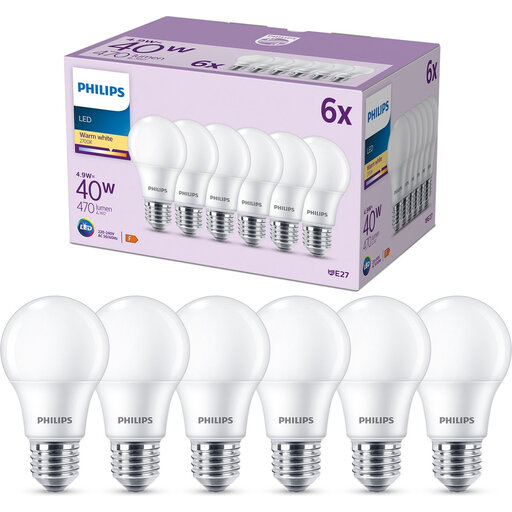
Why it suits this profile: A set of six E27 lamps is practical when several light fittings use the same fitting. The lamps produce 470 lumens each at 4.9 watts and have a colour temperature of 2,700 K.
The E27 fitting and light output are clearly stated. This means you do not have to rely solely on the “40W equivalent” label.
Six lamps, warm white light, 4.9 W per lamp and a stated lifespan of 15,000 hours.
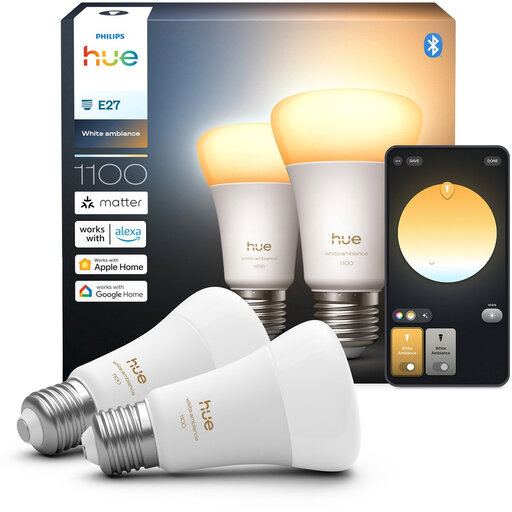
Why it suits this profile: This E27 smart lamp is dimmable and supports control via an app, voice assistant and Hue Bridge. According to the product specification, the lamp produces 1,100 lumens at 8.1 watts.
The controls and compatibility are described clearly. A Hue Bridge is required for features such as controlling the lamp when you are away from home.
Dimmable, 1,100 lumens, E27 fitting and a stated lifespan of 25,000 hours.
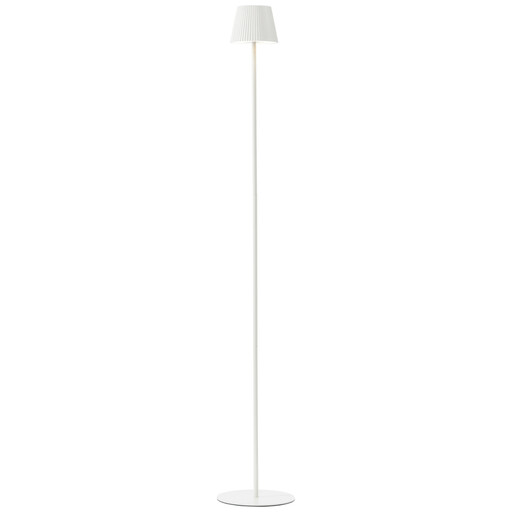
Why it suits this profile: This rechargeable LED floor lamp is designed for patios, balconies or gardens. It runs on a battery, has a three-level touch dimmer and provides 3000 K warm white light.
The IP54 rating is stated, but the safety information warns against heavy rain and immersion. Position the lamp in a sheltered, stable location.
Can be positioned without cables, 340 lumens, 3.4 W and charging via USB-A.
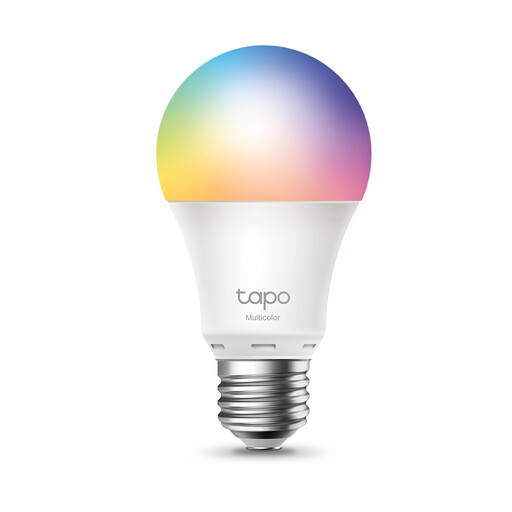
Why it suits this profile: According to the product information, this Wi-Fi lamp works without a hub, has an E27 fitting and offers colour selection, dimming and scheduling via the Tapo app.
The product specification states the Wi-Fi protocol, app support and the fact that no hub is required. Check beforehand that 2.4GHz Wi-Fi is available.
Up to 806 lumens, colour temperature of 2,500–6,500 K, dimming range of 1–100% and control via Alexa and Google Assistant.
We have put together a complete, up-to-date list of products that fully meet these strict selection criteria and the applicable European safety regulations.
That depends on the size of the room and the number of light points. For general lighting, 500 to 1,000 lumens per light point is a useful starting point. Several lamps with a lower light output may create a more comfortable result than one very powerful lamp.
The stated lifespan varies by model. The range includes examples lasting from 15,000 to 25,000 hours. This is a product specification, not a guarantee for every usage situation. Heat, frequent switching and use in a poorly ventilated light fitting can affect the actual lifespan.
LED lighting generally uses little power for the stated light output. So compare watts and lumens and check the energy label for consumption per 1,000 hours. A lamp with smart features may also use a small amount of electricity in standby mode.
