
Vandaag of morgen in huis

Kwaliteit gegarandeerd

Welkomstaanbiedingen ontgrendelen: GRATIS bezorging | Tot 80% korting | Gratis 30 dagen JoyPlus-proefperiode
Download de app
An LED lamp can softly illuminate a bedroom, automatically light up a kitchen cupboard or create a more atmospheric balcony. However, choosing the right one involves more than simply looking at lumens or a low price. Some lamps are mainly decorative, while others are designed to provide functional lighting. Battery life, installation and protection against moisture are also often overlooked.
A higher lumen count means more light, but it does not automatically mean a better choice. 40 lumens may be enough for a bedside table, while a worktop or dark cupboard may need more light. So first consider where the lamp will go and how you intend to use it.
An LED lamp with a motion sensor is only practical if the sensor has a clear view of the route people take. For the cabinet lights described, for example, the detection range is 3 to 5 metres. That is more than enough inside a small cupboard, but the range may be limited in a long hallway. Also consider how often the lamp might switch on unnecessarily.
A rechargeable LED lamp does not need a permanent socket, but it does need regular charging. Check the type of connection, battery capacity and whether a USB cable is included. With a battery-powered lamp, you should also check whether batteries are included and which type is required.
Light output is usually shown in lumens (lm). A 40 lm night light is intended for soft orientation or ambient lighting. A 340 lm lamp, such as a portable floor lamp, can illuminate a larger area.
Colour temperature is measured in kelvin (K):
A dimmable LED lamp offers greater flexibility. However, check whether all light modes can be dimmed. On some models, continuous dimming only works in warm white mode, while RGB colours use a fixed brightness or colour cycle.
A USB rechargeable lamp is useful if you want to move the lamp around regularly. A built-in lithium battery means the lamp does not have to remain connected to a socket while in use. Check the stated charging voltage, such as 5 V, and use a suitable USB power source.
Controls vary by model:
An ambient light sensor is particularly useful when the lamp should only switch on in a dark room. According to the product specifications, the first night light described responds when the ambient light level is no more than 40 lux.
Measure the space before ordering. A 40 cm cabinet light will not always fit beneath a narrow shelf, whereas a 30 cm model might. LED cabinet lighting is often installed using tape or magnets, but check that the surface is clean, flat and strong enough.
For outdoor use, the IP rating is important:
Use an outdoor lamp in accordance with the product instructions and place a portable model on a stable, dry surface.
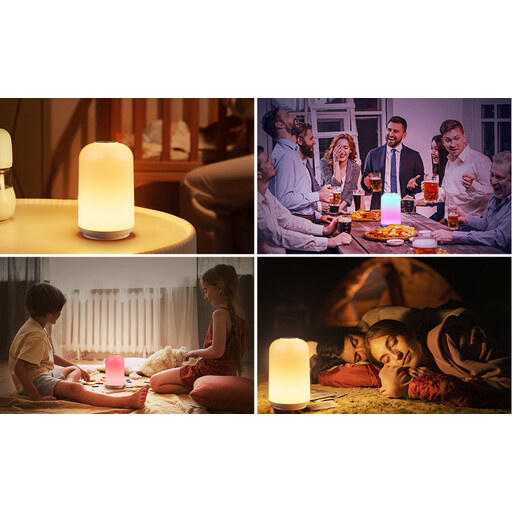
Why it suits this profile: A compact choice for a bedside table, shelf or children's bedroom. The built-in battery and USB charging mean there is no need for a permanent socket.
The specifications list separate warm white and RGB modes. Continuous dimming is available for warm white, so you are not limited to preset brightness levels.
40 lm, 12 SMD LEDs, warm white at 2,600–2,800 K, seven RGB colours and an ambient light sensor.
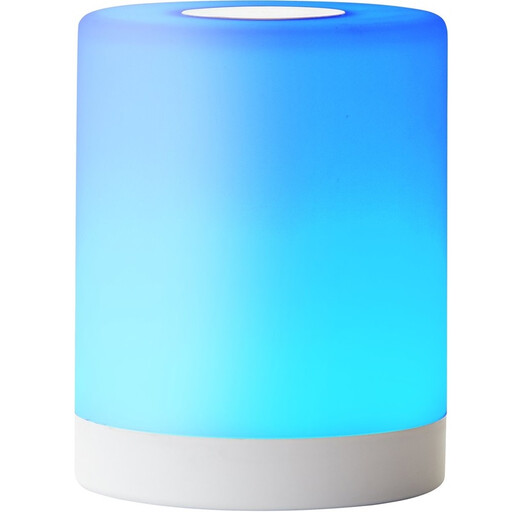
Why it suits this profile: Ideal for anyone who wants to use one portable lamp in the living room, on a table, balcony or patio.
The IP44 rating clearly defines its limits: it is suitable for splashing water, but not for immersion or exposure to severe weather.
RGB lighting, warm white at 3,000 K, touch dimmer, USB charging and an 18650 lithium-ion battery.

Why it suits this profile: For kitchen cupboards, wardrobes, shelves and hallways where you need targeted light without having to search for a switch every time.
The 40 cm length, 3–5 metre detection range and adhesive-strip mounting are all clearly specified. This lets you check in advance whether the location is suitable.
Pack of two, 61 LEDs, three colour temperatures and a rechargeable 1,100 mAh battery.

Why it suits this profile: A decorative choice for a gaming room, children's bedroom or desk belonging to a Minecraft fan. The lamp can stand on a surface or be wall-mounted.
The product information clearly states that this is ambient lighting, with a steady glow or pulsing effect. So do not expect task lighting for a worktop.
41 cm wide, two light modes and power via USB or three AAA batteries. Batteries are not included.
We have put together a complete, up-to-date list of products that fully meet these strict selection criteria and the applicable European safety regulations.
This depends on its power rating and how long it is used. A 1-watt lamp uses approximately 1 kWh over 1,000 hours of operation. For an accurate calculation, multiply the power in watts by the number of hours used and divide the result by 1,000. Rechargeable models also incur charging losses, so actual consumption may vary slightly.
Lifespan varies from model to model and is not always provided in the product information. With wireless lamps, the battery may reach the end of its life before the LED module. So, alongside the light source, consider the charging method, heat dissipation and whether the battery can be replaced. Use the lamp in accordance with the safety instructions and do not leave chargers connected unnecessarily.
Place the light where the sensor can detect the route people take, such as beside a bed, in a hallway or by a cupboard door. Avoid obstacles and do not point the sensor directly at a strong light source. For a fixed LED wall light or LED cabinet lighting, it is sensible to check the dimensions and mounting surface first.
