
Vandaag of morgen in huis

Kwaliteit gegarandeerd

Welkomstaanbiedingen ontgrendelen: GRATIS bezorging | Tot 80% korting | Gratis 30 dagen JoyPlus-proefperiode
Download de app
An LED ceiling light may seem easy to choose: decide on the size, pick a colour and click to order. Yet many people end up disappointed because the light is too bright or too dim, the IP rating is unsuitable, or the controls prove less convenient in practice. A light may look great in a product photo, but still be too bright for a bedroom, offer insufficient protection in a bathroom or be difficult to fit to an existing ceiling junction box.
This buying guide will help you compare specifications sensibly. Find a dimmable ceiling light, a ceiling light with remote control or a simple round light to suit your room and how you use it.
Wattage tells you how much electrical power a light uses, but not directly how much light it produces. So check the lumen output too. For example, a 24 W model with 2,400 lumens produces a different amount of light from a 12 W light with 1,300 lumens.
Also consider the size and purpose of the room. A living room ceiling light can usually provide broad, even illumination. In a bedroom, a lower light output or a dimming function is often more practical.
A bathroom needs more consideration than a dry bedroom. A light with IP44 is described in the product information as protected against splashing water, but that does not automatically mean it is suitable for every mounting point in every bathroom. Check the safety zones, the distance from water sources and the installation instructions. If in doubt, have a qualified installer carry out the electrical connection.
A light with IP20, like many models for dry indoor spaces, is not designed for damp conditions. So don’t use one as a bathroom ceiling light unless the manufacturer specifically says it is suitable.
RGB lighting, a remote control or a starry-sky effect can be appealing. Before buying, check how you can operate the light if you lose the remote, and whether the chosen colour temperature is suitable for everyday use. An RGB ceiling light is best for mood lighting; for reading, cooking or working, standard white light settings are more important.
Use lumens to compare models. Wattage then helps you estimate energy consumption. Froadp model specifications include options rated at 36 W, 48 W and 72 W. Don’t automatically choose the highest output: too much light can be uncomfortable in a small room.
Claims of a lifespan of up to 50,000 hours or savings of more than 85% come from the manufacturer’s product information. Treat these as stated product specifications, not as a guarantee for every use case.
Colour temperature is measured in Kelvin (K):
A dimmable ceiling light gives you more flexibility, but check whether the dimming function works via a remote control, wall switch or external dimmer. Integrated LED lights also don’t use replaceable standard bulbs. If the light module fails, you may need to replace the whole fitting.
Measure the space on the ceiling and check the diameter, height and fixing points. A low-profile round ceiling light works well with low ceilings, while a pendant light needs more clearance above a table.
Also check:
Switch off the power before installation. If you’re unsure about the wiring or the ceiling’s load-bearing capacity, professional installation is a sensible choice.
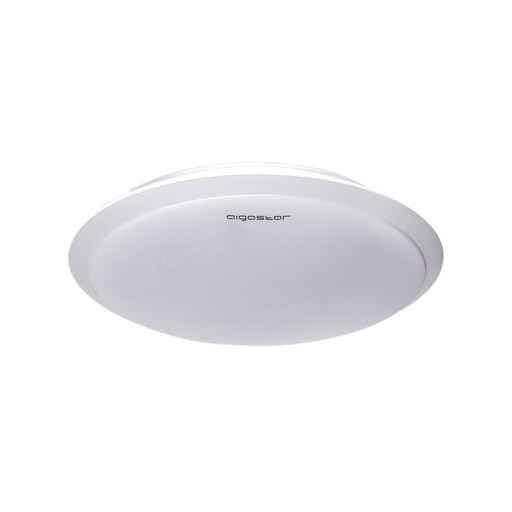
Why it suits this type of user: Its fixed 3,000 K colour temperature and compact design make it a straightforward choice for a dry bedroom, hallway or small home office.
The specifications list both 1,350 lumens and 18 W, so you don’t have to judge the light by its appearance alone. The IP20 rating clearly defines where it can be used: dry indoor spaces only.
18 W, 1,350 lumens, 3,000 K and a diameter of 35 cm; surface-mounted installation according to the product information.
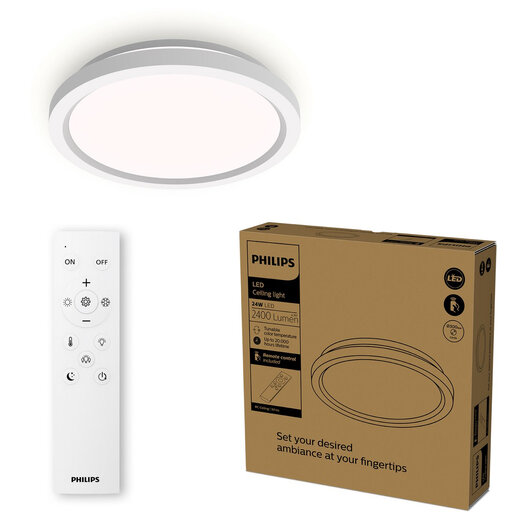
Why it suits this type of user: Ideal if you want to adjust brightness and colour temperature from your bed or sofa, without installing a separate dimmer.
The product information lists three lighting modes, adjustable brightness and control via the remote or wall switch. The light is designed for dry indoor spaces.
2,400 lumens, 24 W, a 30 cm round design and a stated range of 2,700–6,500 K according to the product description.
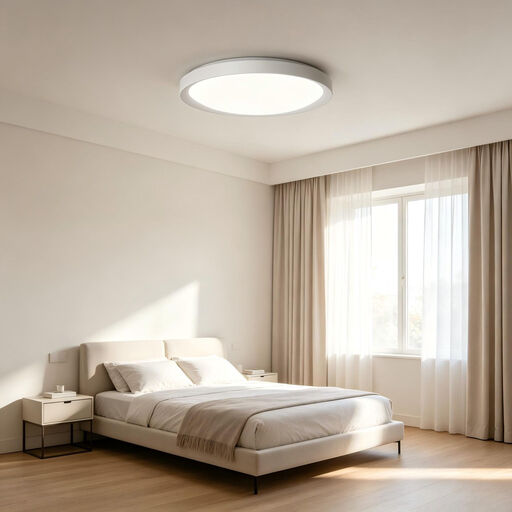
Why it suits this type of user: A practical option if you’re looking for a round ceiling light for a space where damp or splashing water may be an issue, such as a kitchen or bathroom.
The product description lists IP44 and a seamless ABS housing. Even so, check the bathroom zone and local installation requirements before fitting it.
36 W, IP44, integrated LED and a slim, round housing; according to the product information, it is suitable for several indoor spaces.
Not every room needs a ceiling light. An LED table lamp works well as additional reading or mood lighting. A touch lamp is handy on a bedside table, while a pendant light provides more focused illumination above a dining table. For a softer look, you could also choose a lamp with a fabric shade and an E14 fitting. Check whether the light source is included.
For decorative lighting, the Froadp RGB ceiling light with remote control is another option. According to the product description, this model offers adjustable brightness, white light settings and RGB colours. Use these colour settings mainly for mood lighting, and check the IP rating before installing the light in a damp room.
We’ve put together a complete, up-to-date list of products that meet these strict selection criteria and the applicable European safety regulations.
It depends on the size of the room, ceiling height and how you use the space. Start by comparing the lumen output of different models, and consider a dimmable light if you use the room for both relaxing and working.
No. Check the IP rating, the installation zone and the manufacturer’s instructions. IP44 may indicate protection against splashing water, but it does not mean the light is suitable for every location in the bathroom. Have the connection made in accordance with the applicable safety regulations.
Lifespan varies by product and conditions of use. Manufacturers may state, for example, 15,000, 20,000 or 50,000 hours. These are product specifications or manufacturer claims; check the warranty terms too, and find out whether the LED module can be replaced.
