
Vandaag of morgen in huis

Kwaliteit gegarandeerd

Welkomstaanbiedingen ontgrendelen: GRATIS bezorging | Tot 80% korting | Gratis 30 dagen JoyPlus-proefperiode
Download de app
A set of LED interior lighting for your car can give your dashboard, doors and footwells a whole new look. However, many kits seem similar, even though their installation, controls and included components can vary considerably. If you focus only on “16 million colours” or “music sync”, you may find after buying that the strip doesn’t fit properly, the app is difficult to use or the wiring gets in the way.
This guide helps car owners, DIY enthusiasts and motoring fans in the UK compare their options.
“Universal” usually means that a kit is designed for use in several cars, SUVs, vans and lorries. However, the lengths of dashboard seams, door panels and footwells vary from one vehicle to another. So check:
With a fibre-optic car lighting kit, you also need to avoid folding the light fibre sharply. This can reduce the amount of light it transmits.
An RGB LED strip with app control may include features such as fixed colours, colour changes, chase effects, timers and music- or voice-activated lighting. The app you need depends on the specific version. Product information for similar kits mentions apps including “LED LAMP”, “LotusLamp X”, “Lotus Lantern” and “Magic Lantern”.
Before buying, check which app works with the version you’ve chosen and whether your phone runs iOS or Android. A music mode usually works through a microphone in the controller. The effect then responds to sound picked up by the microphone; it doesn’t connect directly to your car’s audio signals.
Most kits in this selection are designed for 12V car interior lighting. Product descriptions warn that components may be damaged by a higher voltage. If your vehicle or circuit runs on 24V, check the voltage first and see whether you’ll need a suitable voltage converter.
Test the lights before fitting them permanently. Keep cables away from pedals, airbags, steering components and moving seats. Set the lighting so that colour changes or high brightness won’t distract you while driving.
An acrylic light strip uses a light-transmitting plastic strip. According to the product descriptions for the Dreamcolor kits, it’s approximately 11.7 mm wide and designed to fit into interior seams. One advantage of this design is that the light is spread along the strip.
A traditional fibre-optic car lighting kit carries light through a fibre from one or more LEDs. This can give you more flexibility when hiding the light source, but installation requires extra care with the bend radius, connectors and fitting.
A basic kit might light just the dashboard or footwell. More comprehensive versions have separate modules for:
Multiple controllers can be useful in an SUV or van, as you won’t need to run all the cables to one point. However, check whether the product description mentions synchronisation between the main controller and the sub-controllers.
Look out for the differences between:
A dynamic car lighting kit isn’t necessarily suitable for everyday use. For your commute, a fixed, dimmed colour may be more practical than a fast chase effect.
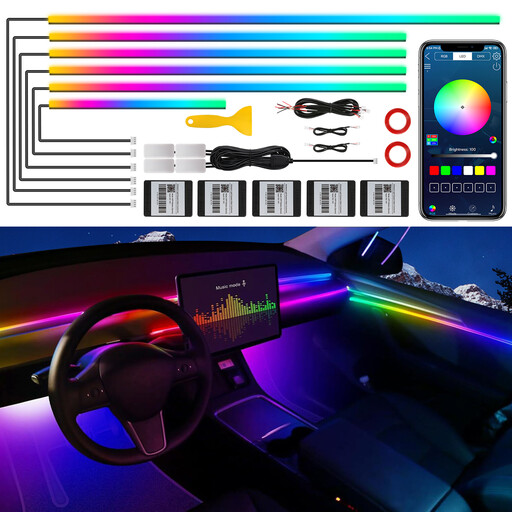
Why it suits this profile: According to the product description, this kit is designed for DIY installation and includes six strips, four footwell lights and four door handle lights. It’s a straightforward starting point if you want to light the dashboard and footwells.
The included components are listed in the product information. Before fitting, check the strip layout and cutting points, as the information gives different quantities and lengths for different versions.
12V connection, Bluetooth app control, fixed colours and music mode, according to the product description.
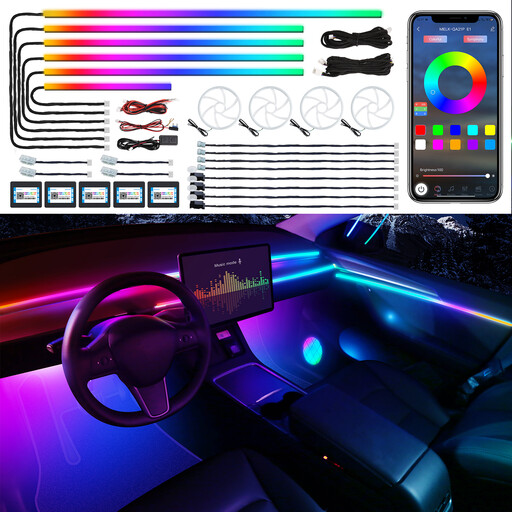
Why it suits this profile: According to the product information, this version is designed for the dashboard, footwells, door handles, storage compartments and door corners. It’s a good fit if you want to light several areas of your car’s interior.
The kit lists four sub-controllers as well as a main controller. This makes the layout clearer than with a standalone strip, but check that there’s enough space behind the panels.
600 LEDs according to the product listing, dual-zone control, Bluetooth and sound synchronisation.
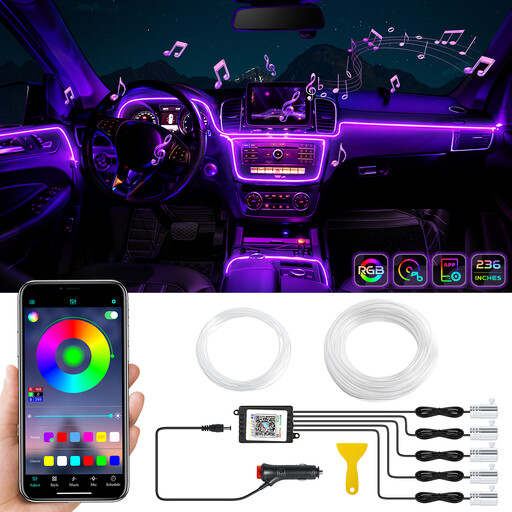
Why it suits this profile: The product description lists an approximately 6-metre optical fibre line, five LEDs and app control. It’s suited to DIY enthusiasts who want to run the light line across several areas of the interior themselves.
The installation instructions explain how to place the fibre in a transparent tube. This means you’ll need to measure beforehand and take care to hide the light sources neatly.
6 metres of optical fibre, 29 pre-programmed modes according to the product listing, and Bluetooth control.
We’ve put together a complete, up-to-date list of products that meet these strict selection criteria and the applicable European safety regulations.
Interior lighting must not distract the driver or obstruct their view. When driving, it’s best to choose a low brightness setting and a steady colour. Also check your car’s manual and the relevant traffic regulations if the lighting is visible outside the interior.
Lifespan depends on heat, moisture, vibration, installation and supply voltage. A correct 12V connection, protection from sharp bends and tidy cable routing can help prevent faults. A stated lifespan isn’t automatically a guarantee for every car or usage scenario.
Power consumption varies depending on the number of LEDs, brightness and zones in use. A short LED strip typically uses less power than a complete kit with dashboard, door and footwell lighting. Switch the lights off when the car is parked, and check whether the connection only receives power when the ignition is on.
