
Vandaag of morgen in huis

Kwaliteit gegarandeerd

Welkomstaanbiedingen ontgrendelen: GRATIS bezorging | Tot 80% korting | Gratis 30 dagen JoyPlus-proefperiode
Download de app
LED interior lighting for your car gives the interior of a car, SUV, van or lorry its own distinctive look. RGB LED strips for cars, Bluetooth app controls and music-responsive effects are particularly popular. But a cheap kit can quickly disappoint: the strip may not fit properly, the adhesive may come unstuck or the lights may not work reliably with your vehicle’s electrical system.
So the key question isn’t how many colours a kit promises, but whether its specifications suit your vehicle and how you plan to use it.
The term ‘universal’ mainly tells you what the product is intended for. Always check:
According to the product information for various Dreamcolor models, a 12V kit is designed for cars, SUVs, vans and pick-up trucks. If your vehicle has a 24V system, as some lorries and buses do, you may need a suitable 12V power converter. Don’t connect the lights directly without checking first.
A kit with footwell lights, door handle lights, storage compartment lights and multiple controllers gives you more options, but also means you’ll need to route the cables neatly. Loose wires must not get near the pedals, steering mechanism or moving seats.
Pay attention to the app, too. Some kits use LotusLamp X, Lotus Lantern, Magic Lantern or a similar Bluetooth app. Check in advance that the app is available for your iPhone or Android phone and that the instructions are clear enough.
Self-adhesive LED car lights stick better to a clean, dry, grease-free surface. Textured plastic, upholstery and sharply curved surfaces can all affect adhesion. A strip fitted under tension may come loose over time.
Clean the mounting surface as instructed and test the lights before fixing the strips permanently in place.
Most 12V car lighting kits connect via a 12V socket, cigarette lighter socket, ACC circuit or another suitable power source. Check:
A product listing may mention features such as memory, low heat output or short-circuit protection. Treat these as information from the product description and check the manual for exact connection instructions.
Acrylic or optical fibre strips work well along dashboard edges and door panels, but they mustn’t be sharply folded. According to Dreamcolor’s product information, you should only cut the strips at the marked points. Cutting too far or in the wrong place could stop part of the strip from lighting up or working in sync.
So measure these areas first:
Interior ambient lighting can offer static colours, colour fades, chase effects or music-responsive effects. Use dynamic effects sparingly while driving. Bright flashing lights or lights shining directly onto the windscreen can be distracting.
Also check the applicable road rules and any MOT or insurance requirements if you want to fit lights outside the cabin, around the windscreen or where they’re visible to other road users. Automotive neon lighting for the interior is different from external decorative lighting.
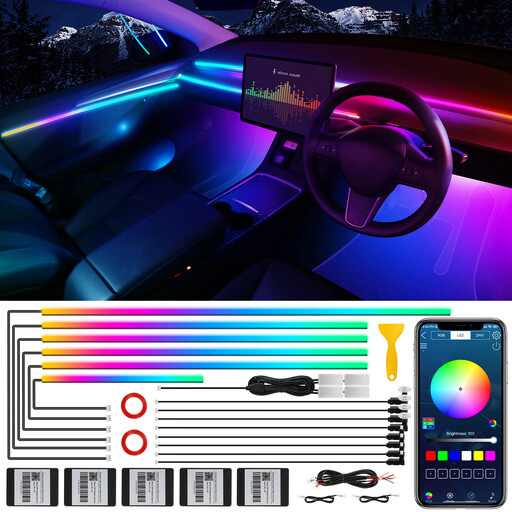
Why it suits this profile: This 10-in-1 kit is designed for a straightforward DIY installation, with dashboard lighting and four footwell lights.
The product information lists a 12V connection, supplied tape and an installation with a controller and extension cables. Be sure to test the kit before sticking it in place.
Bluetooth app control, RGB Smart IC, static colours and dynamic modes, according to the product description.

Why it suits this profile: A good choice if you want a more extensive interior setup with dashboard, door, storage compartment and footwell lighting.
The kit uses a main controller and sub-controllers, allowing multiple zones to work in sync according to the product description. Plan the cable route in advance.
593 LEDs, 12V operation, Bluetooth control, dual-zone features and a built-in sound-sensitive mode, according to the product listing.

Why it suits this profile: A wide-ranging option for drivers who want to combine several interior zones in a car, SUV, van or other suitable 12V vehicle.
The product information lists cuttable strips, four sub-controllers and separate light points. Only cut at the marked points and check the voltage.
22-in-1 design, RGB Smart IC, music mode, memory function and 12V operation, according to the product description.
We’ve put together a complete, up-to-date list of products that meet these strict selection criteria and the applicable European safety regulations.
Many kits are suitable for DIY installation if they connect to a suitable 12V power source and the wiring is straightforward. The main challenge is concealing the wires and removing the interior panels. Follow the supplied instructions, and if you’re unsure about the vehicle wiring, have a permanent connection checked by a professional.
Lifespan depends on heat, moisture, mechanical stress, voltage stability and the quality of the connection. Don’t fit strips against hot components, and only use them within the specified voltage range. A long stated lifespan doesn’t guarantee that the adhesive, controller or cables will last just as long.
Power consumption varies depending on the number of LEDs, brightness, controller and how long the lights are used. A small kit with a few light points will generally use less power than a larger kit with multiple zones. Check the stated power consumption or wattage in the product specifications. Switch the lights off when the car is parked to avoid putting unnecessary strain on the battery.
