
Vandaag of morgen in huis

Kwaliteit gegarandeerd

Welkomstaanbiedingen ontgrendelen: GRATIS bezorging | Tot 80% korting | Gratis 30 dagen JoyPlus-proefperiode
Download de app
Upgrading your standard halogen lights to LED headlights is a popular choice for many drivers. The promise of better visibility, a more modern look, and a longer lifespan is appealing. But the market is filled with technical jargon and marketing claims that can make choosing difficult. Before you invest in a car lighting upgrade, it's important to be aware of a few common pitfalls.
Many buyers fall into the same traps, leading to disappointment, wasted money, or even unsafe situations on the road. Here are the key points to watch out for.
The term plug and play car bulbs suggests a five-minute installation. While many LED bulbs are indeed easy to install, the problem often lies with the car's electronics. Modern cars use a Canbus system to monitor the status of the lights. Because LEDs consume less power than halogens, the on-board computer might think the bulb is broken. The result: an error message on your dashboard or flickering lights.
Manufacturers love to advertise extremely high lumen values for bright headlights. More light seems better, but the way that light is projected onto the road—the beam pattern—is far more important. A poorly designed LED bulb in a reflector made for halogen can scatter light in all directions. This blinds oncoming drivers and can be a reason for failing a vehicle safety inspection. A good beam pattern with a sharp, horizontal cut-off is crucial for safety.
LED chips produce a lot of heat. Without effective heat dissipation, the light output drops quickly and the lifespan is drastically shortened. Cheaper models often skimp on cooling. Check whether a bulb has a solid aluminium heat sink or active cooling with a fan. A bulb that is noticeably dimmer after just a few months likely has a cooling problem.
To avoid a bad purchase, focus on a few technical specifications that truly matter.
This is the first and most important step. The fitment determines if the bulb will physically fit into your headlight assembly. The most common types are H7 LED (often for low beams), H4 LED (combined low and high beam), and H1 LED (often for high beams or fog lights). Other widely used fitments include HB3 9005 LED, HB4 9006 LED, and H11 LED. Check your car's owner's manual or look at the old bulb to see which fitment you need before you proceed with replacing car headlights.
As mentioned earlier, the Canbus system is your car's on-board computer. If you have a car made after roughly 2005, you will likely need Canbus LED headlights. These bulbs have built-in technology that "satisfies" the on-board computer, so you don't get error messages. Brands often state the percentage of cars their Canbus system works for. For some sensitive (often European) car brands, an external decoder may still be necessary.
The colour of the light is expressed in Kelvin (K). Standard halogen is about 3200K (yellowish). A popular choice for a crisp, modern look is xenon white 6000K. Even more important is the design of the bulb itself. A good design mimics the position of the filament in a halogen bulb. This ensures the light is reflected correctly by the headlight assembly, resulting in a safe and effective beam pattern for your LED low beam.
Not all LED bulbs are created equal. Below are a few choices from the Katur car lighting range, tailored for different types of drivers.
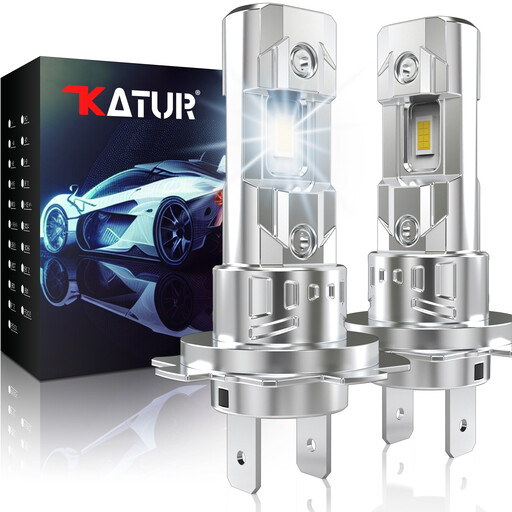
Why it's a match: Ideal for those seeking a reliable and silent upgrade. With no moving parts (fan), there's less risk of failure, making it a solid choice for a first `car lighting upgrade`.
The fanless design addresses the risk of faulty cooling. The 1:1 mini design, similar to a halogen bulb, is focused on maintaining a correct beam pattern.
Silent operation and a compact size that fits in most headlight housings without modification. Simple installation.
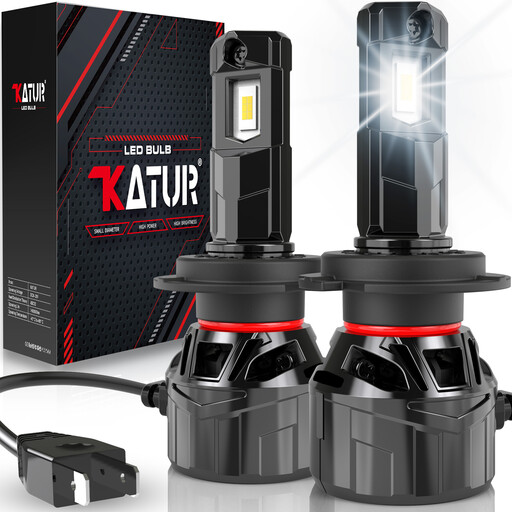
Why it's a match: For those who often drive at night or on unlit roads and want the highest possible light output for maximum safety and visibility.
The high light output is managed by active cooling with a turbo fan (16,000 RPM according to the manufacturer) to prevent overheating. The built-in Canbus compatibility is designed to prevent error messages.
Very high light output (30000LM per pair according to KATUR) and an active cooling system for stable performance and a longer lifespan.
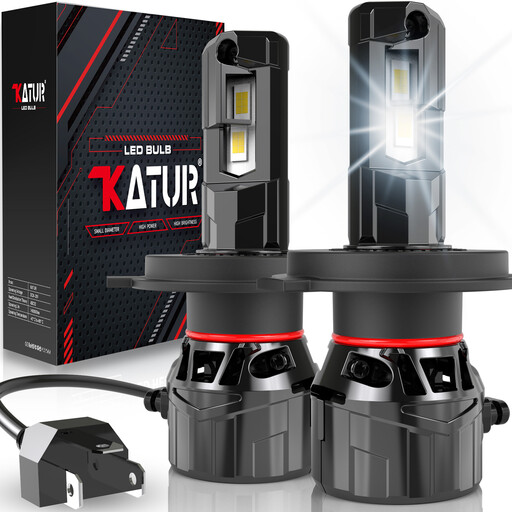
Why it's a match: Specifically designed for vehicles that use an H4 LED fitment, where a single bulb switches between low and high beam. This is a complete upgrade for both low and high beams in one product.
This bulb is designed to accurately mimic the dual function of a halogen H4 bulb. This is essential for a correct beam pattern on both low and high beam, which helps prevent blinding oncoming drivers.
Combines low and high beams in a single bulb with high light output and active cooling for durable performance.
We have a current selection of products that meet these criteria. Find the right lighting for your situation.
Regulations can be specific depending on your region. Aftermarket LED bulbs in a headlight assembly originally designed for halogen often lack official ECE approval for that specific car model. This can be a reason for failing a safety inspection. The inspector will focus on the beam pattern: it must not blind oncoming drivers and must have a clear, sharp light-dark cut-off line. Always check current local road authority guidelines and the bulb's specifications before you replace car headlights.
The easiest way is to check your car's owner's manual. You can also remove the old bulb from the headlight assembly; the type is usually printed on the metal or plastic base of the bulb (e.g., H7, H4, H1). Online databases, sometimes linked to your vehicle registration number, can also provide the answer.
This is a classic Canbus issue. Your car's on-board computer detects a lower power consumption and interprets it as a faulty bulb. The solution is to use Canbus LED headlights that have a built-in resistor or decoder. For some particularly sensitive European car models, a separate, external Canbus decoder may still be required to permanently resolve the error message.
