
Vandaag of morgen in huis

Kwaliteit gegarandeerd

Welkomstaanbiedingen ontgrendelen: GRATIS bezorging | Tot 80% korting | Gratis 30 dagen JoyPlus-proefperiode
Download de app
Driving at night with dim, yellowish halogen bulbs can quickly feel unsafe. It's no surprise that more and more drivers are considering the switch to modern LED headlights. The promise is clear: better visibility, a longer lifespan, and a sleek, modern look. However, the market is flooded with options and marketing claims that aren't always straightforward.
Before you invest in a new set, it's crucial to understand a few common pitfalls. Many buyers fall for these, resulting in unnecessary costs and frustration.
To avoid a bad purchase, it's wise to pay attention to a few technical specifications. This will help you choose the right LED car bulbs for your situation.
This is the most basic, yet most important, step. Every car uses a specific fitting for its headlights. The most common types are:
Always check your car's owner's manual or the code on your current bulb to be sure which fitting you need.
Modern cars use a CANbus (Controller Area Network) system to monitor the status of components. Because LED bulbs consume much less power than halogen bulbs, the onboard computer might think the bulb is broken. This results in an error message on the dashboard.
A good CANbus LED bulb has a built-in resistor that solves this problem for most cars. For highly sensitive systems (often found in brands like Volkswagen, BMW, or Mercedes-Benz), an additional, external CANbus decoder may sometimes be necessary.
A correct beam pattern is crucial for safety. Good plug-and-play headlights are designed to mimic the light pattern of the original halogen bulb. This ensures a sharp, focused beam that illuminates the road without blinding oncoming drivers.
The colour of the light is expressed in Kelvin (K). Standard halogen bulbs have a yellowish colour of about 3200K. Most white car bulbs are around 6000K to 6500K. This provides a bright, daylight-white light that improves contrast on the road and gives your car a modern appearance.
To help you with replacing car lights, we've highlighted a few popular choices and matched them with specific user profiles.
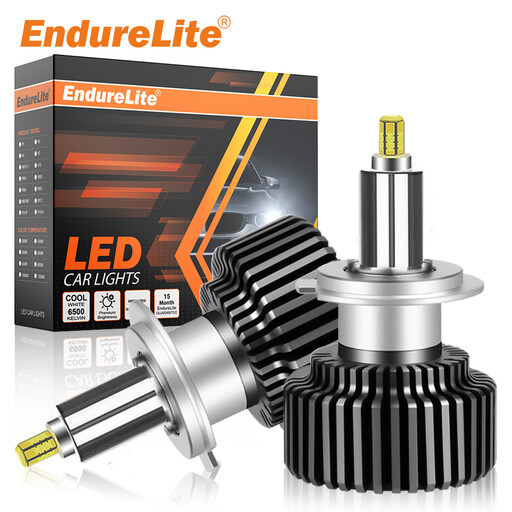
Why This Fits Their Persona: This user wants a noticeable improvement without the hassle. The installation needs to be quick and easy, just like replacing a standard halogen bulb.
The 1:1 design compared to the original halogen bulb ensures a hassle-free installation and a correct beam pattern, helping you avoid the 'lumen trap' of scattered light.
The manufacturer emphasizes a '5-Min Plug-N-Play' installation. The built-in fan provides active cooling, which reduces the risk of premature failure due to overheating.
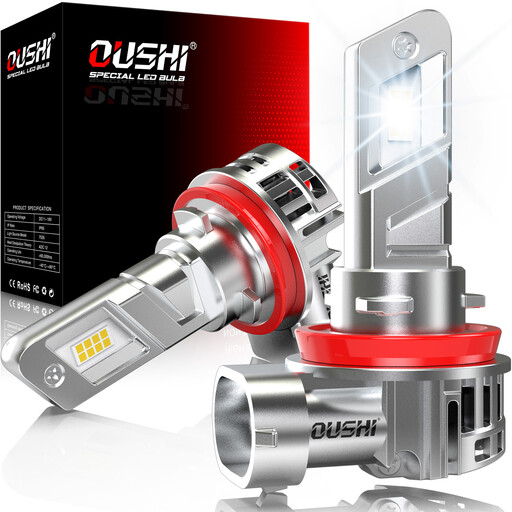
Why This Fits Their Persona: For this driver, maximum visibility and safety are the top priorities. They often drive on unlit roads and want a powerful beam that shines far and wide.
According to the manufacturer OUSHI, these bulbs offer up to 600% more brightness. The combination with a 1:1 mini-design ensures this high output is converted into a usable, focused beam pattern.
The high-speed turbo fan and aluminium housing are designed for efficient heat dissipation, which is essential for guaranteeing high performance and a long lifespan.
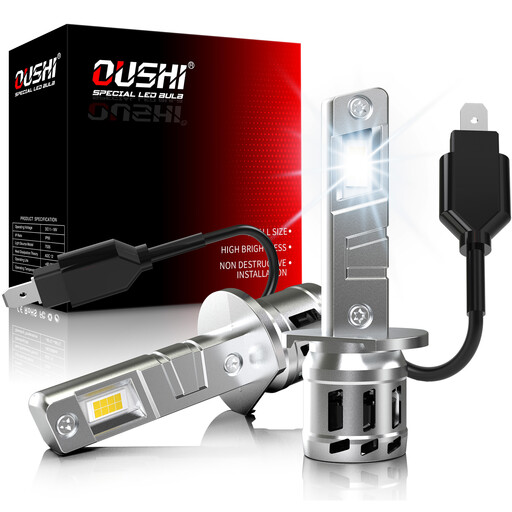
Why This Fits Their Persona: This driver is primarily concerned with compatibility. Dashboard error messages or radio interference are absolute deal-breakers. Reliability within the car's complex electronic system is the priority.
This model bypasses the 'universal' CANbus trap. According to the manufacturer OUSHI, its latest-generation CANbus system is specifically better suited for European vehicles.
The manufacturer claims 98% compatibility without radio interference. Although a few highly sensitive models may require an extra decoder, this provides a solid foundation for an error-free upgrade.
We've compiled a complete, up-to-date list of products that meet these selection criteria.
The regulations for retrofitting LED headlights into housings originally designed for halogens are complex. Not all retrofit LED bulbs have an E-mark certification that is valid for use in a halogen reflector or lens. For safety inspections, the lighting must meet specific requirements regarding beam pattern and light colour. Always check the latest local traffic authority regulations and the product's specifications before using the bulbs on public roads.
Manufacturers often claim a lifespan of 30,000 to 60,000 hours. In practice, this depends heavily on heat dissipation. A bulb with efficient cooling, such as a built-in fan and an aluminium housing, will come much closer to its promised lifespan than a cheaper model that overheats. Overheating is the primary cause of diminishing light intensity and a shorter lifespan.
This is caused by your car's CANbus system. This system measures the resistance of the bulbs to check if they are working. LED bulbs consume significantly less power, resulting in lower resistance. The onboard computer can interpret this as a broken bulb and issue a warning. A CANbus LED bulb with a built-in resistor solves this in most cases. For some cars, an external decoder is needed to fully 'trick' the system.
