
Vandaag of morgen in huis

Kwaliteit gegarandeerd

Welkomstaanbiedingen ontgrendelen: GRATIS bezorging | Tot 80% korting | Gratis 30 dagen JoyPlus-proefperiode
Download de app
Driving in the dark with dim, yellowish halogen bulbs can be tiring and unsafe. Your visibility is reduced, and your car lacks the modern aesthetic of newer models. Upgrading to LED headlights is a popular solution for better visibility and a sleeker look. But with so many options, specifications, and fitments, the choice can be overwhelming.
As a Joybuy Product Recommendation Officer, I'm here to guide you through the technical details. This article provides practical guidance for choosing the right LED lighting for your car, without the marketing fluff. We'll focus on the specifications that truly matter, so you can make an informed decision.
Before making a purchase, there are a few key points to consider. These will ensure you choose a set that fits, works, and delivers the desired result.
Not every bulb fits every car. The fitment is the base of your headlight. The most common types are:
Always check your car's owner's manual or the markings on your current headlight to determine the correct fitment. Many modern kits are plug-and-play headlights, meaning installation is straightforward and requires no wiring modifications.
Two terms you'll constantly encounter are lumens (lm) and Kelvin (K).
Modern cars use a CAN bus system to monitor their electronics. Because LED bulbs consume far less power than halogen bulbs, the system might think a bulb is burnt out. This can result in a dashboard error message or flickering lights. To avoid this, choose CAN bus-ready LED lighting. These kits have a built-in resistor or driver that 'tells' the system that everything is functioning correctly.
Based on specifications, ease of installation, and functionality, we've highlighted a few popular choices for you.
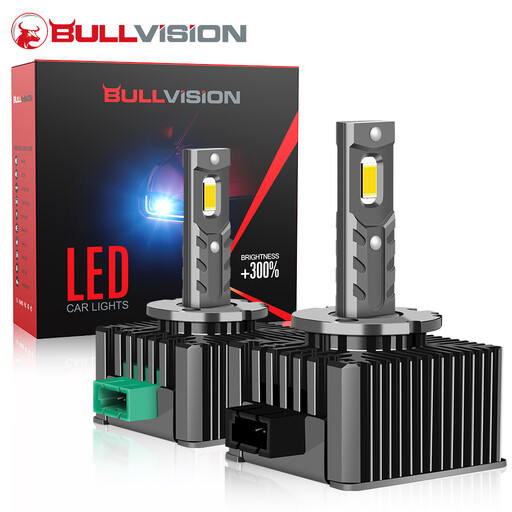
Why It Stands Out: This kit is specifically designed as a 1:1 replacement for cars with standard xenon lighting (D-series). The installation is plug-and-play, making the switch from xenon to LED simple. According to the manufacturer, Bullvision, the bulbs offer a brightness of 26,000 lumens, which is a significant headlight upgrade.
Advantages:
Who Is It For?: Drivers with factory-fitted xenon lighting who are looking for a direct and powerful LED replacement without complex modifications.
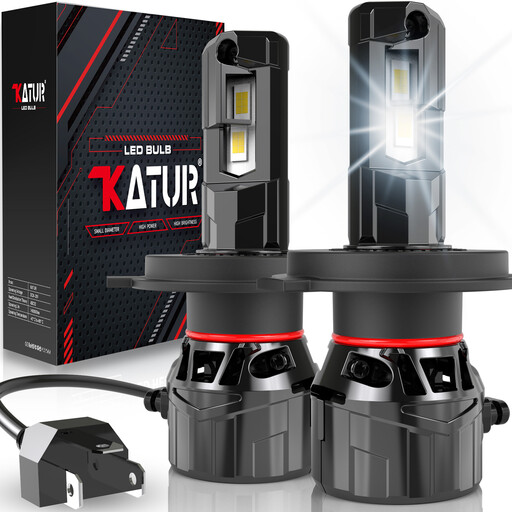
Why It Stands Out: The 1:1 mini design of these H4 LED bulbs is identical to that of a standard halogen bulb. This makes them true plug-and-play headlights, as no external driver or extra space is needed. According to KATUR, the kit delivers an impressive 30,000 lumens.
Advantages:
Who Is It For?: Car owners with H4 fitments who want the simplest, yet most powerful, upgrade for both their low and high beams.
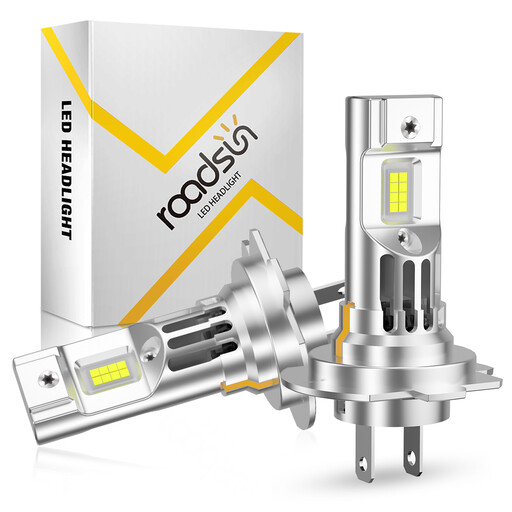
Why It Stands Out: These H7 LED bulbs are designed for an adapter-free installation. This significantly simplifies the process of replacing car headlights. The manufacturer claims a brightness 500% higher than halogen and a slightly cooler light colour of 6500K.
Advantages:
Who Is It For?: DIY enthusiasts looking for a robust and bright H7 bulb that can be installed quickly and hassle-free, for both headlights and fog lights.
The right lighting depends heavily on your car model and personal preference. If the options above aren't exactly what you're looking for, a wider selection is available.
Explore our full range of White Lighting Bulbs for more options to suit your car and preferences.
Regulations for retrofitting LED lighting can be complex. For use on public roads, the entire headlight unit (bulb, reflector, lens) must often be approved as a whole and carry a specific certification mark (like an E-mark in Europe). Many retrofit LED kits do not have this certification and are officially intended for off-road or racetrack use only. It is the owner's responsibility to check and comply with local laws and vehicle inspection requirements.
For most plug-and-play headlights, the process is relatively simple. Turn off the engine and lights, open the bonnet, and remove the dust cover behind the headlight unit. Twist and remove the old bulb. Insert the new LED bulb, connect it, and secure everything back in place. Always consult your car's manual and the bulb manufacturer's instructions.
The main difference is their function. An H7 LED bulb has one set of LED chips and can only perform one function at a time: either low beam or high beam. An H4 LED bulb has two sets of chips, combining low and high beams into a single bulb. Your choice depends entirely on the type of fitment your car uses.
