
Vandaag of morgen in huis

Kwaliteit gegarandeerd

Welkomstaanbiedingen ontgrendelen: GRATIS bezorging | Tot 80% korting | Gratis 30 dagen JoyPlus-proefperiode
Download de app
Thinking of swapping your halogen or xenon lights for LED headlight bulbs for your car? It’s easy to assume that a bulb with plenty of lumens and a white colour temperature will do the job. In practice, the fitting, space inside the headlight housing, heat dissipation and vehicle compatibility matter just as much. A wrong choice can lead to a poor beam pattern, dashboard warning lights or a bulb that simply won’t fit.
This buying guide will help you compare with confidence, without taking marketing claims at face value.
Manufacturers sometimes quote a high light output, for example 16,000 or 20,000 lumens per set. That figure is only useful if you also consider the beam pattern, the positioning of the LED chips and the headlight alignment. A bulb with incorrect chip placement can cause stray light, dazzling oncoming drivers.
According to the product descriptions of the models mentioned, the LED chips are designed in a 1:1 format relative to the original bulb. Always check the beam pattern after installation and have the headlights adjusted if necessary.
A plug-and-play LED bulb usually uses the existing fitting and wiring. However, the available space can be limited, especially if the bulb has a cooling fan or an external driver. Some cars may also show a fault message when the power consumption differs from that of a halogen or xenon bulb.
CANbus LED bulbs are designed to reduce the chance of error messages, flickering or radio interference. That’s no guarantee for every vehicle. So check your car’s make, model, year and headlight type before ordering.
LEDs convert some of the electrical energy into heat. An aluminium housing, copper heat conduction or a cooling fan helps to dissipate that heat. With LED bulbs that have a cooling fan, you also need to check that the fan can spin freely and that the original dust cap still fits properly.
A stated lifespan of, say, 50,000 hours is a manufacturer’s product specification, not a fixed service life under all conditions. Temperature, moisture, installation and daily use all affect the actual lifespan.
Always start with the type of fitting. Common variants include:
Look in the owner’s manual, on the old bulb or in the vehicle’s parts list. “Fits many vehicles” alone is not enough information.
LED car bulbs at 6000K typically give cool white light. Xenon white headlights are often chosen for a modern look and clear colour contrast. However, a higher colour temperature doesn’t automatically mean better visibility in rain, fog or snow. For everyday driving, a correct beam pattern and proper alignment matter more than just the colour.
Also note the difference between headlights and fog lights. For fog lights, a different light colour or light distribution may be more practical than for main or dipped beam.
Look out for these points in the product specifications:
A bulb may technically fit, but still be unsuitable if the dust cap won’t close or the fitting doesn’t lock properly.

Why this fits the profile: This H4 set combines dipped and main beam in one fitting and, according to the product description, is designed for plug-and-play installation. That makes it practical for DIYers who have already checked the fitting and space in their car.
The stated 1:1 shape and built-in cooling system reduce the need for extra parts. However, do check whether your car requires an additional CANbus decoder.
H4 fitting for dipped and main beam, 6000K cool white, fan according to the product information and a set content of one bulb.

Why this fits the profile: These D1S/R bulbs are aimed at drivers with an existing xenon setup who want to switch to LED. The product specification lists an original format and 6000K cool white light.
The fitting and size are clearly specified. This reduces the risk of ordering a generic H1 or H4 bulb for a D1S/R system.
D1S/R designation, 6000K colour temperature, built-in driver and, according to the product description, a stated lifespan of 50,000 hours.
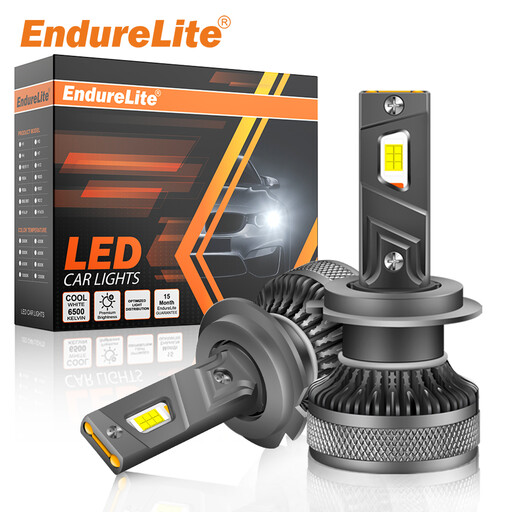
Why this fits the profile: This choice suits cars with a 9006/HB4 fitting and, according to the product description, can also be used as a fog light. That’s relevant for drivers looking for one compatible fitting for headlight or fog light use.
The product name explicitly states the 9006/HB4 fitting. Still check the old bulb and the space around the housing before ordering.
9006/HB4 fitting, 6000K cool white, IP68 according to the product specifications and a built-in cooling fan.
Switch off the lights and let the old bulb cool down completely. Wear gloves if possible and avoid touching the LED chips. Insert the bulb straight into the fitting, check the sealing ring and make sure the dust cap closes properly.
Then check:
A correct installation does not replace a headlight alignment check. If you are unsure about converting from xenon to LED or about legal approval, consult your vehicle documentation and up-to-date information from the DVSA or a garage.
We’ve put together a full, up-to-date list of products that fully meet these strict selection criteria and current European safety regulations.
No. The bulb may fit mechanically, but the car may need a CANbus decoder. Also check the fitting, polarity, available space and the connection to the original wiring.
Manufacturers often quote a long lifespan, for example 50,000 hours. According to the product descriptions of various models, that is the stated lifespan under the manufacturer’s conditions. Heat, moisture and use can affect the actual lifespan.
LED technology can use a different wattage than halogen for a similar light function. The exact consumption varies per bulb. So look at the stated wattage and take into account the operation of your car’s CANbus system.
