
Vandaag of morgen in huis

Kwaliteit gegarandeerd

Welkomstaanbiedingen ontgrendelen: GRATIS bezorging | Tot 80% korting | Gratis 30 dagen JoyPlus-proefperiode
Download de app
A new LED ceiling light may seem easy to choose, but product pages do not always explain what you need in practice. A light with a high wattage is not automatically brighter, RGB lighting is not useful in every room, and an ultra-thin ceiling light will only fit properly if the connection points and dimensions are suitable.
For homes in the Netherlands, three pitfalls are particularly important:
With the right comparison, you can find LED ceiling lighting that suits both the room and your everyday use.
Lumens (lm) indicate how much light a lamp produces. Energy consumption is shown in watts (W). An energy-efficient ceiling light can therefore provide relatively high light output with a lower wattage.
As a general guideline, consider:
These figures are not a fixed standard. Dark walls, high ceilings and a wide light distribution may call for more light. Therefore, also check the beam angle. An angle of 120 degrees spreads the light widely and is practical for general lighting.
Colour temperature is expressed in Kelvin (K):
A ceiling light with warm white light at 3,000 K, such as the Aigostar light mentioned below, provides a fixed colour temperature. A ceiling light with an adjustable colour temperature offers greater flexibility, but check whether it is adjusted via a remote control, wall switch or app.
A dimmable ceiling light is useful when you want bright light during the day and less intense light in the evening. Pay close attention to the control method. Some models work with an included remote control, while others need to be compatible with a separate dimmer.
With an RGB ceiling light, you can use coloured light to create atmosphere. RGB is not the same as good white task lighting. Therefore, check whether the product also supports CCT, for example across a range of 3,000 to 6,500 K.
For damp indoor spaces, the IP rating is relevant. IP44 means protection against splashing water and, according to the manufacturer’s product information, may be suitable for damp environments. Always check the exact installation location and local installation regulations. An IP20 light is intended for dry indoor spaces.
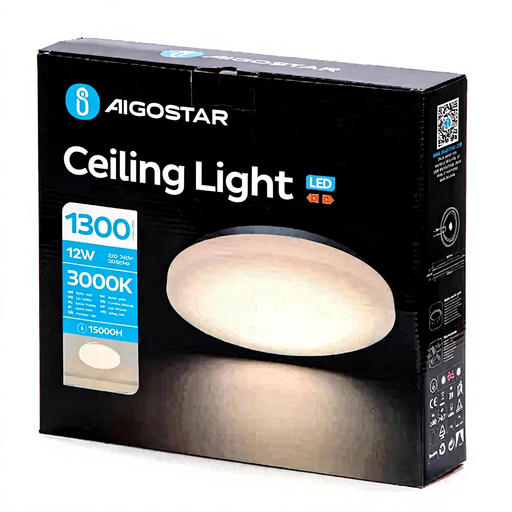
Why it suits this profile: This compact model has a fixed warm colour temperature and clearly specified energy consumption. This makes it a straightforward choice for a bedroom, small hallway, study or balcony.
The product information states both 12 W and 1,300 lumens. This means you are not comparing products based on wattage alone. The fixed 3,000 K colour temperature also means you are not paying for features you do not need.
12 W, 1,300 lm, 120° beam angle, 3,000 K and dimensions of 26 × 6.3 cm. The product information states a minimum statutory warranty of two years.
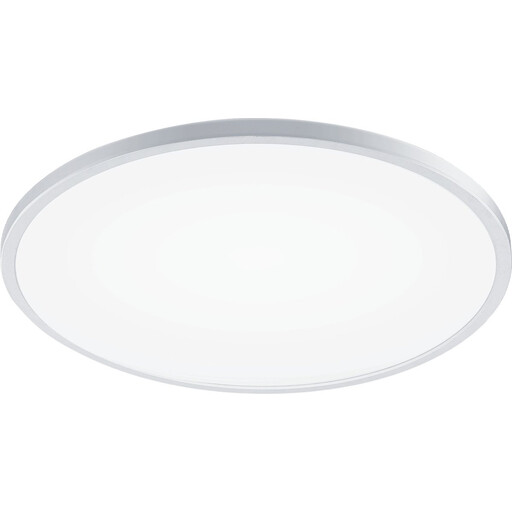
Why it suits this profile: This model combines a flat design with adjustable white light and RGB. According to the product information, its IP44 rating makes it suitable for certain damp indoor environments.
The choice is not based on appearance alone: the product information lists lumens, wattage, colour temperature range and IP44 rating. However, check that the intended installation location falls within the permitted application.
24 W, 2,700 lm, RGB+CCT from 3,000–6,500 K, an ultra-thin height of 26 mm, a 120° beam angle and IP44 rating.
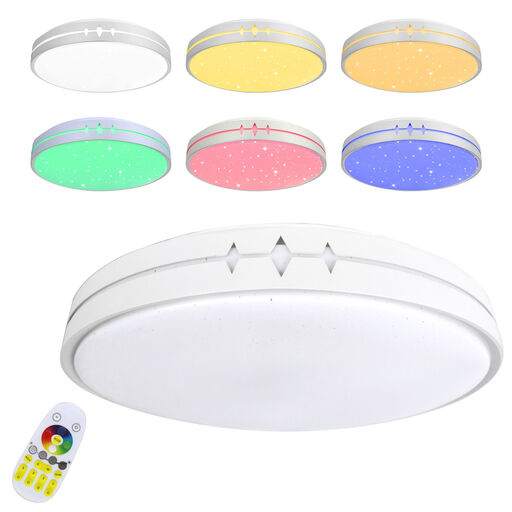
Why it suits this profile: This round ceiling light is designed for people who want to use a single central light point at different times, with dimming, RGB and remote control.
The features are clearly stated in the product name: 60 W, dimmable, RGB and remote control. Before buying, measure whether the 50 cm diameter is suitable for the room.
Dimmable LED ceiling lighting with an RGB function, remote control and a diameter of 50 cm. According to the product name, it is suitable for living rooms, bedrooms, kitchens and hallways, among other spaces.
We have put together a complete, up-to-date list of products that fully meet these strict selection criteria and the applicable European safety regulations.
Before installation, switch off the power at the consumer unit. Then check that the voltage and connection match the product information. For a fixed connection to the mains, it is advisable to call in a qualified installer if you are not certain that the wiring is correct.
Also pay attention to:
The stated lifespan is a product specification, not a guarantee that every light will last exactly that long. Switching frequency, heat dissipation and usage conditions can affect performance. Keep the manual and proof of purchase for any warranty queries.
This depends on the floor area, ceiling height and the atmosphere you want to create. For general living-room lighting, around 2,000 lumens or more is a useful starting point. With a dimmable ceiling light, you can adjust the brightness, but also check that the light is spread widely enough.
No. A remote control may only offer on/off operation, colour selection or additional lighting programmes. Therefore, explicitly check whether dimmability is listed in the product specifications and whether the remote control is included.
The cost depends on the wattage, number of operating hours and your electricity tariff. A 24 W light theoretically uses 24 kWh over 1,000 operating hours. For a fair comparison, look at the stated consumption per 1,000 hours rather than just the number of lumens.
