
Vandaag of morgen in huis

Kwaliteit gegarandeerd

Welkomstaanbiedingen ontgrendelen: GRATIS bezorging | Tot 80% korting | Gratis 30 dagen JoyPlus-proefperiode
Download de app
LED car lighting can be a bright, modern upgrade for dipped beam, main beam, fog lights and interior lighting. But ordering just any LED bulb isn’t a good idea. The wrong fitting, an unsuitable beam pattern or a CANbus system error could mean your purchase won’t fit or isn’t suitable for use on public roads.
As Joybuy Product Recommendation Officer, I cut through the marketing claims to highlight the key product specifications. Here’s what to look for before replacing your halogen lights.
An H4 LED bulb, H7 LED bulb and H11 LED bulb each have a different fitting and application. Even with the same fitting, the available space, plug and mounting can vary from one vehicle to another. So check your car’s manual or the original bulb first.
A product described as having “99% compatibility” isn’t guaranteed to work with your specific model. Some vehicles, including certain Volkswagen, Mercedes-Benz and BMW models, may need an additional CANbus decoder.
Brands sometimes make claims such as “300% brighter” or quote a very high light output. According to product information from Bullvision and ENdureLite, these percentages are based on a comparison with halogen lighting. Actual visibility also depends on the reflector, headlight housing, alignment and beam pattern.
A bulb that shines too high or unevenly can dazzle oncoming drivers. So always check your headlight alignment after replacing a bulb.
A plug-and-play LED bulb may seem easy to connect, but it also needs to fit inside the headlight. A fan, driver or limited space behind the fitting can make installation more difficult. Professional installation may be a good idea for some LED headlights.
Start by checking the original fitting:
Also check whether you need one bulb or a set. Some products are sold individually, while others come as a 2-pack.
Many 6000K LED car bulbs produce cool white light. This can look more modern than warm halogen light, but colour temperature doesn’t tell you whether the light is distributed correctly. Look for a clear, asymmetrical cut-off for dipped beam and correctly positioned LED chips.
For an H4 or H7 retrofit, the LED chip should match the position of the filament in the original halogen bulb as closely as possible. Incorrect positioning can cause dark spots or stray light.
Modern cars monitor the power consumption of their lights. An LED bulb typically uses less power, which can trigger an error message, flickering or shut down the light. CANbus LED car bulbs reduce this risk, but “CANbus-ready” doesn’t guarantee compatibility with every vehicle.
Also check:
Product approval is essential for use on public roads. According to the product information, the OSRAM NIGHT BREAKER LED START H4 and SMART H7 are approved only for specific vehicle models, lighting functions and countries listed in the official compatibility list. So check the latest list from the manufacturer before buying.
According to the product information, the OSRAM NIGHT BREAKER LED SMART ECE H11 is listed as ECE R37-approved for 12V vehicles with an H11 fitting. Still check that your car actually uses an H11 fitting, and follow the manufacturer’s latest documentation. A retrofit without approval isn’t automatically legal for use on public roads.
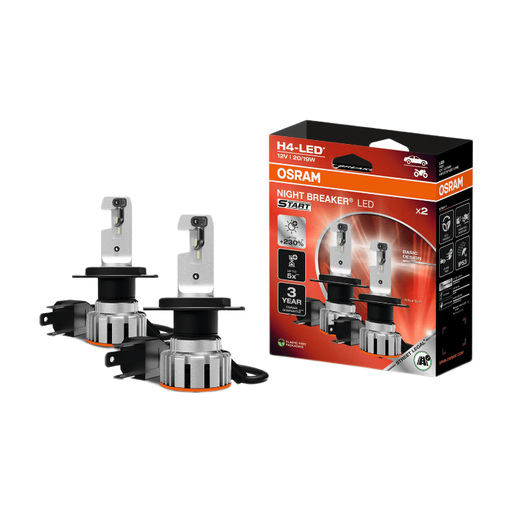
Why it suits this profile: A relatively straightforward upgrade for drivers with H4 lighting who want an LED retrofit with stated road approval. Check the OSRAM compatibility list first.
The product information specifies vehicle and function approval rather than universal compatibility. According to the description, CANbus is available for many compatible vehicles without an extra accessory.
6000K, 20W and up to 1650 lumens according to the product specifications; one bulb combines dipped beam and main beam in H4 applications.
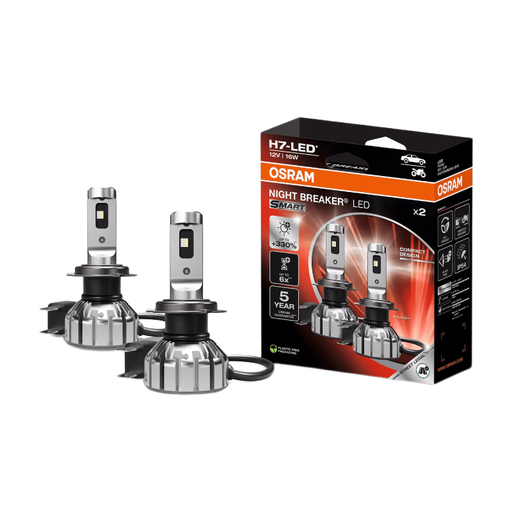
Why it suits this profile: For motorists with H7 lighting who value a compact retrofit solution and product specifications from an established brand.
The manufacturer refers to an official compatibility list. According to the product information, some cars may still need a CANbus adapter or decoder.
16W, 6000K and up to 330% more brightness according to OSRAM’s own product information; supplied as a set of two bulbs.
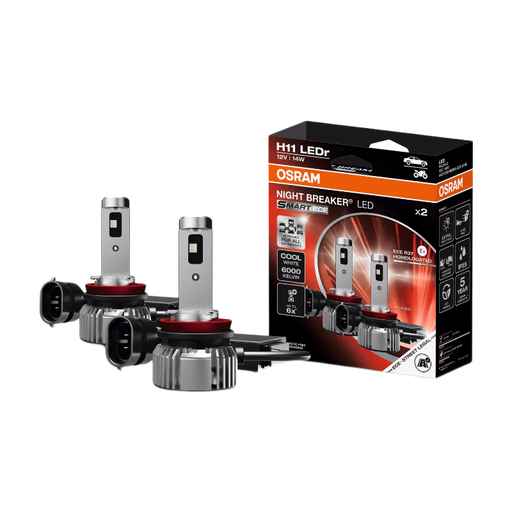
Why it suits this profile: A targeted choice for drivers who use H11 bulbs for dipped beam, main beam or fog lights and are specifically looking for an ECE retrofit.
The product information lists ECE R37 homologation for H11 fittings. The fitting and lighting function still need to match your car.
1350 lumens, 14W and 6000K according to the product specifications; suitable for H11 functions such as fog lights, dipped beam or main beam.
We’ve put together a complete, up-to-date list of products that meet these strict selection criteria and the applicable European safety regulations.
Switch off the car, let the headlight cool down and, ideally, disconnect the battery before you start. Don’t touch the LED chips or electronic drivers. Fit the bulb straight and check that the seal closes properly.
After replacing car bulbs, check:
That depends on the bulb, fitting, lighting function, vehicle and approval. A retrofit isn’t automatically legal just because it has the same fitting. For vehicle-specific models, check the manufacturer’s latest compatibility list. For an ECE-approved H11 model, you still need to check that your car uses H11.
Lifespan varies by product and operating conditions. According to the product information, some models claim up to five or six times the lifespan of halogen bulbs, while Bullvision and ENdureLite models state up to 50,000 hours. These are manufacturer claims, not a guarantee for every real-world situation. Heat dissipation and moisture protection play an important role.
According to OSRAM’s product information, the NIGHT BREAKER LED models mentioned use up to 60% less energy than traditional halogen bulbs. Actual consumption depends on the specific model. Always check the wattage and bear in mind that lower power consumption may trigger CANbus error messages.
