
Vandaag of morgen in huis

Kwaliteit gegarandeerd

Welkomstaanbiedingen ontgrendelen: GRATIS bezorging | Tot 80% korting | Gratis 30 dagen JoyPlus-proefperiode
Download de app
Replacing your car’s LED lights sounds simple: take out the old bulb and fit a new LED bulb. In practice, most problems arise from choosing the wrong fitting, missing vehicle approval or triggering errors in the CANbus system. So a bulb labelled “universal” on the packaging won’t necessarily fit every car safely and legally.
Claims about light output also deserve a closer look. A higher lumen rating doesn’t automatically mean a better beam pattern. The reflector, projector, position of the light source and headlight alignment all affect how well you can see without dazzling oncoming drivers.
Confusing the fitting with vehicle compatibility
An H4 LED bulb, H7 LED bulb or H1 LED bulb may fit mechanically, but that doesn’t mean it’s approved for your car, lighting function and country. Always check the exact make, model, model series, headlight type and whether it’s for high or dipped beam.
Interpreting “road approval” too broadly
An LED bulb with road approval isn’t automatically permitted in every headlight. For retrofit products, approval usually applies only to the vehicles, lighting functions and countries listed in the official compatibility list. So a legal LED retrofit requires more than just the right fitting.
Overlooking CANbus, space and heat
Modern cars monitor the power consumption of their lights. A CANbus LED car bulb can help prevent error messages, flickering or the lights switching off, but some vehicles still need an additional adapter. Also check there’s enough room for a heat sink, fan, driver or dust cap.
Start by checking the bulb currently fitted in your car. Common types include:
Also check how many bulbs are included in the pack. Some products are sold individually, while others come as a pair. For asymmetrical lighting functions, it’s usually best to replace both bulbs at the same time for an even colour and light distribution.
Many LED bulbs use 6000K LED lighting, a cool white colour that product information describes as similar to daylight. However, colour temperature doesn’t tell you anything about the total light output or the quality of the beam pattern.
Look out for:
Manufacturers may claim higher light output or less glare. According to OSRAM’s own information, certain NIGHT BREAKER LED models are compared with the minimum requirements of ECE R112. Treat this as a product specification, not a guarantee that every vehicle will deliver the same result. The headlight housing and alignment still matter.
An LED headlight with road approval must be suitable for your specific vehicle according to the official compatibility list. Before buying OSRAM NIGHT BREAKER LED models, check the latest list at osram.de/ledcheck. It shows the approved vehicles and lighting functions, as well as any accessories required.
Some cars need a CANbus adapter or decoder. Without checking first, you may see a dashboard warning after installation, or experience flickering or radio interference. This also applies to a xenon-to-LED upgrade: a complete headlight unit and a separate retrofit bulb are different products, with different installation and approval requirements.
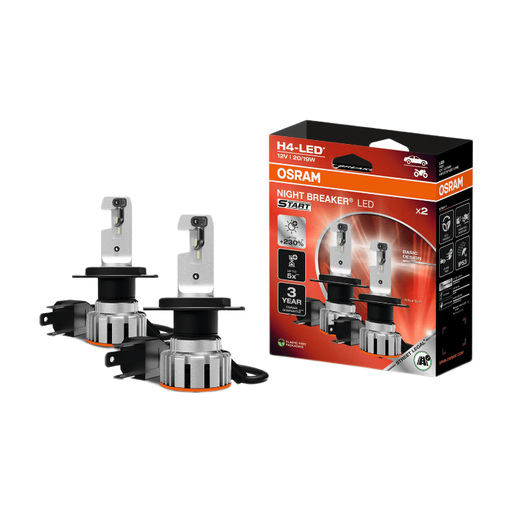
Why it suits this type of buyer: This 12V H4 bulb is designed as an accessible retrofit for vehicles on the official compatibility list.
The product information stresses that compatibility isn’t universal. So check your vehicle, lighting function and country before ordering.
According to OSRAM: 6000K, maximum 20 watts, CANbus support and a lifespan of up to five times that of a halogen bulb.
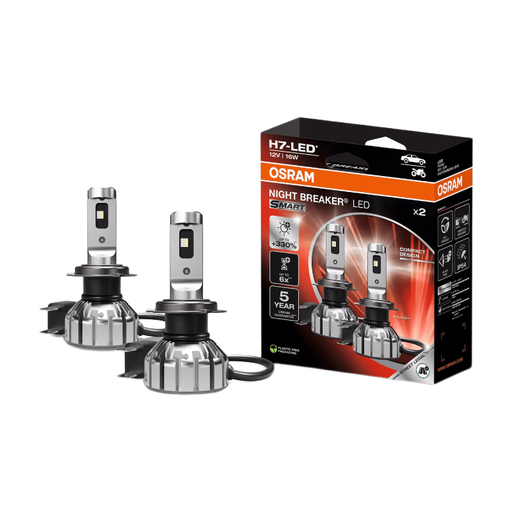
Why it suits this type of buyer: This H7 set is suited to drivers looking for a compact retrofit solution who are prepared to check the vehicle list carefully.
Its compact design can make installation easier, but some vehicles may still need a CANbus adapter or decoder.
According to OSRAM: up to 330% more brightness compared with the ECE R112 minimum requirements, 16 watts and a lifespan of up to six times that of a halogen bulb.
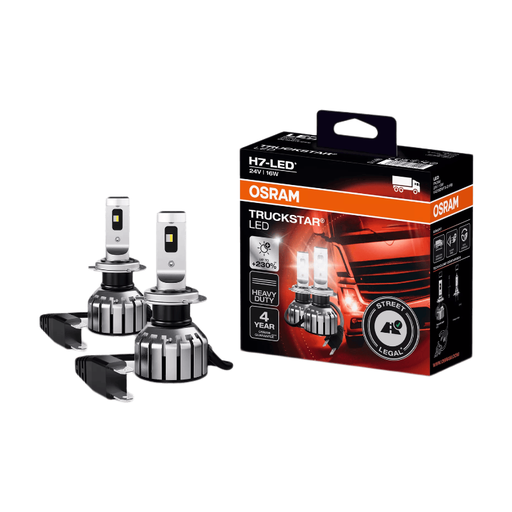
Why it suits this type of buyer: This 24V LED truck bulb is designed for lorries, buses, tractors and other heavy vehicles.
The voltage is clearly stated as 24V. This helps you avoid accidentally using a truck bulb in a standard 12V passenger car.
According to OSRAM: 16 watts, 6000K, a vibration-resistant design and a lifespan of up to five times that of a halogen bulb.
We’ve put together a full, up-to-date list of products that meet these strict selection criteria and the applicable European safety regulations.
Before installation, read the instructions and disconnect the battery. Don’t touch the LED chip, and make sure the bulb is securely fitted. With an H7 LED bulb, the chip must be correctly oriented; fitting it the wrong way can disrupt the beam pattern.
Then check:
For complete units, such as BMW LED headlights or Porsche Cayenne LED headlights, connectors, bodywork fittings, coding and vehicle variant are especially important. So check more than just the appearance: confirm the exact model series and the parts included.
No. Legality depends on the combination of bulb, headlight, vehicle, lighting function and official approval. A retrofit bulb is suitable for road use only if your specific application appears on the current compatibility list and it’s installed according to the instructions.
According to the specifications provided by various manufacturers, the stated lifespan can be several times longer than that of a halogen bulb. Actual lifespan also depends on heat dissipation, vibration, moisture, voltage and the quality of the installation. So a claim such as 50.000 hours should be treated as a stated product specification, not a guarantee for every car.
LED bulbs often use fewer watts than comparable halogen bulbs. According to OSRAM’s own information, certain models use up to 60% less power; up to 75% is stated for the 24V truck version. The savings vary by bulb and vehicle. Also check that the CANbus system correctly recognises the lower power consumption.
