
Vandaag of morgen in huis

Kwaliteit gegarandeerd

Welkomstaanbiedingen ontgrendelen: GRATIS bezorging | Tot 80% korting | Gratis 30 dagen JoyPlus-proefperiode
Download de app
When you want to replace LED car lights, you’ll often look at brightness and price first. That’s understandable, but it’s not enough. A bulb with a high lumen count won’t necessarily fit your headlight. Even a model described as CANbus-ready can still trigger a warning. And with interior lighting, quick installation isn’t the same as a neat, long-lasting fit.
Use this practical guide to focus on the details that really matter: fitting, application, colour temperature, heat dissipation, vehicle compatibility and use on public roads.
H1, H7, H11, D2S and D4S aren’t variations of the same bulb. They refer to different fittings and applications. So an H7 LED bulb can’t simply replace an H1 bulb. Check the fitting on your old bulb, in your car’s handbook or using a vehicle-specific compatibility list.
With compact bulbs, also check how much space there is behind the headlight. An integrated fan or longer housing may touch the cover.
Brands sometimes make claims such as “300% brighter”. According to Bullvision and ENdureLite’s own product descriptions, this refers to a comparison with the original bulb. Actual light output also depends on the reflector, lens, alignment and condition of the headlight.
An incorrectly positioned LED element can cause stray light. After fitting, check the beam pattern and have the headlights adjusted if necessary.
A CANbus LED car bulb contains electronics that try to mimic the power consumption of a traditional bulb. This can help reduce error messages, flickering or radio interference. However, it’s no guarantee for every car. Vehicles with a particularly sensitive monitoring system may need a decoder or resistor.
If a product states “99% vehicle compatibility”, that’s a claim from the brand’s product information. Always check compatibility with your specific car model.
Start by choosing the right base:
A universal fitting doesn’t mean every bulb will fit every light housing. Also check the polarity, base length, diameter and space available for cooling.
6000K LED car bulbs give off a cool white light. They’re a good match if you’re after a modern, bright look. However, a higher colour temperature doesn’t automatically mean better lighting. White, blue, red or amber may be suitable for parking lights, interior lights or styling; for headlights, focus on the beam pattern, approval and the regulations that apply to your vehicle and the intended use.
According to the product information, the OSRAM NIGHT BREAKER LED W5W is offered at 5700 Kelvin and is intended for specific 12V functions such as parking lights, position lights, number plate lights and interior lighting. The manufacturer also states that it has road approval for these applications. Don’t use a bulb behind red or yellow glass if the product instructions rule this out.
LEDs turn less energy into heat than traditional bulbs, but they still get warm. An aluminium housing, fan or cooling fins help dissipate heat. Bullvision and ENdureLite products state a lifespan of up to 50,000 hours and IP68 water resistance. These are specifications from the brands’ product descriptions, not a guarantee for every real-world situation.
For a long service life, the following are especially important:
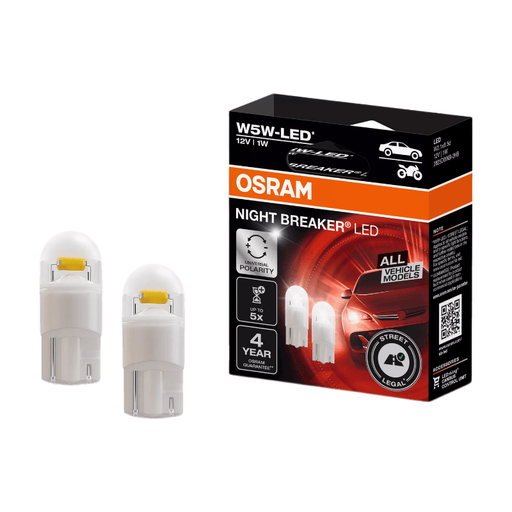
Why it suits this profile: A targeted plug-and-play option for drivers who want to replace W5W lighting without modifying the entire headlight.
The application and fitting are clearly specified. Still, check whether your car uses a W5W/T10 base and allow for the possibility that you may need a CANbus decoder.
12V, 5700K, 50 lumens, universal polarity and designed for parking, position, number plate and interior lights.
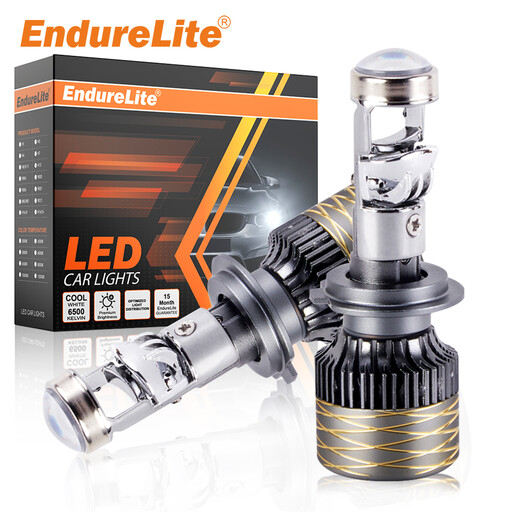
Why it suits this profile: A good choice if you’re looking for an H7 upgrade with integrated cooling and a focus on light distribution.
The description mentions CANbus-ready electronics and a 1:1 beam pattern. Even so, check for error messages and make sure the headlights are correctly aligned after fitting.
H7 fitting, 6000K, plug-and-play design, aluminium housing, fan and stated IP68 protection.
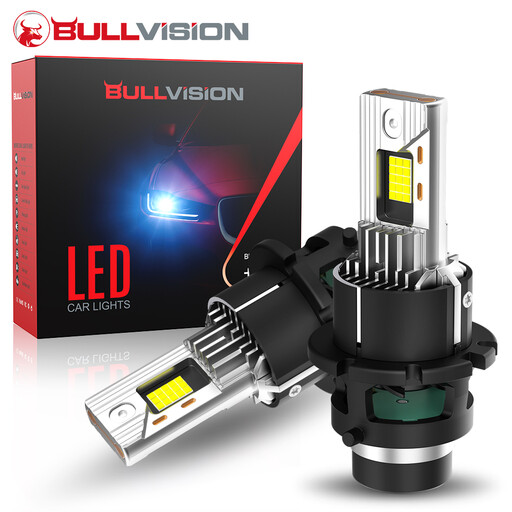
Why it suits this profile: For drivers with a specific D2S/R housing who are considering a technical upgrade with active cooling.
The D2S/R fitting is specifically stated. The claims of 300% more brightness and a 50,000-hour lifespan come from the brand’s description and shouldn’t be considered separately from your headlight.
Set of two, 6000K, integrated fan, aluminium housing, stated IP68 rating and CANbus-ready design.

Why it suits this profile: For adding RGB ambient lighting to your car’s dashboard, doors and footwells, with app control.
The set runs on 12V and includes multiple controllers. Test everything before final installation, avoid sharply bending the fibre and keep the wiring away from pedals and moving parts.
RGB Smart IC, Bluetooth app, music mode, 12V connection and six flexible acrylic strips with a stated length of 175 inches.
We’ve put together a complete, up-to-date list of products that meet these strict selection criteria and the applicable European safety regulations.
That depends on the bulb, the lighting function, the headlight housing and approval for your vehicle. A bulb that fits technically isn’t automatically permitted on public roads. Check the product documentation and the applicable vehicle regulations. According to its product information, the OSRAM W5W is offered with road approval for specific 12V functions; this doesn’t automatically apply to other LED bulbs.
Lifespan varies by product and conditions of use. Some product descriptions state 50,000 or 60,000 hours, but heat, moisture, voltage fluctuations and limited ventilation can all affect lifespan. Treat these figures as stated product specifications, not as a fixed guarantee.
LEDs generally use little power, but total consumption depends on the number of strips and controllers, as well as the brightness setting. An RGB set with multiple light points may use more power than a single T10 bulb. Connect the set to the specified 12V power supply and switch the lights off if the car is parked for an extended period.
