
Vandaag of morgen in huis

Kwaliteit gegarandeerd

Welkomstaanbiedingen ontgrendelen: GRATIS bezorging | Tot 80% korting | Gratis 30 dagen JoyPlus-proefperiode
Download de app
LED car lighting can give your vehicle a modern look and, in some situations, offer a different light distribution than halogen or xenon lights. However, simply ordering a set of LED headlight bulbs for your car isn't a good idea. The fitting, headlight housing, onboard computer and legal approval all need to be compatible.
In this buying guide, you'll find out what to check before buying LED car bulbs, which marketing claims to take with a pinch of salt, and which type of lighting suits different users.
A bulb with an H7, H4 or H11 fitting may physically fit the socket, but that doesn't automatically mean the bulb is suitable for your car. The available space behind the bulb, the dust cover, polarity and the shape of the reflector all play a part.
So first, check:
Brands often quote percentages such as 300%, 500% or 600% more light. According to the product descriptions from the brands themselves, these are stated values under their own measurement or comparison method. They can't simply be translated into the actual light output on the road.
Light distribution is at least as important. A poorly positioned LED chip can cause an uneven beam pattern, dark spots or glare for oncoming traffic. Have your headlights checked and realigned after installation.
A plug-and-play LED bulb usually requires no modification to the wiring. However, your car may still show an error message if the power consumption differs from the original bulb. Volkswagen, BMW, Mercedes-Benz and other European models in particular can be sensitive to this.
A CANbus LED bulb can help reduce error messages or flickering, but "CANbus-ready" is no guarantee for every car. Check the product information and allow for an additional decoder.
The fitting determines whether the bulb physically connects. Common types include:
A fitting number on the bulb itself isn't always enough. Consult your car's manual or check the original bulb.
A value around 6000K white car lighting gives a cool, white impression. 6500K generally looks even cooler. However, colour temperature doesn't automatically tell you anything about light intensity, beam pattern or legal suitability.
For interior and number plate lighting, there are also T10, W5W and 194 fittings. According to the product information for some models, a blue or ice-blue bulb is intended for decoration and not for main lighting.
LEDs generate heat at the rear. So pay attention to:
A stated lifespan of 50,000 or 60,000 hours is a product specification from the brand, not a guaranteed service life in every car. Temperature, vibration, moisture and charging voltage all affect lifespan.
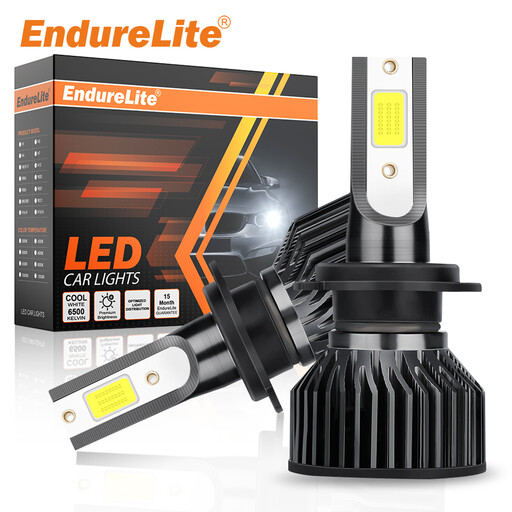
Why this fits the profile: A practical option for anyone looking for an H7 bulb with a 6000K colour and installation without complicated modifications.
The product description states the H7 fitting, plug-and-play installation and a built-in cooling system. Do check yourself whether your vehicle uses H7.
6000K colour, aluminium housing, fan cooling and supplied as a pair according to the product information.
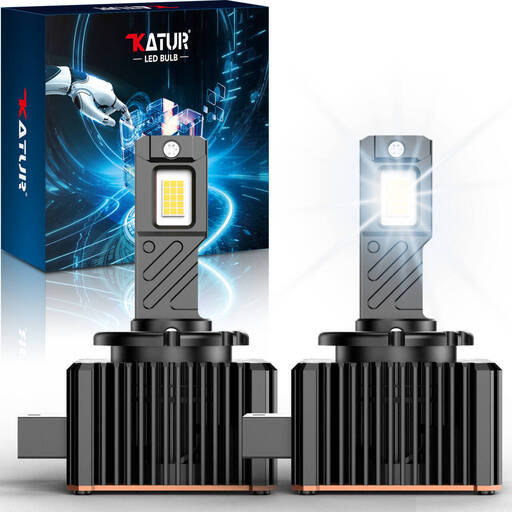
Why this fits the profile: Aimed at drivers with an existing HID headlight unit who want to switch to a white LED solution.
The product description explicitly states that this bulb is only intended as a replacement within an HID assembly, not for a halogen or LED unit.
D3S/D3R fitting, 6500K colour, built-in fan and a 1:1 design according to the product specifications.
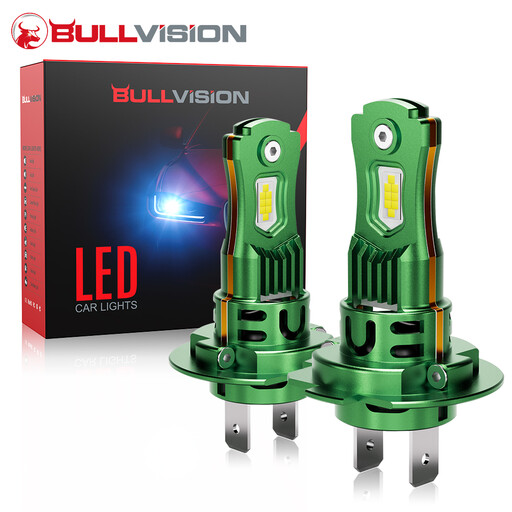
Why this fits the profile: Suitable for motorists specifically looking for LED fog lights and who want to check the correct fitting in advance.
The product information mentions H8, H9 and H11, but also warns that a CANbus decoder may be needed for certain European vehicles.
12V specification, 6000K colour, 1:1 size, IP68 rating and supplied as a pair according to the product description.

Why this fits the profile: For Golf owners looking for a complete set of LED tail lights rather than individual LED bulbs.
The stated compatibility is limited to the mentioned Golf generations, body style and variants. Estate, Alltrack and 3-door models are not a match according to the product information.
Complete set with tail light, brake light, indicator, reverse light and DRL functions according to the product description.
Switch off the lights, let old bulbs cool down completely and disconnect the battery if necessary. Do not touch LED chips and check after installation:
Not every LED retrofit is automatically permitted in every headlight unit. Check the type approval, E-mark, vehicle documentation and current MOT and RDW information. If in doubt, have the installation and check carried out by a garage. Only use LED tail lights and headlights in the way they were designed.
We've put together a full, up-to-date list of products that fully meet these strict selection criteria and current European safety regulations.
That depends on the bulb, the headlight unit and the type approval. A fitting that technically fits is not enough. Check the E-mark, vehicle documentation and current MOT information. An incorrect beam pattern can also cause glare.
Brands often state a lifespan of 50,000 to 60,000 hours. According to the product descriptions, these are stated specifications. In practice, heat, moisture, vibration, charging voltage and usage conditions all play a role. Good cooling helps, but doesn't guarantee a specific service life.
Not always. Some cars accept the lower power consumption of LED bulbs without any problem; others show an error message or cause the bulb to flicker. If you have a sensitive onboard computer, choose a model with CANbus support and check in advance whether an external decoder is needed.
