
Vandaag of morgen in huis

Kwaliteit gegarandeerd

Welkomstaanbiedingen ontgrendelen: GRATIS bezorging | Tot 80% korting | Gratis 30 dagen JoyPlus-proefperiode
Download de app
A set of LED car interior lighting can give the interior of a passenger car, SUV, van or pick-up its own distinctive look. However, not every set is equally easy to install or suitable for every vehicle. A long light strip, a wide range of colours and an app may sound appealing, but they do not automatically tell you anything about installation, power supply or durability.
So pay particular attention to these three common pitfalls:
Many RGB car lights for passenger cars use 12V DC. This usually connects to an accessory socket or a suitable ACC circuit. A product designed for 12V should not be connected directly to a 24V system. This is particularly relevant for some commercial vehicles, buses and heavy-duty vehicles.
According to the product information, the Dreamcolor kits in this selection are intended for vehicles with a 12V system. The manufacturer states that using them above the specified voltage may damage components. So check your vehicle’s voltage and the manufacturer’s instructions before installation.
A fibre optic LED strip or acrylic light strip distributes light through a transparent strip. The Dreamcolor models use an acrylic light guide. According to the product description, it is approximately 11.7 mm wide and designed to be fitted into the seams of dashboards, door panels and centre consoles.
Pay attention to the following points:
A strip that is too short will create gaps in the design. A strip that is too long may be difficult to conceal neatly.
If you regularly change colours or effects, wireless app control is more useful than a simple remote control alone. The Dreamcolor kits mentioned use Bluetooth and, according to their product description, support an app for iOS and Android. Possible functions include fixed colours, colour changes, dynamic patterns and a sound-sensitive mode.
Zonal control is another consideration. With dual-zone control, for example, the dashboard strip and the lighting in the footwell or door pockets can be adjusted separately. This is useful if you want to combine a calm colour on the dashboard with a different effect in the doors.
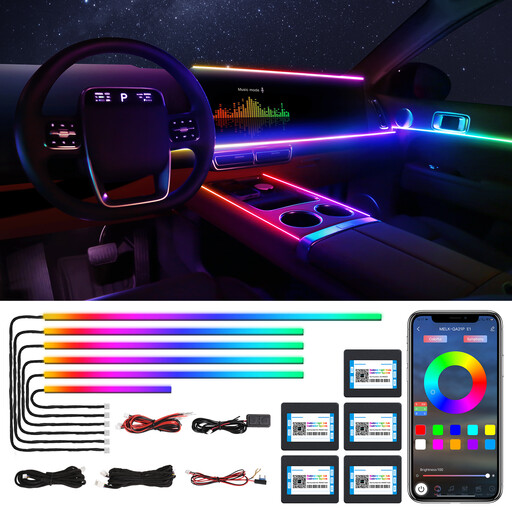
Why it suits this profile: This kit provides a complete starting point for drivers who want to install dashboard and door lighting themselves. App and touch-button controls offer more flexibility than a standalone light strip without a controller.
The product information specifies a 12V connection, Bluetooth app control and guidance on testing and cutting. Check the indicated cutting points and the available space in your own car.
According to the product description: 593 LEDs, dynamic colour patterns, sound-sensitive mode and a total length of 175 inches.
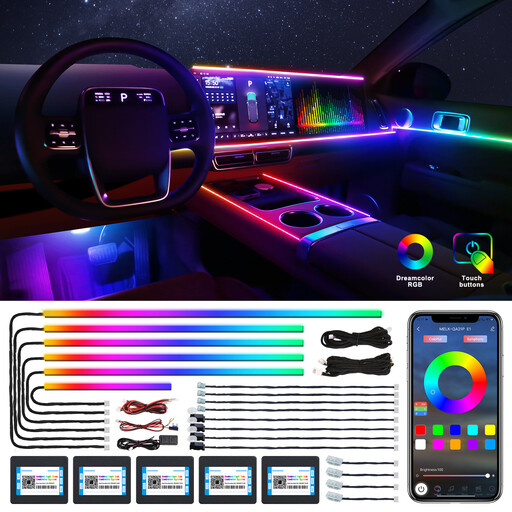
Why it suits this profile: This comprehensive kit is designed for anyone who wants to illuminate several areas of the interior: the dashboard, footwell, door handles and door pockets.
The kit uses a main controller and sub-controllers. According to the product description, zones can be controlled separately, so you do not have to use the same lighting effect everywhere.
According to the product details: 593 LEDs, four control channels, RGB effects, music mode and two colour zones that can be adjusted simultaneously.
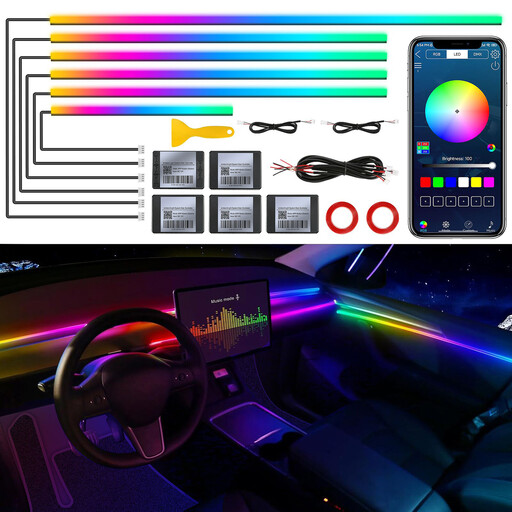
Why it suits this profile: This version is ideal for car audio and tuning enthusiasts who want to combine dynamic RGB lighting with a visible rhythm effect inside the vehicle.
The product information explicitly mentions a built-in sound-sensitive function and warns against sharply folding the light guide. This makes planning and testing in advance particularly important.
According to the manufacturer: 593 LEDs, dynamic chase effects, app control for iOS and Android, and support for fixed colours and music-controlled LED lighting.
Make a simple plan before installation. Decide where the main controller will go, where the 12V power supply will be connected and how the cables will be kept out of sight. First, lay the light strip loosely along the dashboard and door panels. This lets you check that the length is right before using adhesive or fixings.
Also take the following into account:
Installing lighting in a car requires more care than a standard LED car interior strip intended for home use. According to the product information, the Philips Hue Essential LED Strip is designed for indoor use in the home. Do not use it as a direct replacement for 12V car lighting.
We have put together a complete, up-to-date list of products that fully meet these strict selection criteria and the applicable European safety regulations.
Many universal kits can be installed yourself, as long as you follow the instructions and use the correct 12V connection. Test all components first. Extra care is needed when installing lighting behind door or dashboard panels because of cables, airbags and moving parts. If in doubt, professional installation is the safer option.
Service life depends on heat, moisture, vibration, connection quality and how often the lighting is used. A stated service life is not provided for every model. So pay particular attention to the voltage, mounting and protection against moisture. Do not use the strip outside the conditions described by the manufacturer.
Power consumption varies depending on the number of LEDs, brightness and selected effect. RGB lighting at maximum brightness generally uses more power than a dimmed fixed colour. Ideally, connect the kit to a switched 12V source so that the lighting does not remain active when the car is switched off. This helps minimise unnecessary drain on the battery.
