
Vandaag of morgen in huis

Kwaliteit gegarandeerd

Welkomstaanbiedingen ontgrendelen: GRATIS bezorging | Tot 80% korting | Gratis 30 dagen JoyPlus-proefperiode
Download de app
With LED car interior lighting, you can give the interior of a car, SUV, van or truck a whole new look. Choose from RGB lighting along the dashboard, footwell lighting or an LED bulb to replace the original interior light.
However, not every system is suitable for every vehicle. An attractive product photo tells you little about the connection, available space or compatibility with your car’s Canbus system. This buying guide helps you avoid common mistakes and compare products based on verifiable features.
An RGB ambient car lighting kit may be described as suitable for many vehicles, but that does not mean every dashboard or door panel can be accessed just as easily. Therefore, check:
24V trucks and buses often require a suitable voltage converter. Do not connect a 12V kit directly to a 24V system.
Many products are described as RGB LED lighting with music mode. In practice, the controller usually responds to sound picked up by a built-in microphone. According to the product description, this allows the lighting to change colour or pattern in response to music or speech.
The lights are therefore not necessarily connected directly to the radio. Ambient noise can affect the effect. If you mainly want subtle lighting, a fixed colour, dimming function and memory function will be more useful.
A Canbus-free LED car bulb is designed to reduce error messages or flickering. However, sensitivity varies between car models. After installation, always check that the bulb illuminates steadily and that no warning appears on the dashboard.
Some vehicles may still require an additional decoder or resistor despite the product claim. This is particularly worth checking in modern cars with sensitive light-monitoring systems.
First, check the stated voltage range. Most interior kits with an LED strip for cars are designed for 12V direct current. The MAODANER kit specifies a range of 10–16V, while several T10 and W5W bulbs are suitable for 12–24V.
That does not mean every bulb will fit every socket. The fitting, base size and available space remain decisive.
There are broadly two types of LED car interior lighting:
Acrylic strips spread light along a longer line. According to the product information, light fibres should not be folded double or bent too sharply, as this can reduce light transmission through the fibre. Measure the route before cutting.
For car footwell lighting or dashboard lighting, an even, non-dazzling distribution is practical. For a roof light or map-reading light, the fitting is more important than the number of colour modes.
Bear in mind that stated lumen values come from the manufacturer’s or seller’s product information. They are not necessarily directly comparable between different bulb designs. A blue, red or amber bulb may also appear different from a white bulb with the same stated luminous flux.
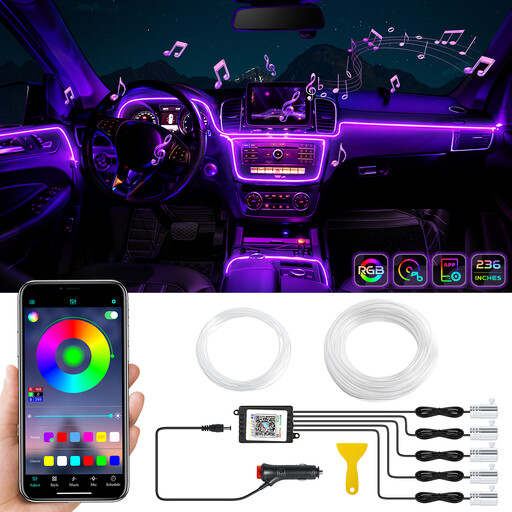
Why it suits this profile: An accessible choice for anyone who wants to install a colourful light line along the dashboard or door panels themselves.
The kit specifies a 12V connection, Bluetooth app control and a trim tool included in the box. Testing before installation is still important.
236-inch optical fibre, 29 preset modes according to the product description, and control via an iOS or Android app.

Why it suits this profile: For car owners who want to illuminate several zones and value an even light line.
The kit has a main controller and sub-controllers for multiple zones. However, check the available installation space in the doors beforehand.
Acrylic light strip, footwell lighting and door lighting; Bluetooth app, RGB Smart IC and dual-zone control according to the product information.
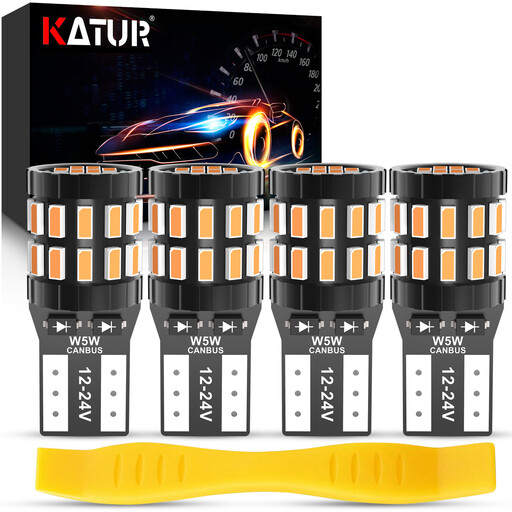
Why it suits this profile: Suitable for anyone who wants to replace an existing T10 or W5W bulb without installing a complete RGB system.
The product information specifies a 12–24V range and Canbus support, but also recommends checking the original fitting and operation after installation.
Four bulbs, 3W per bulb, amber colour and a stated luminous flux of 450 lumens per bulb.
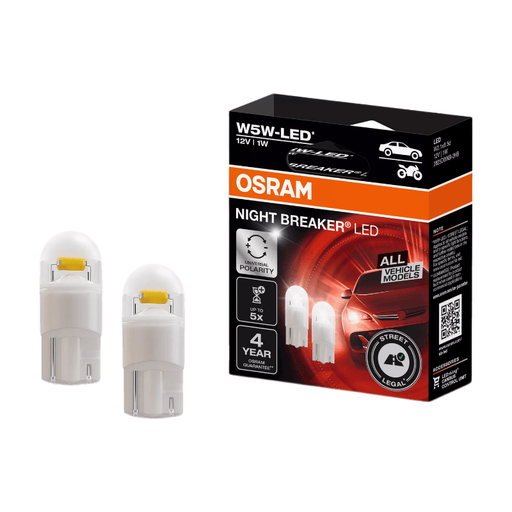
Why it suits this profile: For anyone looking for a white T10/W5W replacement for interior, parking, position or number plate lighting.
The stated application is limited to specific 12V functions. This makes checking easier than with a general claim covering all vehicle lighting.
12V, 5700K, 50 lumens, universal polarity and a two-bulb pack according to the product description.
We have put together a complete, up-to-date list of products that fully meet these strict selection criteria and the applicable European safety regulations.
Do not use lighting in a way that dazzles drivers or other road users. Decorative interior lighting is primarily intended for use where the driver’s visibility and ability to operate the vehicle are not obstructed.
First, check the voltage and fitting. For replacement bulbs, look for the correct type, such as T10, W5W, 501 or 194. For RGB strips, a 12V connection, sufficient installation space and a safe cable route are the most important considerations.
Lifespan varies depending on the product, heat dissipation, operating time and electrical installation. Manufacturers may state a long lifespan, for example, but this is a product specification rather than a guarantee for every car. Good ventilation, the correct voltage and proper installation help to prevent unnecessary strain.
LED lighting generally uses little power, but consumption depends on the number of bulbs, brightness and chosen effects. A compact T10 bulb rated at a few watts will usually use less power than a complete set with several strips, controllers and footwell or door lighting. Therefore, check the stated wattage if the lighting will be used for extended periods.
