
Vandaag of morgen in huis

Kwaliteit gegarandeerd

Welkomstaanbiedingen ontgrendelen: GRATIS bezorging | Tot 80% korting | Gratis 30 dagen JoyPlus-proefperiode
Download de app
LED car interior lighting makes the interior of a car, SUV or van feel more personal. RGB ambient car lighting with app control, music synchronisation and lighting for the dashboard, doors and footwell is particularly popular with tuners and DIY enthusiasts.
However, a cheap or poorly chosen kit can quickly disappoint. Three problems come up time and again:
So do not focus solely on the number of colours. Check the technical specifications first, along with how the kit connects to your car.
Most kits for 12V car lighting are designed to connect to a vehicle’s 12V power supply. Before installation, check that the kit’s voltage matches the connection in your car. Excessive voltage can damage components, while insufficient voltage can reduce brightness and affect music synchronisation.
A plug-and-play connection via the 12V socket is a straightforward option. Kits with a central controller and subcontrollers often offer more possibilities for dashboard, door and footwell lighting, but they do require tidier cable management.
An LED car interior strip needs to be installable at the right length. Acrylic and fibre-optic-style strips are suitable for narrow gaps along the dashboard or door panels, but must not be folded sharply. According to the Dreamcolor kit product descriptions, you should only cut at the designated points and leave extra length around the resistors.
Also check:
A fibre-optic LED car strip can provide an even line of light, but the result depends on the positioning of the LEDs and how the fibre is connected. With an acrylic strip, the product description states that the light is distributed along the strip. This is a product specification, not a guarantee that every car will produce the same result.
If you are looking for Bluetooth LED car lighting, check which app is required. The product information mentions “LED LAMP”, “Magic Lantern”, “Lotus Lantern” and “LotusLamp X”, among others. Only download the app after checking the QR code and compatibility on the product page.
Look out for these features:
Music synchronisation responds to sounds picked up by the sensor. According to the product descriptions, this may include music or speech. The effect therefore depends on volume, the controller’s position and ambient noise. Use lighting effects in a way that does not obstruct your vision or distract you while driving. Neon car lighting is intended for the interior and must not cause confusion with mandatory vehicle lighting.
The recommendations below are based on verifiable information from the product descriptions, such as the number of components, power supply voltage, controls and included light modules.
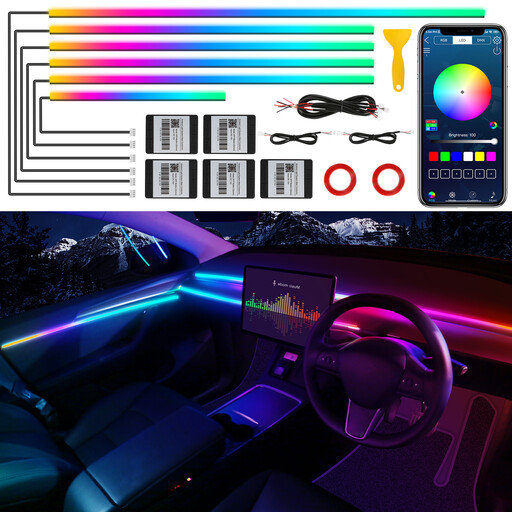
Why it suits this profile: This kit combines dashboard and footwell lighting with Bluetooth control via the “LED LAMP” app mentioned. It is suitable for anyone who wants to get started with RGB lighting without making extensive modifications.
The product description lists six strips, four footwell lights, one main controller and four subcontrollers. This makes it clearer in advance which components are available for different zones and cable routing.
12V connection, music mode, static colours and a stated Bluetooth range of 0–10 metres.
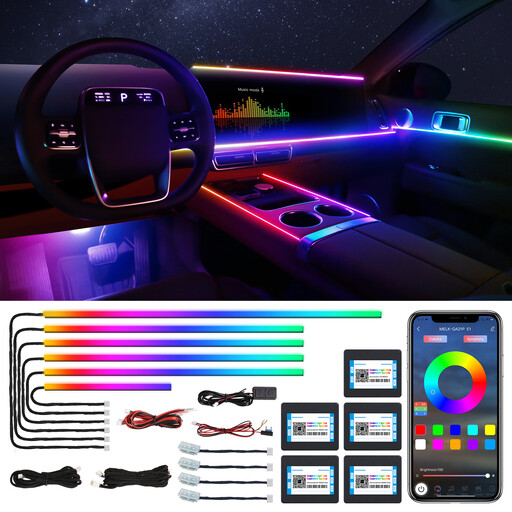
Why it suits this profile: This version is designed for a comprehensive interior setup covering the dashboard, footwell, door handles and door pockets. It is well suited to tuners who want to configure multiple zones separately.
The kit lists not only a long main strip, but also four footwell lights, four door-handle lights and four door-pocket lights. However, check beforehand that your door panels have enough space for this installation.
593 stated LEDs, 12V, two colour zones and support for static and dynamic modes.
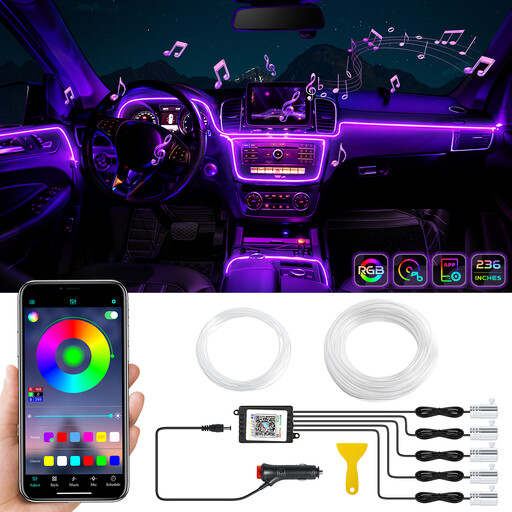
Why it suits this profile: According to the product information, the kit has a 6-metre fibre-optic line, five LEDs and Bluetooth control via the “Lotus Lantern” app. This is practical for creating a bespoke setup along several dashboard or door sections.
The description explains that the fibre can be divided into three to five sections and should only be connected at suitable points. This allows you to adjust the length, provided you do not kink the fibre.
6 metres of fibre, 29 preset modes according to the product description, music function and app control for brightness and speed.
We have put together a complete, up-to-date list of products that fully meet these strict selection criteria and the applicable European safety regulations.
Test the LED car interior lighting before securing the strips permanently. Clean and dry the installation area, keep cables away from the pedals, steering mechanism and moving seats, and check that the doors close without resistance.
A practical order of installation:
Only use the supplied tape on clean, flat surfaces. Extra fixing may be needed on fabric, rough plastics or sharply curved gaps.
That depends on how it is used and where it is installed. Interior lighting must not obstruct your view or be confused with mandatory or signalling vehicle lighting. Check the current traffic regulations and switch off striking effects if they distract you while driving.
Its lifespan depends on voltage, heat, moisture, vibrations and installation quality. A correct 12V connection, adequate protection and avoiding sharp bends can help prevent damage. Manufacturer lifespan claims are not a guarantee for every car or usage situation.
Power consumption varies according to the length, number of LEDs, brightness and selected effect. A short strip will generally use less power than a complete kit with door and footwell lights. Check the product page for the stated electrical specifications, and do not leave the lighting switched on unnecessarily when the engine is off.
