
Vandaag of morgen in huis

Kwaliteit gegarandeerd

Welkomstaanbiedingen ontgrendelen: GRATIS bezorging | Tot 80% korting | Gratis 30 dagen JoyPlus-proefperiode
Download de app
Driving in the dark with dim halogen headlights feels unsafe. You only see road markings and traffic signs at the last second. That's why many car owners consider upgrading to LED headlights. The promise is brighter visibility and a modern look, but the reality is often more challenging.
Before you decide to buy LED bulbs for your car, it's crucial to understand the common pitfalls. Many drivers fall for marketing claims and end up with bulbs that don't fit, cause error messages, or blind oncoming traffic. These are the points to watch out for to avoid a bad purchase.
To bypass these problems, there are a few technical specifications you need to check. By paying attention to these details, you ensure you choose a set that is a genuine improvement.
The first step is to check the correct fitment for your car. Popular types include H1 LED, HB3 LED (also known as 9005 LED), and HIR2 LED (also known as 9012 LED). You can find the correct fitment in your car's owner's manual or by inspecting the old bulb.
Next, opt for a bulb with a 1:1 mini design. This means the dimensions of the LED bulb are identical to those of the original halogen bulb. This guarantees that the bulb will fit into the housing without any modifications and that the dust cover can be reinstalled. This is the true definition of plug-and-play.
If you have a car made after roughly 2005, it likely has a CAN bus system. To prevent error messages, you need a CAN bus proof LED kit. These bulbs have a built-in resistor or an external decoder that simulates the power consumption of a halogen bulb, so the car's computer system isn't confused. Look for kits that explicitly state "98% or 99% CAN bus ready," indicating they work for most vehicles.
The colour of the light is expressed in Kelvin (K). Standard halogen bulbs have a yellowish colour of around 3200K. Most LED headlights have a colour temperature of 6000K. This results in a bright, white light often described as xenon-look lighting. This not only improves contrast and visibility in the dark but also gives your car a more modern appearance.
A good beam pattern is just as important. The LED chips must be positioned to mimic the filament of a halogen bulb. This ensures a sharp light beam that illuminates the road where it's needed, without the glare that can hinder oncoming drivers.
Based on these criteria, we have selected a few options that suit different user profiles.
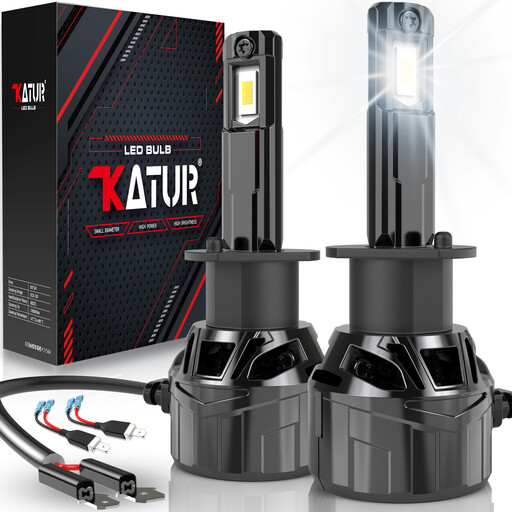
Why it fits this profile: Perfect for those who want to replace their car's lighting themselves but have limited technical space. The compact, driverless design makes installation as simple as changing a standard halogen bulb.
The 1:1 mini design is identical to an H1 halogen bulb, ensuring the dust cover always fits. The built-in CAN bus decoder is designed to prevent error messages on 99% of vehicles.
No external driver or cables needed, which significantly simplifies installation. The powerful cooling fan (16,000 RPM) ensures stable operation and a long lifespan.

Why it fits this profile: For those seeking maximum visibility and a powerful upgrade. The high specifications (120W, 30000LM per pair according to the manufacturer) offer a significant improvement for the low beam LED, ideal for drives on unlit roads.
Despite the high output, this is an HIR2 LED with a 1:1 design, which prevents installation issues. The advanced cooling system with copper heat pipes and a turbofan is designed to keep the high performance stable.
The combination of high light output and an efficient cooling system ensures a durable and noticeable improvement in night vision. The 6000K colour temperature provides a bright white, modern look.
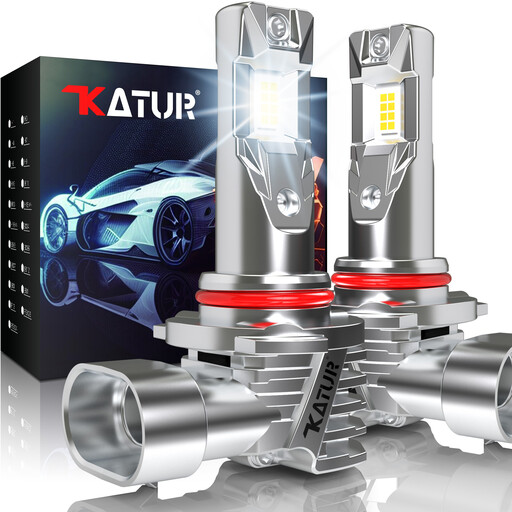
Why it fits this profile: For the driver who wants a "set-it-and-forget-it" solution. The fanless design eliminates the risk of a faulty fan, the most common point of failure in LED headlights.
The fanless design is not only quieter but also more reliable in the long run. The compact HB3 9005 size ensures a hassle-free installation without any modifications.
Maximum reliability due to the absence of moving parts. Heat is passively dissipated through the aluminium housing, ensuring a long and stable lifespan.
We have compiled a complete, up-to-date list of products that meet these strict selection criteria and local regulations.
Yes, the use of LED headlights is generally permitted. However, for safety inspections, it is crucial that the bulbs produce a correct beam pattern and do not blind oncoming traffic. Aftermarket LED bulbs installed in a headlamp unit originally designed for halogen must accurately replicate the original light pattern. Always have the headlights checked and correctly aligned at a garage after installation.
LED bulbs have a significantly longer lifespan than halogen bulbs. Manufacturers often state a lifespan of 30,000 to 60,000 operating hours. In practice, this means that with normal use, the bulbs can last for many years, often outlasting the car itself. The quality of the cooling system (active with a fan or passive) is a decisive factor here.
This is a real risk with modern cars that have a CAN bus system. This system measures the resistance of the bulbs and can generate an error code due to the low power consumption of LEDs. To prevent this, it is advisable to specifically look for CAN bus proof LED bulbs. These kits have a built-in solution to allow the car's system to function correctly.
