
Vandaag of morgen in huis

Kwaliteit gegarandeerd

Welkomstaanbiedingen ontgrendelen: GRATIS bezorging | Tot 80% korting | Gratis 30 dagen JoyPlus-proefperiode
Download de app
Want to replace halogen or xenon lighting with LED car bulbs? At first glance, the choice seems simple: find the fitting, order the bulbs and install them. In practice, problems are often caused by the wrong fitting, insufficient space behind the headlamp or a warning message on the dashboard.
High lumen claims also deserve a critical look. A large number on the packaging does not automatically mean that the beam pattern is suitable for your headlamp housing. Always check the technical specifications and the regulations applying to your vehicle first.
H4, H7, H8, H9, H11, 9005/HB3 and 9006/HB4 are not interchangeable designations. They refer to different fittings and applications. For example, an H7 bulb will not simply fit an H4 socket.
Check the existing bulb, your car’s manual or a reliable vehicle catalogue. Also pay attention to the difference between dipped beam, main beam and fog lamps. With xenon lighting, you should also check whether a D1S-, D2S- or D4S/R connection is suitable for an LED replacement.
A plug-and-play car bulb usually uses the existing connector. However, there may be very little space behind the bulb for a driver, cooling fan or heat sink. So check the total length and diameter, not just the fitting.
In some cars, the CANbus system monitors the lighting’s current draw. This can lead to a warning message, flickering or radio interference after installation. CANbus error-free LED bulbs can help reduce the likelihood of this happening, but “compatible with 99% of vehicles” is a manufacturer’s claim, not a guarantee for every version. According to the manufacturer’s product description, sensitive models may still require a decoder.
LEDs do not convert all electrical energy into light; heat needs to be dissipated. That is why many LED bulbs with cooling fans use an aluminium housing and a small fan. This can provide effective heat dissipation, but check that the fan can rotate freely and that the noise level is acceptable to you.
A bulb without a fan may be quieter, but it will need a different cooling design. Look at the material, dimensions and stated IP rating. An IP68 rating in the product description indicates a certain level of protection against water and dust, but it does not mean that every installation location will remain trouble-free in all conditions.
The fitting is the first selection criterion. Common options include:
Always check that the bulb is intended for the position you want to use it in. A product title may mention several applications, while practical suitability depends on your car’s headlamp.
6000K cool white gives a bright, white appearance. 6500K generally looks even cooler. However, colour temperature is not the same as light output. Also pay attention to the positioning of the LED chips. A 1:1 design aims to replicate the position of the original filament or light source. This can help retain the existing beam pattern more effectively.
Check the headlamp alignment after installation. A bulb that fits physically can still produce an incorrect beam pattern. Dazzling oncoming drivers must be avoided. Also check whether the LED bulb you have chosen is permitted under the applicable Dutch regulations and vehicle documentation for use on public roads and during the APK roadworthiness test.
Product descriptions sometimes state 50,000 or 70,000 operating hours. These are manufacturer-provided figures; the actual lifespan depends on factors including temperature, voltage, vibration and operating time. So do not compare lifespan claims alone. Also consider:
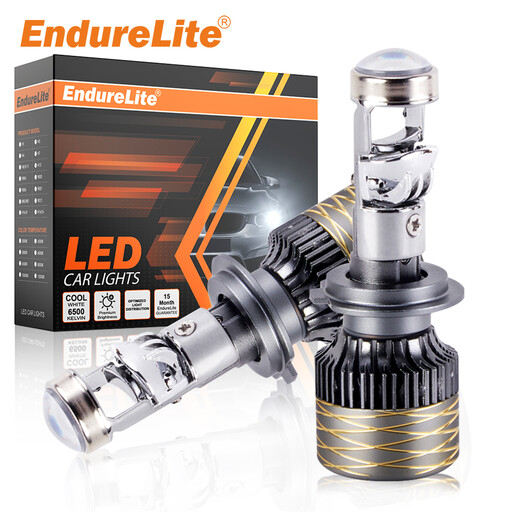
Why it suits this profile: For anyone looking for an H7 replacement that is easy to install and provides a neutral, cool-white light colour. The set contains two bulbs.
The product description states that it has a 1:1 design, built-in cooling and a CANbus-ready driver. However, check the H7 fitting and available space yourself.
6000K cool white, plug-and-play according to the product description, aluminium housing, IP68 rating and a stated lifespan of 50,000 hours.
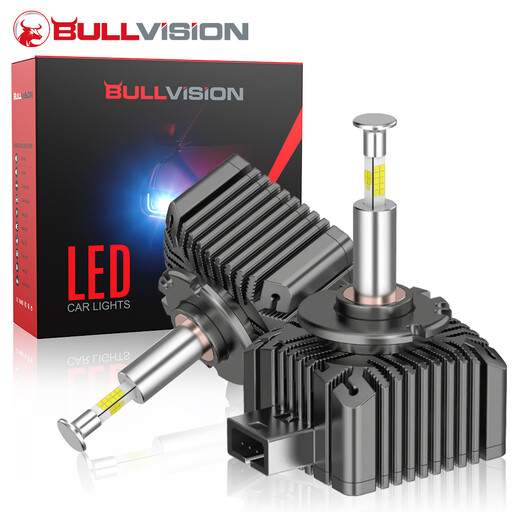
Why it suits this profile: An option for motorists with a suitable D4S/R connection who value a robust aluminium housing and integrated heat dissipation.
The fitting is clearly listed as D4S/R, and the product description mentions a built-in driver and CANbus-ready design. Compatibility must be checked for each car.
120W and 25,000 lumens per product according to the product data, 6000K cool white, fan cooling, a water-resistant design and a set of two.

Why it suits this profile: Designed for drivers looking for a 9005/HB3 bulb for regular night-time driving or intensive use, with an emphasis on active cooling.
The product data mentions a turbo fan, 1:1 design and built-in driver. Before buying, check whether your vehicle requires an additional CANbus decoder.
6500K white, CSP LED chips according to the product description, turbo fan, no flickering according to the manufacturer’s claim and a stated lifespan of 50,000 hours.
Switch off the lights and ignition before you begin. Allow old bulbs to cool down and avoid touching the glass or LED chips unnecessarily. With bulbs that have a fan, check that the dust cap still closes properly and that there is enough clearance.
After installation, test:
Correct installation does not replace checking the headlamp alignment. If necessary, have it checked at a garage.
We have put together a complete, up-to-date list of products that fully meet these strict selection criteria and the applicable European safety regulations.
LED lighting can use less electrical energy than halogen for a comparable lighting function, but actual consumption varies by model. Check the stated wattage and compare it with the original bulb. The purchase price, installation and any CANbus decoder all contribute to the total cost.
Manufacturers often state a lifespan of 50,000 hours or more. According to the brands’ own information, these are stated values under specific conditions. Heat, vibration, moisture, voltage fluctuations and the use of a fan affect real-world performance. Treat the lifespan claim as a product specification, not a guaranteed service life.
No, it depends on the vehicle. Some CANbus error-free LED bulbs work without an additional module, while sensitive vehicle electronics may still display a warning message. Check vehicle compatibility, the fitting and the manufacturer’s instructions before ordering.
