
Vandaag of morgen in huis

Kwaliteit gegarandeerd

Welkomstaanbiedingen ontgrendelen: GRATIS bezorging | Tot 80% korting | Gratis 30 dagen JoyPlus-proefperiode
Download de app
Are your current halogen bulbs looking dim and yellow? You're not alone. Many car owners are looking for an upgrade to improve visibility in the dark and achieve a more modern look. Switching to LED car bulbs seems like a logical choice, but the range of options can be overwhelming. Which fitting do you need? What is Canbus? And how do you choose a bulb that performs well without blinding oncoming traffic?
As a Joybuy Product Recommendation Officer, I'll guide you through the specifications. In this article, we'll look at the most important factors to consider and highlight some popular choices, so you can make an informed decision for your vehicle.
Before you add any bulbs to your cart, it's wise to check a few technical aspects. This will prevent disappointment and ensure you choose the right products.
Not every bulb fits every car. The fitting is the foundation of your choice. Check your car's owner's manual or the old bulb itself to find the correct code. Some common types include:
Modern cars use a Canbus (Controller Area Network) system to monitor the status of various components, including the lighting. Because LED bulbs consume significantly less power than halogen bulbs, the system might think a bulb is broken. This results in an error message on your dashboard.
Therefore, opt for Canbus error-free car lighting. These bulbs have a built-in resistor that mimics the power consumption of a traditional bulb, preventing error messages.
The performance of an LED bulb is expressed in lumens (light output) and Kelvin (colour temperature). A popular choice is 6000K white, which provides a bright, daylight-like light and gives your car a modern appearance.
However, don't just focus on brightness. A well-designed LED bulb mimics the filament of a halogen bulb. This ensures a correct and sharp beam pattern, illuminating the road properly without dazzling oncoming drivers. A plug-and-play design that follows the dimensions of the original bulb often helps with this.
Based on product specifications and functionalities, we have highlighted a few interesting options for you.
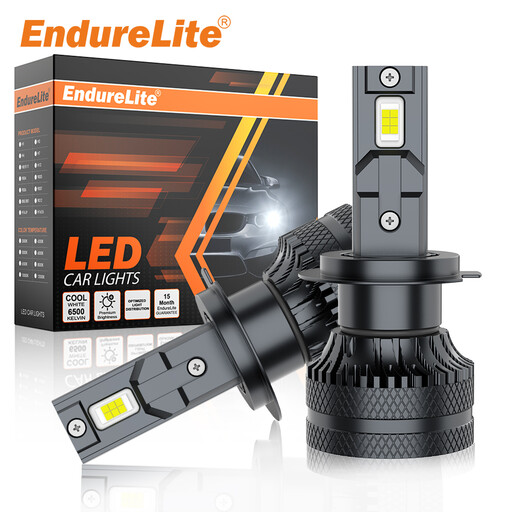
Why it stands out: This set is designed as a direct replacement for H4 halogen bulbs. The 1:1 design and built-in Canbus technology make installation simple and error-free for most vehicles.
Advantages:
Who is this for? For car owners seeking a direct, error-free, and powerful replacement for their H4 halogen headlights, with a focus on ease of installation.
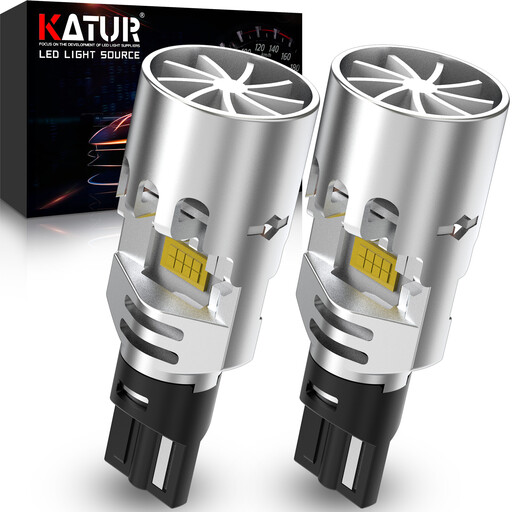
Why it stands out: These W16W T15 reverse light bulbs are specifically designed for maximum brightness. The inclusion of an active cooling fan in such a compact bulb is uncommon and aimed at longevity.
Advantages:
Who is this for? For drivers who want maximum visibility and safety when reversing or manoeuvring in the dark.
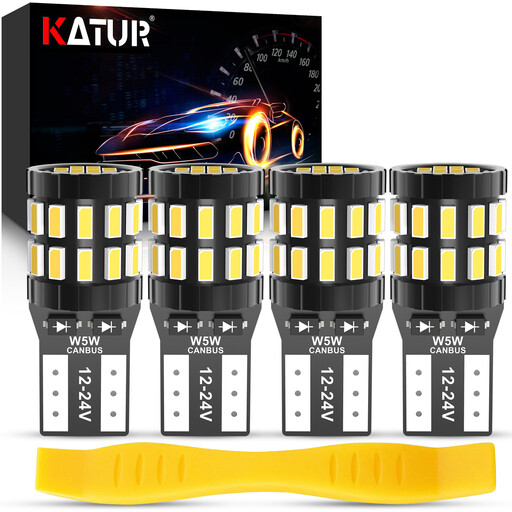
Why it stands out: This set of four T10 W5W LED bulbs is a versatile solution for various small lighting points in and around the car. The 360-degree illumination ensures even light distribution.
Advantages:
Who is this for? For the DIY enthusiast who wants to modernise multiple lighting points on their car at once with bright, white light.
Every car and every driver has different needs. The products mentioned above are just a sample of the possibilities. If you're looking for a different fitting or specific features, it's worth exploring further.
Check out our full range of Canbus car lighting for more options that suit your vehicle.
In many regions, including the EU, headlights must have an E-mark certification for the specific car model in which they are used. Many aftermarket LED kits do not (yet) have this for every car, making their use on public roads officially not permitted. Different rules apply to interior lighting, license plate lighting, or lighting used on private property. Always check the current regulations with your local transport authority before replacing headlights.
This means the LED bulb has a built-in resistor or circuit that simulates the power consumption of a traditional halogen bulb. This makes your car's on-board computer 'think' a working bulb is installed, so you won't get an error message on your dashboard.
For many bulbs, such as the T10 W5W LED or W16W T15 reverse light, installation is often a matter of pulling out the old bulb and plugging in the new one (plug and play). For headlights like the H4 LED headlight, it can be slightly more complex, depending on the space behind the headlight unit. After installing headlights, it is always recommended to have the beam pattern checked and adjusted at a garage to prevent dazzling oncoming drivers.
