
Vandaag of morgen in huis

Kwaliteit gegarandeerd

Welkomstaanbiedingen ontgrendelen: GRATIS bezorging | Tot 80% korting | Gratis 30 dagen JoyPlus-proefperiode
Download de app
A night light that stays too bright, a motion sensor that switches on unnecessarily during the day or a bathroom mirror that cannot withstand splashes: with LED lighting for the bedroom and bathroom, the most important differences often come down to the details. Marketing copy usually focuses on atmosphere and design, but for everyday use, you should pay particular attention to specifications, positioning and safety.
When shopping, look out for these three common pitfalls:
Looking only at wattage
Watts tell you how much electricity a light uses, but not how much light it produces. For that, you need to look at the light output in lumens. A low wattage can be practical, but check that the light output is suitable for the space too.
Choosing a motion sensor without an ambient light sensor
A night light with a sensor may switch on unnecessarily during the day or when there is already enough ambient light. Check whether the sensor only works in the dark and how far its range extends.
Confusing IP protection with waterproofing
An IP44 bathroom mirror is protected against splashes, but not necessarily against a direct jet of water. Positioning and connection are still important, especially in a damp room.
Colour temperature is measured in kelvins. A warm white night light of around 2800–3200 K usually creates a softer feel in a bedroom, nursery or hallway. Cooler white light of around 5000–5500 K can be more practical in a bathroom, but may feel harsh in a bedroom.
Also check the lumen output:
A dimmable night light gives you more flexibility. Five brightness settings, as found on some rechargeable models, let you adjust the lighting for sleeping, reading or getting around at night.
A night light with a motion sensor is especially useful when you do not want to search for a switch at night. Check:
A rechargeable night light with a USB connection can be placed wherever you need it, as it does not require a fixed socket. Do check the charging time, and only use a compatible charger. Do not open or modify a built-in lithium battery.
In a bathroom, a bathroom mirror with a touch sensor can be practical. When installing it, make sure the wiring remains dry and protected. Touch controls are no substitute for a safe electrical installation.
Measure the available wall space before ordering a mirror. A bathroom wall mirror measuring 80x60 cm needs a sturdy wall and enough room around it. Also check that it will not obstruct cabinet doors, taps or lights.
For a mirror with IP44, the first 4 indicates protection against solid objects larger than 1 millimetre; the second 4 indicates protection against splashes from different directions. According to the product information, this makes the mirror suitable for a damp bathroom environment, but not for direct jets of water.
Also check whether the product comes with an adapter and mounting materials. For wall mounting, the surface must be suitable, and installation must be carried out by an adult.
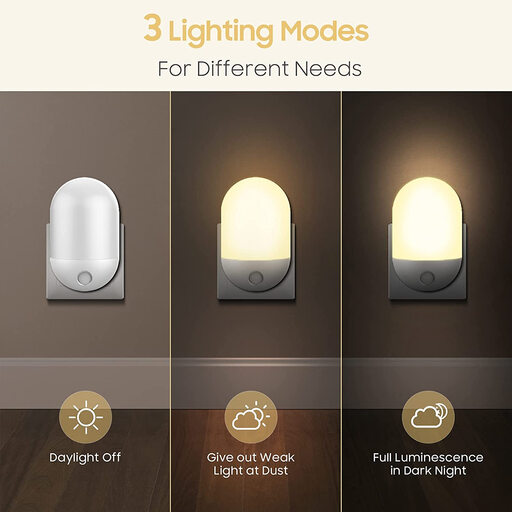
Why it suits this profile: This compact model is designed for a bedroom, nursery or hallway. It uses a light sensor, so there is no need to switch it on and off manually.
The product information specifies a warm colour temperature of 2800–3200 K and a low power rating of 0.5 W. Just check in advance whether 20 lumens will be enough for your chosen spot.
Warm white light, SMD LED, 20 lumens and a compact ABS and metal housing.

Why it suits this profile: A practical choice for households looking to light several areas, such as a bedroom, nursery, staircase or hallway.
According to the product description, the motion sensor works in low light and has a range of 3–5 metres. This makes its operation more targeted than that of a light that stays on continuously.
Three colour temperatures, five dimming settings, 30 lumens and a built-in 500 mAh battery with USB charging.
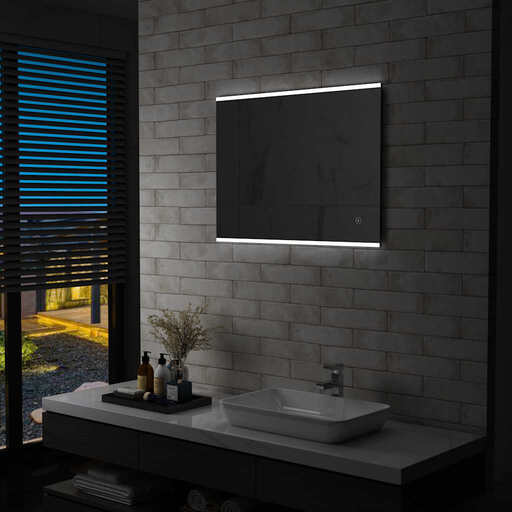
Why it suits this profile: For anyone looking to upgrade their bathroom with a fixed mirror and integrated lighting for everyday grooming.
The specification lists an IP44 rating and makes clear that direct jets of water are not permitted. Check the installation location and ensure the electrical connection is fitted carefully.
80×60 cm, two LED light strips, touch sensor, 6 W power rating and wall mounting with adapter and mounting materials.
We’ve put together a complete, up-to-date list of products that meet these strict selection criteria and the current European safety regulations.
A colour temperature of around 2800–3200 K is often chosen to create a calm lighting atmosphere. Check the brightness too, and position the light so it does not shine directly into your baby’s eyes. Use electrical products in a nursery according to the safety instructions, and do not leave children unsupervised with the device.
Battery life depends on brightness, sensor activity and battery capacity. According to the product description, the 500 mAh model mentioned above provides up to 10 hours of use in sensor mode. Actual results may vary. Regular charging and using a suitable USB charger will help you use the product correctly.
Energy use depends on the wattage and the number of hours the light is on. A 0.5 W light uses around 0.5 Wh when switched on for one hour. A 6 W bathroom mirror uses around 6 Wh in an hour. Multiply this by the number of hours and your electricity tariff to work out the running costs. Actual costs therefore depend on how you use the lights.
