
Vandaag of morgen in huis

Kwaliteit gegarandeerd

Welkomstaanbiedingen ontgrendelen: GRATIS bezorging | Tot 80% korting | Gratis 30 dagen JoyPlus-proefperiode
Download de app
You want to give your car a personal touch. A sleek interior that lights up in your favorite colors, reacts to your music, and sets the mood for every drive. The market for car LED ambient lighting is vast, but it's riddled with pitfalls. Many kits promise the world but only deliver frustration.
As a Joybuy Product Recommendation Officer, I'll filter out the noise for you. No marketing jargon, just practical information. Let's discuss the three most common mistakes that cause car enthusiasts to waste their money, and how you can avoid them.
To prevent these problems, there are a few technical specifications you need to check. These are the factors that truly separate a sleek result from a disappointment.
The technology behind the light strip determines the quality of the light.
An app is convenient, but only if it works well. Look for the following features that ensure a good user experience:
A good kit is designed for a smooth DIY installation. Check if the following components are included:
Based on these criteria, we have selected a number of popular choices that suit different user profiles.
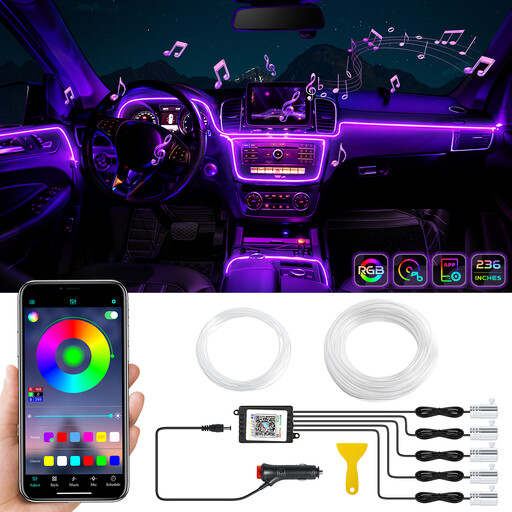
Why This Fits Their Persona: Ideal for those taking their first step into car interior lighting. This 6-in-1 kit focuses on the essential components (dashboard and doors) and is designed for a simple plug-and-play installation via the car's cigarette lighter.
The kit comes with a pry tool and a clear manual, ensuring you don't get stuck with an incomplete set. The fiber optic is designed to work with multiple LEDs, which minimises 'hotspots'.
The set includes a long fiber optic cable (236 inches) that you can cut to size for a perfect fit. Control via the "Lotus Lantern" app gives you access to 29 pre-programmed modes.

Why This Fits Their Persona: For the driver who wants it all. This 22-in-1 kit is one of the most comprehensive sets on the market, with lighting for the dashboard, doors, handles, footwells, storage compartments, and even the speakers.
This kit uses a system with one main controller and four sub-controllers. This ensures stable power and data distribution, keeping the app reliable even with 22 light points. The acrylic strips guarantee uniform brightness.
The Dual-Zone Control is a major advantage here. You can give the main strips (dashboard/doors) a different color or mode than the accent lighting (footwell/handles), all through a single app.
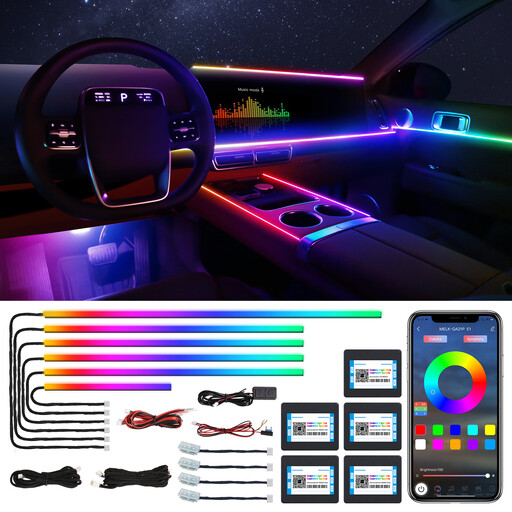
Why This Fits Their Persona: If music takes center stage during your drives, you want lighting that moves perfectly with it. This 18-in-1 kit combines extensive coverage with a focus on dynamic, music-driven effects.
The built-in, sensitive microphone and RGB Smart IC technology ensure responsive synchronisation. The lights truly 'dance' to the music, instead of flashing randomly like cheaper systems.
The 'Dynamic Chasing' mode, combined with the music sensor, creates a visual experience that enhances the mood of your music. With 18 pieces, the kit is very complete for a full interior makeover.
We've compiled a complete, up-to-date list of products that meet these strict selection criteria and EU guidelines.
Yes, most modern kits are designed for DIY installation. They come with the necessary tools and can often be connected without soldering to a 12V source, like the cigarette lighter. The most important part is to neatly tuck the strips into the crevices of your dashboard and door panels for a professional look.
A standard RGB LED strip for cars can display the entire strip in one color at a time. You can choose from millions of colors, but the whole strip will be the same color. RGBIC, also known as dreamcolor, has an additional chip. This allows the strip to be divided into different segments that can each have their own color. This enables dynamic effects like smooth color gradients and 'chasing' animations.
Rules apply to car interior lighting. The lighting must not hinder or distract the driver. Additionally, the lighting should not be visible from the outside in a way that could cause confusion with official vehicle signals. For example, blue flashing or strobing lights are strictly prohibited. As long as the ambient lighting is subtle and primarily intended for the interior, it is generally permitted. When in doubt, always consult the current guidelines from your local transportation authority.
