
Reader in a reverberant room
Wants to capture their voice up close and hear less of the room, without expecting a lavalier microphone to change the room’s acoustics.


Choose a lavalier microphone that can be clipped close to your voice and has a connector that matches your phone, camera or recorder. It won’t eliminate the room’s reverberation altogether. A wired microphone suits a reading from one spot, while a wireless option gives you more freedom to move but also means charging, pairing and checking the set-up. Make a test recording with either option in the room where you’ll be reading.
Wants to capture their voice up close and hear less of the room, without expecting a lavalier microphone to change the room’s acoustics.
Wants to record a reading directly on a phone and check in advance that the plug, input and any adapter are compatible.
Wants to walk or gesture while reading without a cable restricting movement, and is happy to manage the extra steps involved with a wireless set.
Best if: you’ll mostly be sitting or standing still and want a simple wired recording set-up.
Bear in mind: the cable limits your movement; USB-C, TRS and TRRS are not interchangeable.
Best if: you already have a compatible recorder, camera or transmitter with a powered TRS microphone input.
Bear in mind: you may need a TRS-to-TRRS adapter for a phone with a TRRS input.
Best if: you’ll be walking or turning while reading and want to avoid a cable between you and the recording device.
Bear in mind: the transmitter and receiver need charging and pairing; check the frequency version too.
| Buying consideration | What to look for | Who is it most important for? |
|---|---|---|
| Keeping your voice clear | Clip the microphone close to your voice and listen back to a test recording in your own room. | If I’m reading in an untreated room, I want my voice to come through clearly without expecting the microphone to eliminate reverberation. Around 28% of consumers prioritise speech intelligibility over room sound. |
| Connecting to your device | Check the exact input, plug type and any adapter; also make sure your recording app is using the external microphone. | When I record on my phone, camera or recorder, I want to know that the plug and input I’ve chosen will work together. Around 22% of consumers make compatibility their first consideration. |
| Freedom to move | Decide whether you’ll be walking while reading; for wireless models, check what’s included, how they connect to your device and the frequency version. | If I want to walk or gesture, I don’t want a cable to restrict me, and I’m happy to accept the extra set-up involved with wireless. Around 22% of consumers prioritise freedom of movement. |
| Vocal nuance and interference | Record both quiet and loud passages, then listen for plosives, clothing rustle and the effect of any processing. | If my reading includes quiet lines and emphatic accents, I want to hear them clearly without distracting background noise. Around 17% of consumers focus on vocal nuance and recording flaws. |
| A simple recording set-up | Check which microphone, adapter, transmitter, receiver and other components you’ll need for your device. | If I want to record without unnecessary extra components, I want to know in advance what’s included and what I already have. Around 11% of consumers prioritise a simple, complete set-up. |
An omnidirectional microphone picks up more than just your voice. The distance from the speaker and the sound of the room still affect the recording.
Choose a practical position close to your voice and assess the result in your own room, rather than relying on the polar pattern alone.
A plug that looks as though it will fit won’t necessarily work with your device’s microphone input. The RØDE Lavalier GO uses TRS; the Sennheiser XS Lav Mobile and Shure MVL use TRRS.
Before buying, check the exact plug and input on your recording device.
Depending on the devices in your recording set-up, you may need a compatible adapter or a different version of the microphone.
A standalone microphone such as the RØDE Lavalier GO cannot record or transmit wirelessly on its own.
Check what’s included in each offer and whether you already have a recorder, transmitter and receiver.
For the recording you have in mind, you may need a compatible transmitter, receiver or recorder, and sometimes an adapter.
A processing feature is not an independent assessment of quiet lines, dynamics or reverberation in your room.
Make a short recording with the feature switched on and off, then listen for clothing rustle and loud accents.
The XS Lav range includes wired versions for USB-C and 3.5 mm TRRS. Choose the one that matches your recording device’s input.
The MOTIV MVL is a wired 3.5 mm TRRS lavalier for a device with a compatible input.
The Lavalier GO is a standalone wired microphone with a 3.5 mm TRS connector for a compatible input or transmitter.
The Mic Mini is a wireless clip-on option for readers who move around while recording.
The wired BY-M1 is an option for the camera and smartphone use cases listed by BOYA.
These products are aimed at wireless clip-on set-ups for readings where freedom to move is important. Before buying, check the exact bundle and connector; for wireless equipment, also check that the frequency version is suitable for the permitted frequency band.
 Image unavailable
This wireless set is designed for anyone who wants more freedom to move while reading.
The product name lists 2 TX, 1 RX and a Charging Case. Make a test recording to hear how your voice sounds in your room.
 Image unavailable
This wireless clip-on microphone could suit a reading where you don’t want to be tethered to the recording device by a cable.
The product name lists 1 TX and 1 RX. Check the set’s connector and make a test recording in the room where you’ll be reading.
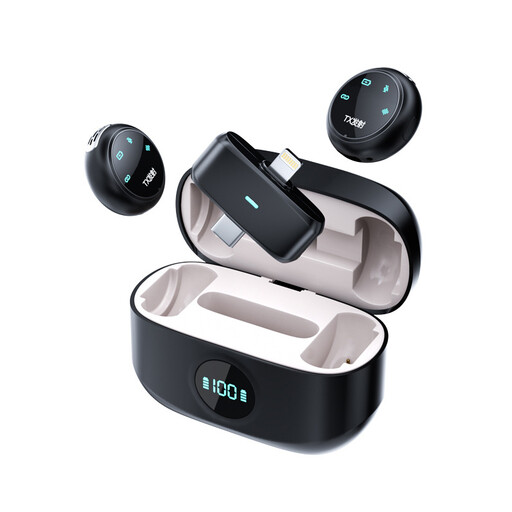 Image unavailable
A wireless clip-on option for anyone who wants to move around while reading.
The product name lists two microphones and compatibility with iOS and Type-C interfaces. Check which connector works with your recording device.
 Image unavailable
This wireless clip-on microphone could suit you if you want more freedom to move while reading.
The product name lists a Type-C interface. Check that it works with your recording device and make a test recording beforehand.
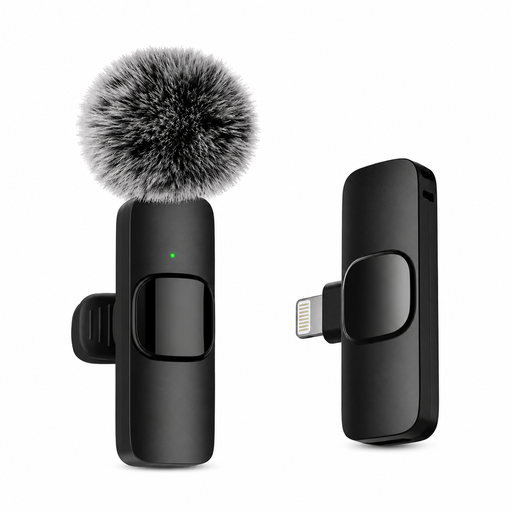 Image unavailable
This wireless clip-on microphone is an option if you want to move around while recording.
The product name lists one microphone and an iOS interface. Check that the connector works with your device and make a test recording in your own room.
No. A microphone placed close to your voice can help change the balance between direct sound and room sound, but the room’s acoustics and microphone placement still matter. Listen back to a test recording in the room where you’ll be reading.
Position it so that your clothes or the cable don’t brush against the capsule, then make a test recording with some movement and loud passages. For the Shure MVL, the manual specifically recommends placing it 15–25 cm from your mouth and lists a windscreen as included; check the individual instructions for other models.
First, check whether the microphone uses USB-C, 3.5 mm TRRS or 3.5 mm TRS, and whether your phone has a compatible external microphone input. For the Lavalier GO, RØDE specifies a TRS-to-TRRS adapter when connecting to a TRRS phone; if your phone doesn’t have a 3.5 mm port, you may also need a suitable port adapter.
You may need an adapter, transmitter or receiver if it isn’t included with your device or set, so check the full recording set-up. According to ACM ConsuWijzer, for an online purchase in the Netherlands you generally have a statutory 14-day cooling-off period from the date of delivery, with some exceptions. Your statutory guarantee depends on what you could reasonably expect from the product under normal use; a manufacturer’s warranty doesn’t replace these rights.
According to the Dutch Authority for Digital Infrastructure, wireless microphones generally don’t require a licence, but you must use an authorised frequency band. The available spectrum for UHF microphones can vary by location, so check the frequency of the specific set and, if necessary, local availability.