
Interviewer in an echoey room
Your main aim is to capture the interviewee’s memories clearly. Speaking History’s practical advice emphasises careful placement and making a test recording.


Start with clarity: clip the microphone close to the interviewee’s mouth, keep it away from rustling clothes and listen back to a test recording in the room. Then choose a wired microphone for a straightforward single-voice recording, or separate microphones and channels if both voices matter. Also check the connection, what’s included and the recording settings.
Your main aim is to capture the interviewee’s memories clearly. Speaking History’s practical advice emphasises careful placement and making a test recording.
You need both the questions and the answers, so you’re comparing a single-speaker setup with separate microphones or recording channels. Sennheiser and RØDE describe examples using a single USB-C microphone and two microphones.
You want to connect a microphone to a device you already own. Speaking History recommends checking in advance that the device is using the external microphone. Also check that your recording app and connection are suitable.
First, check that you can capture the voice clearly in the room. Then choose a microphone based on how many voices you want to record and your device’s connection.
| What to consider | What should you check? | Who is this important for? |
|---|---|---|
| Clarity and clothing rustle | Speaking History recommends clipping the microphone about 15 cm below the mouth and keeping it away from clothing. Make a short recording in the room and listen back to it. | If you don’t want to miss important words, pay attention to placement and clothing noise; around 33% of consumers rank clarity as their top priority. |
| Recording both people in the conversation | Check how many microphones and recording channels are included, and whether the questions and answers can be used separately. | If you need both the questions and the answers, look for a microphone for each speaker; around 27% of consumers prioritise capturing both voices. |
| Connecting to your device | Check that the microphone and recording app work with your phone, computer, camera or recorder. According to Sennheiser, the Sennheiser XS Lav USB-C has a USB-C connection and a 2 m cable. | If you want to record on a device you already own, you’ll want to make sure the external microphone is actually being used; around 20% of consumers rank device compatibility as their top priority. |
| Recording a long conversation | Check the power supply, available storage and whether recording has started. Make a test file and listen back to it. Also make sure you can secure your files afterwards. | If you can’t re-record a long interview, pay attention to power, storage and saving the file; around 20% of consumers rank recording without interruption as their top priority. |
A microphone worn by the interviewee won’t automatically capture the interviewer’s voice just as clearly.
Decide in advance whether you need to hear the questions too. Then check how many microphones and recording channels the version you’re considering actually includes.
Even with the right connection, the device or app may not use the external microphone.
Check the input, then make a short test recording with your own device and listen back to it.
Tascam Europe lists the DR-10L Pro on its European download page under ‘Discontinued products’.
Use the model to compare recording approaches at most, and check the current product version separately before relying on it.
An internal recording feature doesn’t automatically mean that recording has started, that there’s enough storage or that the file has been saved.
Check the power supply and storage, make a test file, then listen back to your recordings and make sure they’re safely saved.
The XS Lav USB-C is a wired option for a compatible mobile device or computer.
The Wireless PRO is a two-channel wireless system for a setup with two wearable microphones.
The F2 is a separate recorder supplied with a lavalier microphone for recording one voice.
With the Mic 2, the number of transmitters depends on the version you choose.
The DR-10L Pro is an example of a lavalier microphone with a local recorder.
These Joybuy products are wireless lavalier microphones for conversations with one or more speakers. Check the number of microphones and the connection for each version.
 No image available
The product name specifies two transmitters, making it suitable for a conversation where both participants wear a microphone.
Listed version: 2 TX + 1 RX and Charging Case.
 No image available
The product name specifies two microphones, making it suitable when both the interviewer and interviewee need to wear one.
Listed components and connection: camera receiver, smartphone receiver, charging case and USB-C.
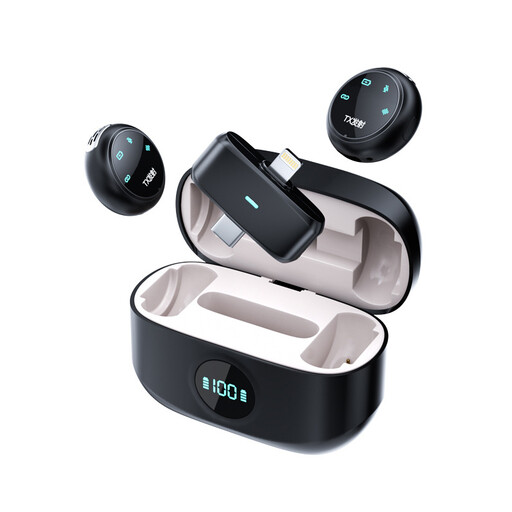 No image available
The product name specifies two microphones, making it suitable for a conversation where both participants wear one.
Listed features: magnetic design and connections for iOS and Type-C.
 No image available
The product name mentions interview recording and a Type-C connection; check that it’s compatible with your device and recording app.
Listed features: wireless mini lavalier microphone and Type-C interface.
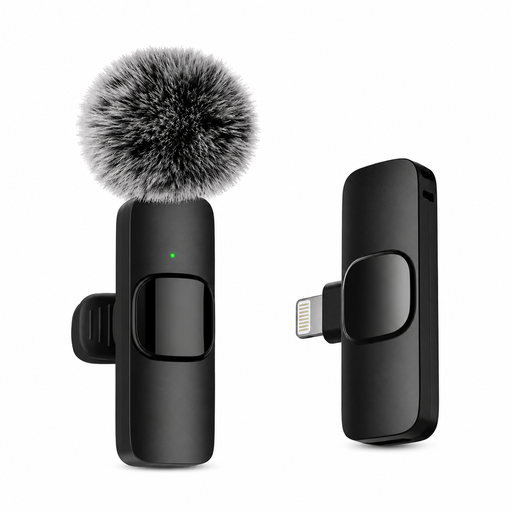 No image available
The product name specifies one microphone, making it suitable for a setup where you want to record one voice.
Listed features: wireless mini lavalier microphone with iOS interface.
Speaking History recommends clipping the microphone about 15 cm below the interviewee’s mouth, away from rustling clothes. Make a short recording in the same room and listen back to it. Also check that the external microphone has actually been selected.
No. Don’t treat these features as a substitute for careful placement and a listening test. Manufacturers specify 32-bit float recording for some of the models mentioned, but Speaking History’s advice for clear speech focuses on the distance from the speaker and avoiding clothing rustle.
Usually not, but you do need to use the right frequency band. The Dutch Authority for Digital Infrastructure says a licence is generally not required and that available UHF frequencies can vary by location, so check the frequency and version of the system you choose.
An organisation needs a legal basis under the GDPR to process personal data; consent is one possible basis. According to the Dutch Data Protection Authority, consent is required in most cases to publish personal data online, except where it is solely for personal or household use. For a project, separately record what has been agreed about keeping, using and publishing the interview.
Contact the seller. According to the Dutch government, there is no fixed statutory warranty period in the Netherlands; if there’s a problem with a product, the seller must provide a solution. Any additional warranty is on top of your statutory rights.