
Solo reader with a wide vocal range
For anyone who alternates between whispers and loud passages in a single recording and wants to wear the microphone while reading aloud.


For one reader who whispers and speaks loudly, a lavalier microphone with its own recorder is a practical option if you can transfer and listen back to the audio file afterwards. If you stay in one place, a wired microphone may be enough; if you move around a lot or have two speakers, a wireless set is worth comparing. According to Zoom, the F2 records mono 32-bit float WAV without a gain setting, but this does not prevent clothing rustle and is not an independent assessment of sound quality.
For anyone who alternates between whispers and loud passages in a single recording and wants to wear the microphone while reading aloud.
For anyone who walks or acts while reading aloud and needs to choose between a body-worn recorder and a wireless connection to a receiver.
For anyone recording two readers at the same time who wants to check how many microphones, transmitters and recording channels are actually included in the set.
Suitable for: one reader in a fixed position and a recording device with a compatible microphone input.
Trade-off: you do not have to manage a wireless connection, but the cable may restrict your movement.
Suitable for: one reader who moves around or varies their volume considerably and wants to record a separate audio file.
Trade-off: you need to manage the recorder and transfer and listen back to the file afterwards; this is not a live wireless connection to a camera.
Suitable for: two readers speaking at the same time or moving around a lot, using a receiving device.
Trade-off: check the number of transmitters and what is included in the package, and bear in mind the batteries, possible interference and frequency requirements.
For a dramatic reading, vocal dynamics, freedom of movement, connectivity and the number of voices are the main things to consider. The percentages below indicate how many consumers might rank each concern as their top priority in this use case.
| Consideration | What to look for | Who is this most relevant to? |
|---|---|---|
| Capturing changes in volume | Check whether the recorder or transmitter records audio itself, which file formats are available, and how you can listen to and transfer the file. | If I whisper and then speak loudly, I want to be able to assess the recording afterwards. Around 33% of consumers prioritise capturing vocal dynamics. |
| Freedom of movement | Compare the cable length with using a body-worn recorder or a wireless set; make a test recording where you plan to move around. | If I walk or act while reading aloud, I do not want a cable to restrict my movement. Around 27% of consumers give freedom of movement top priority. |
| Connectivity | Check the input on your phone, camera or recorder, and whether the plug and any adapter are compatible. | If I want to use my existing device, I want to make sure the microphone and input work together. Around 20% of consumers put connectivity first. |
| Two voices | Check how many microphones and transmitters are included and how many recording channels the set has. | With two readers, I want to check whether the set suits both voices and how they will be recorded. Around 20% of consumers say two voices are their main concern. |
A 3.5 mm plug alone does not tell you enough about compatibility: TRRS and TRS plugs may be intended for different inputs. Also check that your recording app is actually using the external microphone. For wireless equipment, the Dutch Authority for Digital Infrastructure publishes frequency bands that may be used licence-free under certain conditions, as well as bands that may require a licence; check the frequency and transmission power of the specific set.
A clip-on microphone and a separate lavalier are not the same thing. The Sennheiser Profile Wireless 2-Channel Set has two clip-on microphones and connections for optional external lavaliers; RØDE lists two Lavalier II microphones as included with the Wireless PRO.
Check what is included in the package if you need a separate microphone capsule that you can position yourself.
You may need a compatible external lavalier for the Sennheiser set if you want to use a separate lavalier microphone.
RØDE distinguishes between the TRRS plug on the smartLav+ and the TRS input on a Wireless GO II transmitter.
Check the plug, input and any adapter for the exact combination of microphone and device.
32-bit float is a recording format; clothing rubbing against the microphone capsule or cable can still be audible.
Make a test recording in the clothes you plan to wear while reading aloud, and try whispering, loud passages and movement.
The F2 combines a portable audio recorder with a lavalier microphone for one reader who wants to record a separate file.
The wired smartLav+ is designed for a compatible smartphone connection; the Wireless PRO is a different set-up with two transmitters.
The wired ATR3350xiS is an option for a camera or recorder with a suitable 3.5 mm input.
The wired MVL is an omnidirectional lavalier microphone for a compatible phone or tablet.
The Profile Wireless 2-Channel Set is worth considering if two people are moving around and you want a two-channel set-up.
These product options include wireless microphone systems for two voices and a wired lavalier option. Check the connection and package contents listed for each product before pairing it with your recording device.
 No image available
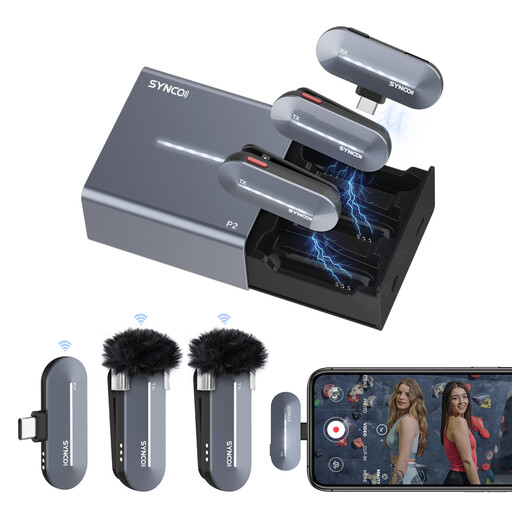
This set may suit a recording set-up for two speakers; check that the receiver is compatible with your recording device.
The product name lists 2 TX, 1 RX and a Charging Case.
 No image available
The dual-microphone set-up may be useful if you want to record two voices; check that the connection listed is compatible with your device.
The product name lists USB-C, Dual Mic, 2.4GHz and a Charging Case.
 No image available
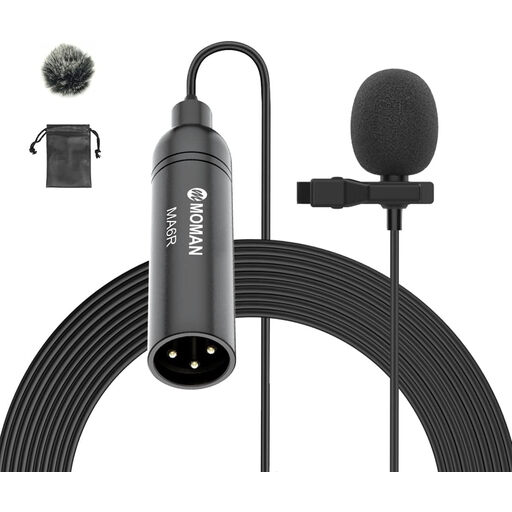
A wired option for a set-up where the connection listed is compatible and the cable length allows you the freedom of movement you need.
The product name lists a 6 m cable, a 3.5 mm connection and smartphone compatibility.
 No image available
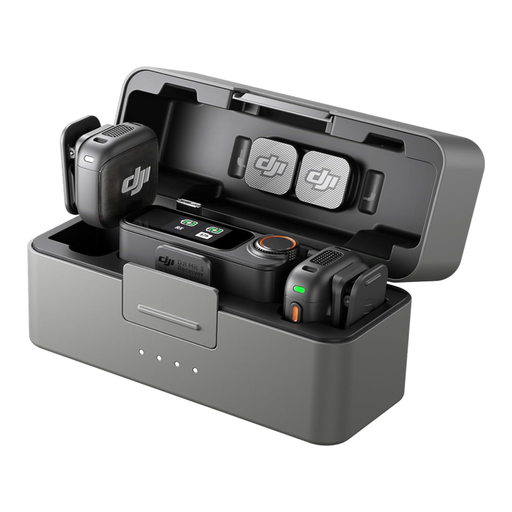
This set may suit a two-speaker set-up; check that the receiver connection is compatible with your recording device.
The product name lists 2 TX, 1 RX and a Charging Case.
 No image available
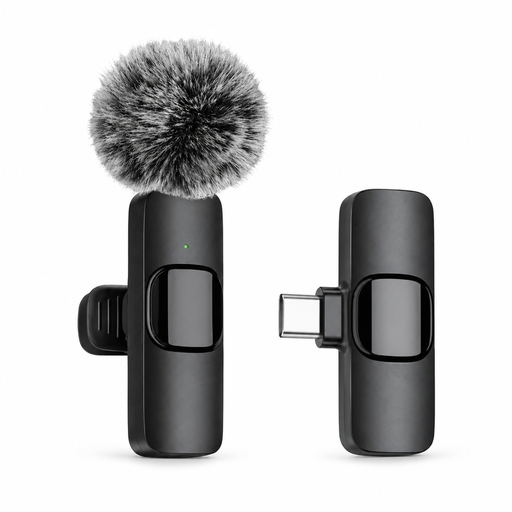
A wireless option for recordings where the Type-C interface listed is compatible with your device.
The product name lists a Type-C interface.
RØDE’s general guidance is to place the microphone on your chest, around 20–30 cm from your mouth. Make a short test recording while moving and speaking loudly; Shure points out that clothing rubbing against the capsule or cable can cause handling noise.
No, it depends on the device’s connection. RØDE specifies a TRRS-to-TRS adapter for using the smartLav+ with a Wireless GO II transmitter; Shure describes the MVL as suitable for compatible connections or a suitable CTIA adapter. Check the entire connection chain between your chosen microphone and device.
No, it depends on the frequency band and the conditions that apply to the specific set. The Dutch Authority for Digital Infrastructure publishes frequencies on which wireless microphones may operate licence-free under certain conditions, as well as bands that require a licence. Check your set’s frequency and transmission power.
Your statutory rights sit alongside any manufacturer’s or seller’s warranty. According to ACM ConsuWijzer, if a product becomes faulty under normal use sooner than could reasonably be expected, the seller must repair it, replace it or refund you free of charge, subject to the applicable conditions. There is no single fixed statutory warranty period for every product.
There is no straightforward yes or no; the purpose, the people involved and how the recording is shared all matter. If an organisation processes personal data, the Dutch Data Protection Authority requires a valid legal basis under the GDPR. Talk to everyone involved beforehand about why the recording is being made and how it will be shared.