
Readers with a fixed recording spot
You read sitting down in a small booth and want consistent recordings. Keeping the microphone in a fixed position and minimising clothing and cable noise matter more than having plenty of freedom to move around.


Start with a lavalier microphone and recording setup that connect to your phone, recorder or audio interface. A wired microphone keeps things simple; a separate recorder is an option if you want to record in the booth without a computer. Wireless is mainly worth considering if you need freedom of movement, but you’ll also need to think about power and, depending on the system, frequency use.
You read sitting down in a small booth and want consistent recordings. Keeping the microphone in a fixed position and minimising clothing and cable noise matter more than having plenty of freedom to move around.
You want to keep using your phone or recorder. Check that the microphone plug and any adapter are compatible with the input.
You want to record chapters on a separate recorder and transfer them later. You’ll need to make power, storage and checking your files part of your recording routine.
A good fit if: you read in one place and your device has a compatible microphone input.
Check: the plug type, any adapter you need and how you route the cable.
A good fit if: you want to record in the booth without a connected phone or computer.
Check: the power supply, storage and how you’ll transfer your files.
A good fit if: you genuinely need to move around while recording.
Check: you’ll have extra components, and will need to check power, connectivity and, where relevant, frequency use.
For long chapters, being able to repeat your microphone position and having a working connection are important starting points. Make a test recording in your usual clothes and posture, then listen back before starting a full session.
| What to consider | What should you check? | Who will find this important? |
|---|---|---|
| Consistent voice recordings | Test in your usual clothes and posture; listen for clothing and cable noise, and keep the microphone in the same position. | If I’m recording chapters from the same spot, I want a repeatable position and as little rustling as possible. Around 36% of consumers prioritise consistent recordings. |
| Connecting to your device | Check the exact input type, microphone support and whether you need an adapter. | If you want to use your existing phone or recorder, make sure the external microphone works with its input. Around 29% of consumers are most concerned about device compatibility. |
| Recording without a computer | Check the recorder, storage and power supply; make a full test recording beforehand. | If I want to record chapters separately from my computer, I also need to be able to transfer and check the files later. Around 21% of consumers prioritise a standalone recording workflow. |
| Freedom of movement | Decide whether you really need to move away from the recording device without a cable while reading; then check the receiver, power supply and any frequency requirements. | If you need to move around the room while recording, you may need a wireless connection. Around 14% of consumers say freedom of movement is their main concern when choosing. |
A TRS microphone won’t necessarily work with a device that expects TRRS. As a result, the microphone may be recognised incorrectly or not at all.
Check the input on your recording device and the microphone’s plug type. Also check whether an adapter is supported, and make a short test recording. You may need a compatible adapter or a different microphone.
Clothing and cables can move and make noise while you’re reading; a product specification can’t rule that out.
Record a test passage in your usual clothes and with your usual movements, then listen back with headphones. Testing before you record a whole chapter can help avoid re-recording and extra editing time.
A wireless connection won’t automatically prevent clothing rustle or an incompatible connection. With frequency-dependent systems, you’ll also need to check the requirements for the frequency being used.
First, compare a wired setup with how much you actually need to move. If you choose wireless, check the power supply, connection and frequency requirements that apply to your system and recording location.
The MVL is a wired lavalier microphone designed for use with a compatible mobile device.
The Lavalier II is designed for a recording setup with a compatible locking 3.5mm TRS microphone input.
The F2 is a standalone recorder supplied with an LMF-2 lavalier microphone.
The W.Lav Pro, with its locking 3.5mm TRS plug, is an option for a compatible recording or transmitter system.
The MKE 2 is available in versions for specific professional connections; choose the one that’s compatible with your system.
These wireless microphones are for anyone who needs freedom of movement while recording. Before buying, check that the receiver’s connection is compatible with your recording device; wireless recording also means paying attention to power and connectivity.
 Image unavailable
A wireless option if you need freedom of movement while recording; check that the USB-C receiver is compatible with your recording device.
The product information lists a battery life of up to 6 hours.
 Image unavailable
A wireless set for anyone who needs a two-transmitter setup; check that the receiver is compatible with your recording device.
This version includes two transmitters, one receiver and a charging case.
 Image unavailable
A wireless option for a recording device with a compatible Type-C connection; check the connection before ordering.
The product information lists a battery life of 3–6 hours. Avoid using it in extreme temperatures or high humidity.
 Image unavailable
This version is designed for a two-microphone setup; check that the Type-C connection is suitable for your recording device.
The product information lists a battery life of 3–6 hours and warns against extreme temperatures and high humidity.
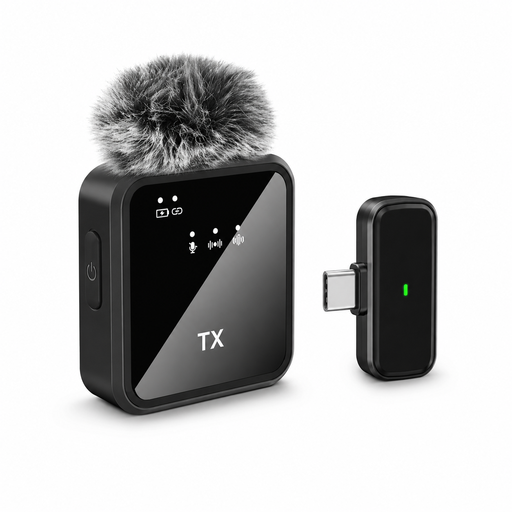 Image unavailable
A single-microphone version for anyone who wants to record wirelessly; check in advance that the receiver interface works with your recording device.
The product information lists a battery life of 3–6 hours and warns against extreme temperatures and high humidity.
No, not if your recording isn’t filmed. Try a secure position where fabric doesn’t touch the capsule, and route the cable so movement won’t create audible noise. Listen back to a test recording.
Not without first checking the input and the adapter you need. RØDE describes TRS as being used with devices including recorders, and TRRS with many phones; a phone that expects TRRS may need a suitable TRS-to-TRRS adapter. For USB-C or Lightning adapters, also check specifically that they support an external microphone.
Ask the publisher or platform you’re recording for to provide its current submission requirements. For submissions to ACX, the ACX technical requirements apply; ACX also offers an analysis tool for finished files. These platform-specific requirements aren’t general Dutch legal standards, and they don’t prove that a particular microphone model meets them.
Usually not, as long as the specific system meets the requirements for the frequency band being used. The Dutch Authority for Digital Infrastructure says that available UHF spectrum varies by region, so check the frequency for your recording location. Some other frequency bands may require a licence.
For a standard online consumer purchase, you’ll generally have a statutory 14-day cooling-off period from delivery, with some exceptions. If the product is faulty, you also have statutory rights against the seller; according to ACM ConsuWijzer, there’s no fixed general two-year period for this in the Netherlands. The cooling-off period lets you cancel a purchase, while your warranty rights apply to a faulty product.