
Holiday-let owner with a short turnaround
You need to wash guests’ clothes and want to know whether the full wash and dry cycle will fit into your schedule.


A washer-dryer is a good fit if you only have space for one appliance and the tracksuit care labels allow tumble drying. Bear in mind the drying capacity and the length of the full cycle. If you need to process several loads between guest stays, separate appliances are worth comparing, provided you have enough space and the right connections. If the care label rules out tumble drying, air drying may be suitable if you have enough time and drying space.
You need to wash guests’ clothes and want to know whether the full wash and dry cycle will fit into your schedule.
You wash tracksuits made from different fabrics or with different care labels, and want to avoid confusing wash programmes with permission to tumble dry.
You have limited space for laundry appliances and need to weigh up capacity, dimensions and connections against the space available.
A good fit when: you have space for one appliance, want to tumble dry and the clothing care labels allow it.
What to consider: a combined cycle can take a long time, and drying capacity may be lower than washing capacity. Conventional washer-dryers also use water during drying.
A good fit when: you have space and connections for two appliances, and need to process several suitable loads between guest stays.
What to consider: you’ll need two spaces for appliances; compare the total purchase price of the appliances you’re considering too.
A good fit when: the clothing care label rules out tumble drying, or you have enough time and suitable drying space.
What to consider: you’ll need to plan for drying space and the time before the next guests arrive.
Start by checking the clothing’s wash and drying symbols. Then work out how much time and drying space you have between guest stays, and choose an appliance capacity that suits your usual load.
| Consideration | What should you check? | Who is this important for? |
|---|---|---|
| Time between guest stays | Compare the maximum wash-and-dry load and the length of the full cycle for the programmes you plan to use. | If the next guests are arriving soon, I want to know whether the full cycle will finish in time. Around 33% of consumers put turnaround time first. |
| Caring for clothes according to the label | Check the wash and drying symbols on each garment, and compare them with the programmes on the exact model. | I want to care for tracksuits according to their individual care labels, because being machine washable doesn’t automatically mean they can be tumble dried. Around 27% of consumers give clothing care top priority. |
| Space for the appliance | Measure the available space and access route; also check the model’s dimensions and installation requirements. | With space for just one appliance, I want to choose one that fits without losing sight of the capacity I need. Around 20% of consumers name space as their top priority. |
| Ongoing running costs | Compare the washing and full-cycle figures on the EU energy label, then calculate costs using your own usage and tariffs. | If I dry clothes regularly, I also want to take energy and water consumption into account. Around 20% of consumers put running costs first. |
Drying capacity may be lower than washing capacity, so you may not be able to process the same amount of clothing in one continuous cycle.
For the exact model, compare both the washing capacity and the wash-and-dry capacity with your usual load.
A smaller drying load could mean an extra drying cycle and less time between guest stays.
Wash and drying instructions specify different treatments. Being washable doesn’t prove that tumble drying is allowed.
Check the wash and drying symbols for each tracksuit separately before choosing a wash-and-dry programme.
The EU energy label shows figures for the wash cycle and for the full wash-and-dry cycle separately. Conventional washer-dryers can also use water during drying.
Compare the full-cycle figures and drying technology on a like-for-like basis, and take your own usage into account.
Very similar model numbers can refer to different appliances, with different capacities or features.
Check the full model number and product details before choosing an appliance.
The information below applies to the models and product ranges listed, not automatically to every appliance from the same brand.
The AEG LWR9706C8 is a heat-pump washer-dryer with a washing capacity of 10 kg and a drying capacity of 6 kg, according to AEG.
According to Bosch, the Bosch WNG24406NL can wash up to 9 kg and wash and dry up to 6 kg.
According to Beko, the freestanding Beko BM5DFT4841A has a washing capacity of 8 kg and a drying capacity of 5 kg.
According to Samsung, the Samsung WD90DG6B85BBU3 is a washer-dryer with a washing capacity of 9 kg and a drying capacity of 6 kg.
According to the product information, the Hisense WD3S9043BW3 is a washer-dryer with a washing capacity of 9 kg and a drying capacity of 6 kg.
These products combine washing and tumble drying in one appliance. Check whether the care label on each tracksuit allows tumble drying, and compare the maximum drying load with the amount of laundry you usually wash.
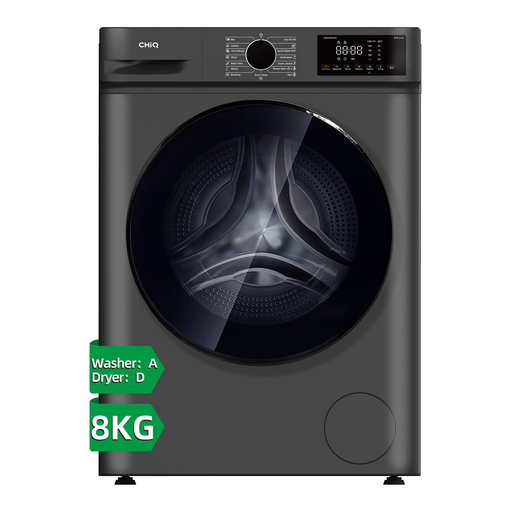 Image unavailable
For anyone looking to combine washing and drying in one appliance; check whether tumble drying is allowed for each garment.
The product title lists 8 kg, 1400 RPM and Steam Function.
 Image unavailable
An option if you want to combine washing and drying in one appliance; bear in mind the lower drying capacity when running a continuous load.
The product title lists 8 kg washing, 6 kg drying, 1400 rpm, Wi-Fi and Steam Function.
 Image unavailable
For anyone looking to combine washing and drying in one space; assess the drying capacity against your usual load.
The product title lists 8 kg washing and 5 kg drying.
 Image unavailable
An option if you’re looking for a higher stated washing capacity; check how much of your usual load you can dry in one go too.
The product title lists 10 kg washing and 6 kg drying. According to the product title, Quick Wash takes 15 minutes; this is a wash programme, not the full wash-and-dry cycle.
 Image unavailable
For anyone looking to combine washing and drying in one freestanding appliance; match the load to the drying capacity and clothing care labels.
The product title lists 10 kg washing, 7 kg drying, Steam Care and Auto Dry.
No. Don’t assume that the wash symbol means tumble drying is allowed. Check the separate drying symbol and permitted treatment for each garment; otherwise, choose a suitable way to air dry it.
Use the stated capacity for the full wash-and-dry cycle, not just the maximum washing capacity. Drying capacity may be lower, so compare both figures with your usual load.
Compare the separate figures on the EU energy label for washing only and for the full wash-and-dry cycle. Calculate your costs using your expected number of cycles and tariffs; label figures don’t predict the consumption of every sportswear programme.
Measure the space and access route, and follow the instructions for your chosen model. The Dutch Consumers’ Association recommends, among other things, a firm, level surface, correctly connected water supply and drainage, and an earthed socket.
Follow the care instructions for the exact model and dose detergent according to the packaging. Remove clothes from the drum after use; the cleaning steps required vary from machine to machine.