
Fans of generously filled rolls
You want to open the roll lengthways and fill it without its size limiting your choice of fillings. So judge the roll itself: ‘thick cut’ doesn’t tell you how much room there is inside.


For a late-night snack with generous fillings, choose a roll that you can open lengthways to give you plenty of room; the term ‘thick cut’ alone doesn’t tell you whether it will. A white bake-at-home roll is an option if you’re looking for a simple base, while for more fibre, compare the ingredients and fibre per 100 g. If you’re buying frozen rolls, check the instructions for after defrosting, and always read the latest label if you have allergies or questions about iodised salt.
You want to open the roll lengthways and fill it without its size limiting your choice of fillings. So judge the roll itself: ‘thick cut’ doesn’t tell you how much room there is inside.
You want to have rolls ready for a late-night snack. Storage instructions, cooking time and defrosting guidance all help you decide whether a pack suits your needs.
You might compare fibre, ingredients or allergens, or want to know whether iodised salt has been used. The name of the type of bread won’t always tell you.
First, decide what matters most for your late-night snack: room for fillings, ingredients, a practical supply or a specific labelling requirement. Then compare only the rolls that meet your needs.
| What to consider | What to check before buying | Who it matters to |
|---|---|---|
| Room for fillings | Check the size and whether you can open the roll lengthways to give it plenty of room. Don’t assume it will be sturdy just because it looks rustic. | If I want to use plenty of filling, the roll needs to be easy to open and fill. For around 36% of consumers, having room for fillings matters most. |
| Fibre and type of bread | Read the ingredients and compare fibre per 100 g; ‘multigrain’ on its own doesn’t tell you how much fibre a roll contains. | For my snack, I want to know which grains it contains and how much fibre is in the roll. Around 27% of consumers prioritise these ingredients. |
| Storage and preparation | Compare the storage, defrosting and baking instructions with the equipment and time you have available. | When I get hungry late at night, I want to be able to prepare a roll from my supply without missing the instructions for after defrosting. Around 27% of consumers prioritise this convenience. |
| Allergens and salt | Check the allergen information and look in the ingredients list for baker’s salt or iodised salt. | If I need to avoid gluten or other allergens, or want to check for iodised salt, the label determines my choice. For around 10% of consumers, this is the first thing they check. |
Those words don’t tell you how much room there is inside a particular roll. Its colour or rustic appearance won’t tell you either.
Check the size and make sure you can open the roll lengthways to give it enough room for your fillings.
According to the Voedingscentrum, using baker’s salt when baking isn’t compulsory. So you can’t tell whether it’s included from the product name.
If it matters to you, look for baker’s salt or iodised salt in the ingredients list.
Fibre content and allergens vary by product. A multigrain roll isn’t automatically suitable for someone who needs to avoid certain grains or other allergens.
Compare the ingredients, allergens and fibre per 100 g of the rolls you’re considering.
For its white frozen rolls, Jumbo says they must not be refrozen after defrosting and should be prepared and eaten within 24 hours.
Defrost only what you need and follow the instructions on the pack of your rolls.
Albert Heijn lists a pack of four rolls and also uses brown rolls in a recipe for a generously filled sandwich.
Jumbo offers white, multiseed and brown frozen rolls, so you can consider the type of bread and storage method separately.
PLUS provides product information for white, multigrain and gluten-free rolls, with details you can compare for each variety.
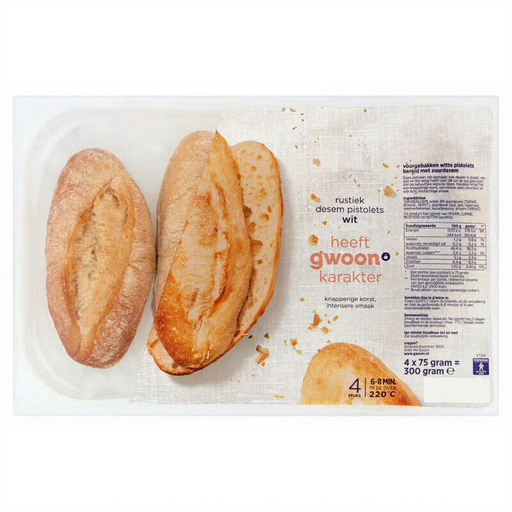
These white rolls are an option if you’re looking for something to enjoy as a late-night snack. Check whether the size gives you enough room for your fillings, and read the pack instructions before preparing them.
 No image available
For a late-night snack with fillings: check whether you can open this roll lengthways to give it plenty of room.
Pack: 4 pieces. Check the latest pack for cooking instructions and allergen information.
No, the term doesn’t tell you how much room a particular roll offers. Check its size and make sure you can open it lengthways to give you enough room for the fillings you want to use.
No. According to the Voedingscentrum, using baker’s salt when baking isn’t compulsory. Check the ingredients list to see whether it mentions baker’s salt or iodised salt.
For opened bake-at-home bread rolls, the Voedingscentrum recommends 2 to 4 days in the fridge and 1 to 3 months in the freezer. For a specific pack, also follow the storage and cooking instructions on the label.
Follow the instructions for the specific product. For its white frozen rolls, Jumbo says they must not be refrozen after defrosting and should be prepared and eaten within 24 hours.
Read the allergen information for the roll you want to buy, even if the type of bread sounds familiar. The Netherlands Food and Consumer Product Safety Authority says that allergen information for prepacked products must appear on the label; also check any warnings about allergens that may be present if they’re relevant to you.