
Vandaag of morgen in huis

Kwaliteit gegarandeerd

Welkomstaanbiedingen ontgrendelen: GRATIS bezorging | Tot 80% korting | Gratis 30 dagen JoyPlus-proefperiode
Download de app
A large cat tree can make a big difference in a home with active cats or several cats. It gives them more space to climb, rest and scratch, while helping to keep your furniture from becoming their favourite scratching spot. However, a tall cat tree won’t automatically suit every home or cat.
Look out for these common pitfalls:
A 206 cm tall cat tree offers plenty of vertical space, but its construction needs to be up to the job. So don’t just check the overall height. Also look at:
A stable cat tree should stand on a flat, non-slip floor. For models over 150 cm tall, securing the tree to a wall is strongly recommended. Check the screws and connections regularly after assembly, especially during the first few weeks.
A manufacturer may state a total static load capacity. This is a technical indication of how much stationary weight the tree can support, not a guarantee of how it will perform when cats are jumping on it. If you have several cats, their movements, landings and use of the upper platforms all matter too.
For a cat tree for multiple cats, several resting and climbing areas are therefore just as important as the stated weight capacity. This means your cats won’t have to share the same platform or hideaway as often.
A cat tree with sisal posts should offer plenty of vertical scratching surfaces. Natural sisal is ideal for creating a dedicated scratching area, but the quality of the finish and the length of the posts also affect how practical the tree is.
Also look for:
A cat tree with a hammock combines rest with activity. A cat climbing tree with sleeping areas is especially useful if you want to make the most of your floor space.
The JOYFURNOS Cat Tree, measuring 206 cm, is designed as an XXL cat tree with 13 sisal posts, two platforms, two cat houses, a basket, a hammock and a plush ball. According to SONGMICS HOME product information, the construction comprises particleboard, polyester plush, natural sisal rope and metal fittings. The stated maximum total static load is 75 kg. This is a product specification, not a guarantee for every use or every cat.
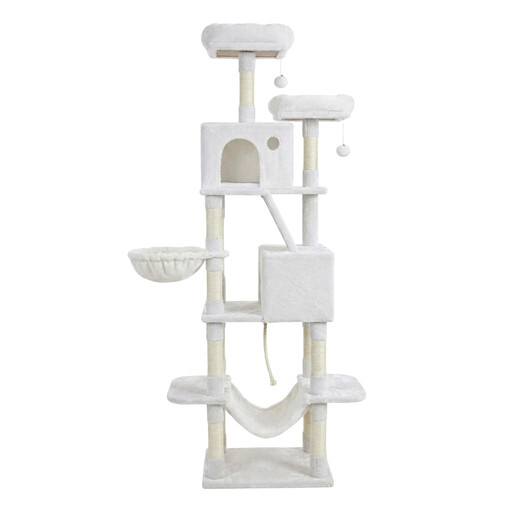
Why it suits this type of buyer: This large cat tree combines several features in one structure: scratching, climbing, playing and resting. It could be more practical than buying separate accessories.
The product description lists 13 natural sisal posts, two cat houses and a reinforced base. Place the tree on a flat surface and use the anti-tip kit provided, following the instructions.
Stands 206 cm tall and features 13 sisal posts, two platforms, two cat houses, a basket and a hammock. The cream-white plush covering suits a light interior style.
Why it suits this type of buyer: If you pay attention to materials and finish, this model features natural sisal rope, E0 particleboard according to the product information, and cream-white plush covering.
The choice isn’t based on height alone: the product details also list the materials and reinforced base, and recommend checking the screws and connections regularly.
The combination of 13 scratching posts and several resting spots helps spread out use. According to the description, the covering can be spot-cleaned.
Why it suits this type of household: Active cats and homes with several cats get a tall climbing route, separate hideaways and a range of places to rest.
Two cat houses, two platforms, a basket and a hammock provide more options than a model with just one sleeping area. Secure the tall structure to the wall.
At 206 cm tall, it makes the most of your vertical space. Its stated static capacity of up to 75 kg gives a clear product specification for the total load.
We’ve put together a complete, up-to-date list of products that meet these strict selection criteria and the applicable European safety regulations.
Don’t place your large cat tree right next to a radiator, open window, open fire or loose cables. Choose a spot where your cat can survey the room, but where the base won’t be in a walkway. A flat floor helps reduce wobbling.
Follow the assembly instructions carefully, then check:
Replace or repair any parts as soon as they become loose or damaged. This helps keep the structure in good working order and stops a small problem from becoming a bigger one.
There’s no set maximum height for a cat tree in the home. For a model around two metres tall, a wide base, a flat surface and wall fixings are important. Also check that there’s enough clear space above the tree for your cat to sit safely on the highest platform.
Its lifespan depends on the number of cats, their weight, how much they scratch, and the quality of assembly and care. Check the sisal, covering, screws and connections regularly. Any loose or broken part should be secured or replaced before the cat tree is used again.
That depends on the layout and the total load. A model with several platforms, cat houses and sleeping areas gives cats more choice. As well as checking the stated weight capacity, consider how much space each resting area offers, and secure a tall cat tree according to the safety instructions.
