
Vandaag of morgen in huis

Kwaliteit gegarandeerd

Welkomstaanbiedingen ontgrendelen: GRATIS bezorging | Tot 80% korting | Gratis 30 dagen JoyPlus-proefperiode
Download de app
A large outdoor chicken run may seem simple at first: a frame, wire mesh and a roof. In practice, the dimensions, weather protection and quality of the mesh or steel are what determine whether your chicken coop and run will still be practical after a few months.
Many garden owners in the Netherlands buy a run that’s too small or focus mainly on the price. This can quickly lead to a lack of space to move around, mud in the run or extra work to repair damaged materials. Use these practical checks to compare a spacious chicken run using verifiable product details rather than marketing claims.
A run for four chickens isn’t automatically suitable for six. The animals’ behaviour matters too. Chickens need room to walk, scratch, rest and get out of each other’s way. Ducks and rabbits also have different needs when it comes to the layout and moisture resistance.
So don’t just check whether it says “for 4 to 6 chickens”; look at the overall length, width and height too. A larger outdoor run gives you more space for food and water stations and makes cleaning easier.
A cover can help keep out rain and strong sunlight, but not every roof protects the entire run. When it’s windy, rain can blow in from the sides. Check the roof’s design and covering, and how it’s attached to the frame.
If you’re considering a chicken run with a UV-resistant roof, check exactly what that means. The product description may say the roof is UV-resistant, but that doesn’t automatically mean the run will stay fully shaded. Ideally, place the run partly in the shade and make sure there’s enough ventilation.
“Metal” is a broad description. For long-term outdoor use, it’s worth checking whether the frame and mesh are made from galvanised steel. Galvanisation is a protective zinc coating designed to help protect steel from moisture and rust. The quality and thickness of the finish can vary between products.
Also check that the joints, hinges and fixing points are well made. These are often the places where a run can start to loosen over time.
The stated external dimensions don’t always match the actual space available for your chickens to move around. Legs, frame bars and any dividers take up room. Check the following:
For a chicken run for 4 to 6 chickens, a larger floor area is practical, especially if the chickens will regularly spend long periods in the run.
A galvanised steel chicken run is generally designed for outdoor use. Check the product information to see whether only the frame, or the mesh as well, is made of steel. Also look at:
A run for chickens and ducks may be exposed to more moisture than one placed on dry grass alone. If the ground is wet, make sure there’s adequate drainage and replace the bedding regularly.
A roof should provide protection without completely blocking airflow. A covered section can be useful in the rain, while open sides help with ventilation. Check whether the structure needs to be assembled and which parts are included.
Missing information is worth noting. For example, there isn’t a detailed product description available for the model below. Before buying, check the current package contents, assembly instructions and warranty terms on the product page.
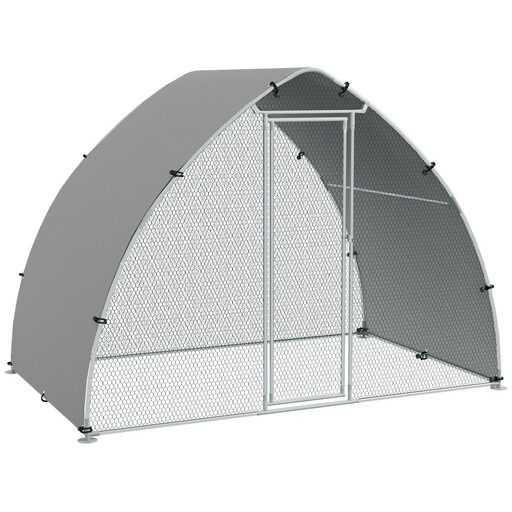
Why it suits this type of buyer: At 3 x 1.9 x 2.2 metres, it offers a spacious starting point for anyone keeping several chickens for the first time and who doesn’t want to replace a small run straight away.
The product title gives specific dimensions and states that the run is made from galvanised steel. This makes it easier to compare the space and stated material with those of a product described only as a “large run”.
Stated dimensions of 3 x 1.9 x 2.2 metres; galvanised steel frame; described in the product title as suitable for 4 to 6 chickens, ducks or rabbits.
Why it suits this type of buyer: If material and weather resistance are your main priorities, you can compare the stated galvanised steel construction and UV-resistant roof with other options.
Rather than making only a general claim about outdoor use, the product title specifically mentions galvanised steel and a UV-resistant roof. Check the exact roof covering and assembly details on the product page.
Galvanised steel construction; roof described as UV-resistant; product name indicates it’s suitable for a garden or yard.
Why it suits this type of buyer: The larger size is practical if your animals spend longer periods outside, or if you want to create separate areas for food, water and shelter.
The generous size helps prevent the run from feeling cramped once you’ve added food bowls, shelters and bedding. If you’re keeping different types of animals together, always check that the mesh size and layout are suitable for them all.
3 metres long; 1.9 metres wide; 2.2 metres high; stated as suitable for chickens, ducks and rabbits.
We’ve put together a complete, up-to-date list of products that meet these strict selection criteria and the applicable European safety regulations.
Place the run somewhere that allows rainwater to drain away. Avoid a permanent layer of mud, as it makes cleaning more difficult and can put extra strain on the structure. In practice, a mix of grass, sand and a dry shelter is often easier to manage than a completely bare surface.
Check weekly:
A chicken aviary or spacious run also needs to be secure against escapes and unwanted visitors. Check the bottom edge and the fastening, especially if the run is on loose soil.
Don’t just look at a guideline per chicken; consider the total usable space. For four to six chickens, a run with plenty of length and width is more practical if they spend a lot of time outdoors each day. Position food, water and shelters so that everything isn’t crowded into one small area.
It depends on the quality of the steel, the zinc coating, the assembly and how much moisture it’s exposed to. Regularly checking joints, scratches and rust spots can help you spot damage early. Don’t leave the structure standing in water.
Ongoing costs mainly include bedding, repairs and any extra protection against rain or animals that dig. A larger run may need more ground covering, but it also gives you more room for a practical layout and makes maintenance easier.
