
Map and detail reader
If you want to make out maps, text and small in-game elements clearly, compare screen size and resolution together. Philips and Dell offer examples of 31.5-inch QHD and 31.6-inch 4K screens respectively.


Start with the size and resolution that suit your map, interface and PC. A 32-inch QHD screen, a 32-inch 4K screen and a 34-inch ultrawide each offer a different balance. Then check that your PC, connection and game can handle your chosen resolution and refresh rate. With OLED, it’s also worth considering interface elements that stay on screen for long periods.
If you want to make out maps, text and small in-game elements clearly, compare screen size and resolution together. Philips and Dell offer examples of 31.5-inch QHD and 31.6-inch 4K screens respectively.
If smooth visuals matter to you, don’t just look at the stated refresh rate. Check the connection and your PC’s performance too. AMD describes FreeSync as synchronising the display’s refresh rate with the output of compatible graphics cards.
If interface elements stay in the same place during long matches, weigh up OLED picture quality against maintenance and the possibility of image retention. LG warns that displaying the same image for long periods can cause faint marks.
First decide whether you’re looking for more detail, smoother visuals, extra width or a panel suited to long-term use. Then check that your PC and game can handle your choice.
| What to consider | What to look for | Who might prioritise this? |
|---|---|---|
| Sharpness and screen space | Compare QHD and 4K at the resolution you play at, and check the game’s scaling settings too. | If you want to see maps, text and units clearly without losing sight of what your PC can handle, sharpness and screen space are likely to be priorities for you. Around 33% of consumers put these first. |
| Smoother visuals | Check the supported resolution and refresh rate for each connection, as well as compatibility between your PC, monitor and VRR. | If you’re mainly looking for a smoothly updating image during ranked matches, make sure your PC and connection can deliver the settings you choose. Around 27% of consumers prioritise responsiveness. |
| Extra screen width | Check that your game and ranked mode support the aspect ratio, and measure the space available on your desk. | If you mainly want more width for the game interface or other windows, an ultrawide monitor could suit you, provided your game supports the layout you want. Around 20% of consumers put screen width first. |
| Long sessions and OLED | Read the model-specific panel care instructions and information about image retention, and compare these with an LCD option. | If fixed interface elements stay on screen for a long time, you’ll want to know how much care an OLED model needs. Around 20% of consumers prioritise long-term use and panel care. |
A monitor can only display the settings supported by the source, connection and configuration. VRR also requires compatible equipment.
Check the resolution and refresh rate supported by each connection, and see what your own PC can deliver in your strategy game.
A monitor’s width alone doesn’t tell you whether a particular ranked mode supports the aspect ratio or displays the interface correctly.
Check your game’s aspect ratio support and ranked settings before choosing ultrawide for this reason.
According to LG, displaying the same image for long periods can cause faint marks. A manufacturer’s commercial warranty is separate from the legal assessment of what you can reasonably expect from a product.
Read the model’s care instructions and commercial warranty terms, and keep your purchase details. Don’t assume there is one fixed statutory warranty period for every monitor.
Philips offers examples of a 32-inch QHD screen and a 34-inch ultrawide model.
The Alienware AW3225QF is a curved 31.6-inch 4K QD-OLED monitor.
The PG32UCDM3 is a 32-inch 4K QD-OLED monitor.
LG offers OLED monitors with a Dual-Mode option, among other models.
This selection includes 32-inch QHD or 4K monitors and 34-inch ultrawide models. For ultrawide, check that your ranked game supports the aspect ratio; don’t assume you’ll automatically see more of the playing field.
 No image available
Suited to anyone looking for a 32-inch gaming monitor who wants to make the most of its stated refresh rate with their PC and connection.
IPS panel; 180 Hz.
 No image available
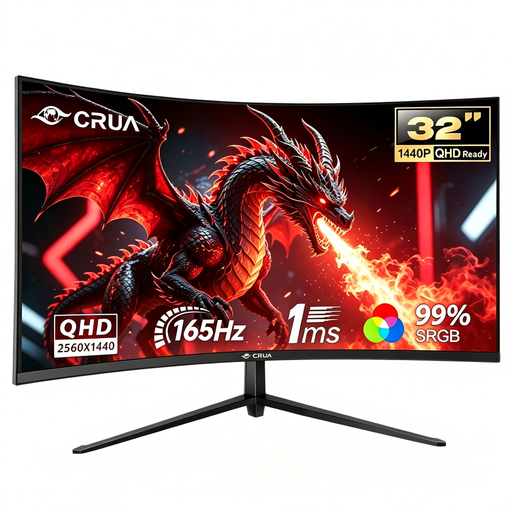
A curved 32-inch option for anyone looking for a large QHD screen. Check that your PC can handle your preferred settings.
QHD; 165 Hz; stated 1 ms GTG; 1500R curvature; FreeSync.
 No image available
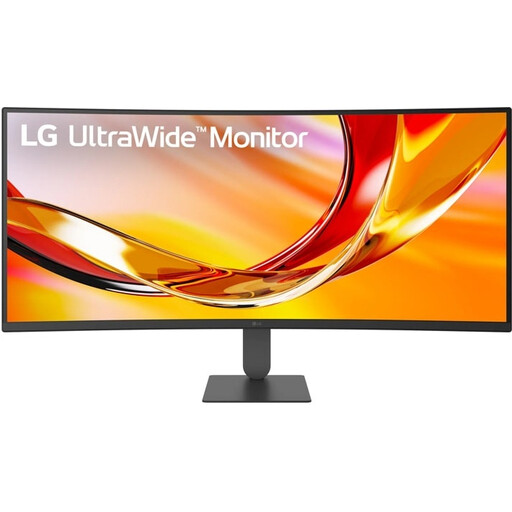
Worth considering if you’re looking for a wider screen. Check that your ranked game supports 21:9; you won’t necessarily see more of the playing field.
34-inch; WQHD; 144 Hz; curved VA panel.
 No image available
An ultrawide option if you’re looking for more screen width. Check in advance that your ranked game supports the aspect ratio.
34-inch; UWQHD 3440 × 1440; 165 Hz; VA panel; 1500R curvature.
 No image available
Suited to anyone who values fine detail on a large 4K screen. Check that your PC can run the game at your chosen resolution.
4K UHD 3840 × 2160; VA panel; 3000R curvature; HDR10; Adaptive Sync.
No, 4K isn’t essential. Large monitors are also available in QHD, so choose based on the level of detail you want and what your PC can handle in your game. A higher resolution alone doesn’t prove a ranked performance advantage.
First, check which resolution and refresh rate your monitor, port, cable and PC support together. Then choose a supported setting and use VRR only with compatible equipment. AMD describes FreeSync as synchronising with compatible graphics cards.
Follow the care instructions for your model. LG warns that displaying the same image for long periods can cause faint marks, and describes pixel cleaning as a possible measure. A feature that the manufacturer says reduces the risk doesn’t rule out image retention.
According to ACM ConsuWijzer, online purchases generally come with a 14-day cooling-off period from delivery, although exceptions apply. You’re also entitled to a statutory guarantee if, under normal use, a product doesn’t meet what you could reasonably expect; the seller is responsible for this. A manufacturer’s warranty doesn’t replace your statutory rights.