
Competitive PC gamer
Wants to follow the action in fast-paced matches and weighs up achievable refresh rates against extra resolution. RTINGS notes that competitive PC gamers may prefer a higher refresh rate and lower resolution.


Start by choosing a screen size and aspect ratio that let you comfortably follow the action. Then check whether your PC or console can deliver the resolution and refresh rate you want through the connection you’ll be using. QHD, 4K and ultrawide suit different preferences, and a higher Hz or response-time figure doesn’t, by itself, prove that a game will play better.
Wants to follow the action in fast-paced matches and weighs up achievable refresh rates against extra resolution. RTINGS notes that competitive PC gamers may prefer a higher refresh rate and lower resolution.
Wants a larger or wider view of the action, while keeping viewing distance and the aspect ratio of their game in mind. RTINGS discusses larger screens as an option for gaming and other uses.
Uses one monitor with multiple devices and checks which resolution and refresh rate are available for each device and connection. Gigabyte’s specifications and PlayStation’s guidance on video output show that the available setting can vary by source.
Start with the aspect ratio that suits your game, then compare the resolution and refresh rate your equipment can actually support.
Best for: anyone who values a large, familiar playing area and smooth PC matches more than the extra detail of 4K.
Trade-off: at the same screen size, QHD displays fewer pixels than 4K. The achievable Hz also depends on the source and connection.
Best for: anyone who wants sharp image detail as well as a view of the arena, and has equipment that can handle their preferred combination of 4K and Hz.
Trade-off: the available speed varies by resolution, source and port. OLED screens need extra care when displaying static images for long periods.
Best for: anyone looking for a wider view for gaming and work, who has checked how their own game is displayed.
Trade-off: extra width doesn’t guarantee a larger usable view of the action. Check how menus and the playing area are displayed, too.
| What to consider | What to check before buying | Who should pay particular attention? |
|---|---|---|
| Smooth motion | Compare the maximum achievable Hz at your preferred resolution and connection. Don’t treat GtG and MPRT figures as the same measurement or as input lag. | If I want to follow fast-moving action, I first check the refresh rate my source can actually deliver. Around 36% of consumers prioritise speed. |
| Overview and readability | Compare QHD and 4K at a similar screen size. For ultrawide, check how your own game is displayed and measure the space available on your desk. | If you’re mainly looking for a larger or wider view of the action, you’ll want to know whether the size and aspect ratio work well in your game. Around 29% of consumers prioritise having a good overview. |
| PC, console and port support | Check the output, cable, monitor port and available settings for each source. Your PC’s maximum specification won’t automatically apply to a console. | If I want to use one screen with my PC and console, I check in advance which display modes each device supports. Around 21% of consumers prioritise the connection. |
| Panel and long-term use | Compare the panel type and care instructions for the exact model. Manufacturer OLED care features don’t guarantee protection against image retention. | If you’re weighing up panel performance and long-term use, you’ll want to know what care a screen needs when displaying static HUD elements or menus. Around 14% of consumers prioritise image quality and maintenance. |
An MPRT figure isn’t the same as measured input lag. Xiaomi describes the G34WQi’s 1 ms as an MPRT figure from its own laboratory; Gigabyte uses MPRT for the M32U.
Only compare figures with the same definition, and check independent tests of the exact model if you’re unsure.
A 21:9 aspect ratio doesn’t tell you how every arena game displays the playing area and menus.
Check how your own game supports and displays ultrawide before making the extra width a reason to buy.
ACM ConsuWijzer distinguishes between statutory guarantees and seller or manufacturer warranties. Extra cover doesn’t replace your statutory rights.
Compare what additional cover includes, and contact the seller if there’s a problem with a faulty product.
An additional warranty product may cost extra, so check what cover you’ll get in return.
LG UltraGear includes the 32GX870B-B, a 32-inch 4K OLED monitor with two display modes, according to LG.
The M32U is a 31.5-inch 4K IPS monitor for anyone comparing large 16:9 screens for PC and console gaming.
The MAG 325CQRF QD E2 and MPG 321URX QD-OLED offer two different screen options: QHD with VA and 4K with QD-OLED.
According to Xiaomi, the G34WQi is a curved 21:9 ultrawide monitor with up to 180 Hz, for anyone looking for extra width.
The ROG Swift OLED PG32UCDM Gen3 is a 31.5-inch 4K QD-OLED model with 240 Hz, according to ASUS’s US product specifications.
This selection includes large QHD and 4K screens, as well as an ultrawide model for online arenas. Check that your game supports the aspect ratio you want and that your PC or console can handle your chosen resolution and refresh rate through the connection you’ll be using.
 No image available
A large QHD monitor for anyone considering variable refresh rates for PC gaming.
32 inches, IPS, QHD and 180 Hz. The product description lists support for G-SYNC and FreeSync.
 No image available
A large QHD screen to compare if you’re looking for a curved display and a high refresh rate.
32 inches, QHD, 180 Hz and 1500R curvature. The product description lists Adaptive Sync.
 No image available
A large curved QHD screen to consider if you prefer how your game looks on a curved model.
32 inches, QHD (2560 × 1440), 165 Hz and 1500R curvature. The product description mentions AMD FreeSync.
 No image available
A large 4K screen to compare if you’re looking for OLED and a high refresh rate.
31.5 inches, 4K and OLED. The product description lists 165 Hz and FreeSync Premium Pro.
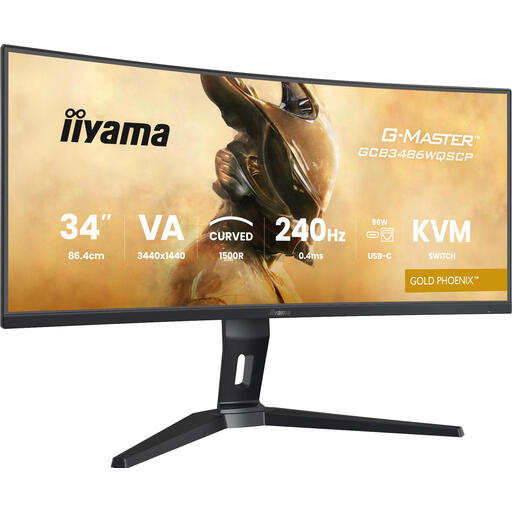 No image available
An ultrawide model to compare if you’re looking for extra screen width; check how your game displays in 21:9 first.
34 inches, 3440 × 1440, 240 Hz and 1500R curvature. The product description mentions FreeSync Premium.
Not necessarily: the available display mode depends on your console, game, cable and monitor port. PlayStation lists 4K/120Hz video output for the PS5; Gigabyte lists 120 Hz for console gaming on the M32U, compared with up to 144 Hz for the monitor.
That depends on how the specific game displays the image. Check how the playing area and menus appear in 21:9 before choosing extra width as your deciding factor.
No, an MPRT figure isn’t the same as measured input lag. Check which measurement method applies to the stated figure, and only compare specifications that use the same definition.
For its OLED monitors, LG recommends using the image-cleaning function in the monitor settings if static elements have been displayed for a long time and faint marks appear. Follow the instructions for the exact model; image cleaning doesn’t guarantee that every mark will disappear.
For online consumer purchases, you generally have a 14-day cooling-off period, subject to legal exceptions, according to the Dutch government. You’re also entitled to a product that meets what you could reasonably expect; ACM ConsuWijzer explains that statutory rights exist alongside seller or manufacturer warranties.