Which factors should you consider?
First, compare how easily you can read the game information. Then check that your device, desk and preferred panel type are a good match for the monitor you’ve chosen.
| Factor |
What to look for |
Who is this important for? |
| Overview and text clarity |
Compare QHD and 4K at the same screen size and from your usual viewing distance. Also check how easy the interface is to read in your games. |
If I want to see the map and menus at the same time, I look for details that remain readable from my viewing distance. Around 33% of consumers prioritise an overview and clear text. |
| Achievable resolution and refresh rate |
Check which combination of resolution and Hz your PC or console supports through the connection you’ve chosen. |
Before choosing a monitor, I want to know which display mode my device can actually run. Around 27% of consumers prioritise an achievable resolution and refresh rate. |
| Panel for a fixed interface |
Weigh the contrast you want against the likelihood of static images remaining on screen for long periods. Check the care and warranty terms for the exact model. |
For long gaming sessions with a fixed HUD, I want to know what panel trade-offs to expect. Around 20% of consumers prioritise the interface and panel care. |
| Size and connection |
Measure the available space, including the stand, and check that your game and device support the aspect ratio you want. |
If my desk is short on space or I’m considering ultrawide, I first check the physical fit and how the game displays on my device. Around 20% of consumers start with screen size or aspect ratio. |
Joybuy products for big-screen gaming
These Joybuy products include 32-inch QHD models and 34-inch ultrawide screens. If you’re considering ultrawide, check that your game and device support the aspect ratio you’ve chosen.
 Image unavailable
Samsung Odyssey G5 G50F LS32FG502EUXEN, 32-inch IPS
A good fit if you’re looking for a large QHD screen that gives you a clear overview while gaming.
32 inches; 2560 × 1440; IPS; 180 Hz; adjustable stand.
Joybuy
 Image unavailable
LG UltraWide 34U601B-B, 34-inch WQHD VA
A good fit if you’re considering a wider screen and want to check your game supports it first.
34 inches; 3440 × 1440; VA; 21:9; 120 Hz; 1800R curvature.
Joybuy
 Image unavailable
KTC H32S17, 32-inch QHD gaming monitor
A good fit if you’re looking for a large QHD gaming display with a stated high refresh rate.
2560 × 1440; 180 Hz; HVA panel; 1500R curvature; Adaptive Sync; HDR10; 1 ms.
Joybuy
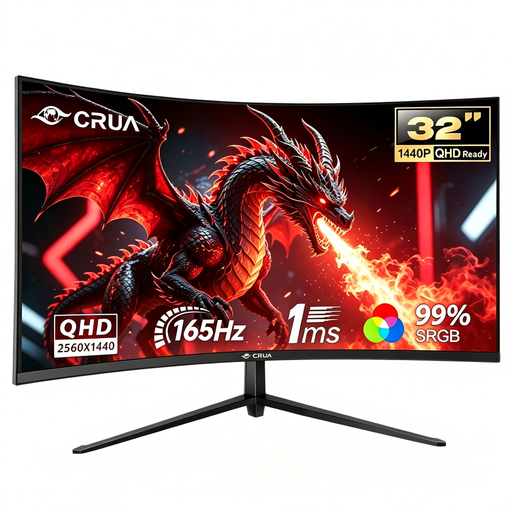 Image unavailable
CRUA CR320C-H, curved 32-inch gaming monitor
A good fit if you want a large curved screen and would like to compare its listed connections with your own setup.
QHD; 165 Hz; 1500R curvature; 1 ms GTG; FreeSync; VESA mounting; DisplayPort.
Joybuy
 Image unavailable
Gawfolk 34-inch UWQHD, curved, 144 Hz
A good fit if you’re looking for a wide screen. How games are displayed depends on support from the game and device.
3440 × 1440; VA panel; 1500R curvature; no speakers.
Joybuy
Frequently asked questions
Does a large monitor for tower defence need to have 240 Hz?
No, there’s no evidence that 240 Hz is essential for tower defence. First choose a screen size and resolution that suit your reading needs and device. The 240 Hz refresh rate of the ASUS PG32UCDM Gen3 is a model specification.
How can I check whether a monitor will fit on my desk?
Measure the available width and depth, then compare them with the monitor’s dimensions, including the stand. Also check that your PC or console supports your preferred resolution and refresh rate through the input you plan to use.
What should I bear in mind when using an OLED monitor for long gaming sessions?
Follow the panel care instructions for the specific model and check the warranty terms. ASUS notes that image retention or burn-in can occur when static, high-contrast images are displayed for a long time.
What rights do I have in the Netherlands when I buy a monitor online?
According to ACM ConsuWijzer, online purchases generally come with a statutory 14-day cooling-off period from the date of delivery, although exceptions apply. You also have statutory warranty rights against the seller if a product is faulty; a manufacturer’s warranty doesn’t replace these rights.
How can I compare monitors’ power consumption?
Compare the EU energy label and product information sheet for the exact version. The European Commission says the label for monitors includes, among other things, the efficiency class and information for SDR and HDR use.


