
Support player who wants a clear view of the interface
You want to be able to follow game information on a large screen while practising. Start by considering screen size, resolution and how the interface is laid out in your game.


A large 16:9 monitor is a sensible choice if you haven’t yet checked whether your game, HUD and system can handle ultrawide. Then choose between QHD and 4K based on the level of sharpness you want and what your PC or console can output at your preferred refresh rate. Ultrawide and OLED may suit specific preferences, but require extra consideration around game compatibility and HUD elements that remain visible for long periods.
You want to be able to follow game information on a large screen while practising. Start by considering screen size, resolution and how the interface is laid out in your game.
You prioritise smooth movement and want to check which refresh rate and synchronisation features your system can actually use.
You want more horizontal screen space, but will first check whether your game and interface work well on an ultrawide display.
A good fit if: you want a large gaming display and a high stated refresh rate, without making 4K your starting point.
The trade-off: QHD has fewer pixels than 4K at the same screen size. The achievable refresh rate also depends on your game, system and connection.
A good fit if: sharpness and detail are important to you and your system supports your desired 4K output.
The trade-off: to use 4K at a high refresh rate, your PC or console and connection must also support that output. With OLED, a HUD that remains static for long periods calls for extra consideration of burn-in risk.
A good fit if: you play on PC, want more horizontal space and have checked that your game and HUD support the aspect ratio.
The trade-off: extra width doesn’t guarantee a more useful view of game information. RTINGS notes that consoles don’t support ultrawide aspect ratios.
| Consideration | What to check before buying | Who should pay extra attention? |
|---|---|---|
| Readability and sharpness | Compare the screen size and native resolution with your viewing distance and the HUD layout in your game. Check that your system can handle the resolution you choose. | If I want to read small interface elements while practising, I look at both screen size and resolution. Around 40% of consumers say readability and sharpness are their top buying priority. |
| Smooth movement | Check your PC or console output, the port and cable you’re using, and support for variable refresh rate. Only compare response times measured using the same method. | If I want to follow movement smoothly in fast-paced team fights, I check what my whole setup can deliver. Around 30% of consumers prioritise motion performance. |
| Extra screen width | Check the aspect ratio supported by your game and the position or scale of HUD elements. Don’t assume ultrawide will be usable on console. | If I want more horizontal space on PC, I first want to know whether my game makes good use of it. Around 20% of consumers say extra screen width is their top priority. |
| Fixed HUD during long sessions | For OLED, check the model-specific maintenance features and warranty terms. A feature designed to reduce risk doesn’t prove that the risk has disappeared. | If the same HUD elements stay on screen for a long time, I take that into account when choosing a panel. Around 10% of consumers give this usage risk the greatest weight. |
An ultrawide screen offers extra horizontal space, but the game and interface need to handle it well. RTINGS notes that consoles don’t support ultrawide aspect ratios.
Check the aspect ratio and HUD in the game you actually practise before switching from 16:9 to ultrawide.
The maximum refresh rate depends in part on your system and connection. What’s more, response time measurements such as MPRT and GtG aren’t directly comparable.
Check the resolution, refresh rate and connection requirements for the exact model. Philips specifically states that the 32M1N5500VS/01 can deliver its maximum resolution only via DisplayPort.
ACM ConsuWijzer explains that statutory guarantee rights apply in addition to a retailer’s or manufacturer’s warranty.
Consider the cover offered by any extended warranty separately from your statutory rights with the retailer.
The Odyssey G5 G50F LS32FG502EUXEN is a large, flat 16:9 QHD IPS model.
The UltraGear 32GR75Q-B is a 31.5-inch QHD IPS model with an adjustable screen position.
The Evnia 32M1N5500VS/01 and 34M2C3500L/00 models represent a 31.5-inch 16:9 QHD model and a 34-inch ultrawide model respectively.
The MAG 323UPF is a large 4K Rapid IPS model for anyone looking to combine sharpness with a high stated refresh rate.
The ROG Swift OLED PG32UCDM Gen3, also known as the PG32UCDM3, is a 31.5-inch 4K QD-OLED model.
These Joybuy products include large QHD and 4K screens, as well as an ultrawide option. Check that the model you choose is a good match for your game, system and preferred aspect ratio.
 Image unavailable
A large 16:9 QHD model for anyone who wants to view a spacious game interface without making ultrawide their starting point.
32 inches, QHD, IPS and 180 Hz.
 Image unavailable
A large 4K model for anyone who values detail and wants to take the possible trade-off around static HUD elements into account.
31.5 inches, 4K UHD and QD-OLED; the product name lists 165 Hz and 0.03 ms.
 Image unavailable
A large QHD screen for anyone looking for a high stated refresh rate and a curved display.
32 inches, 2560 × 1440, 180 Hz, HVA, 1500R and Adaptive Sync.
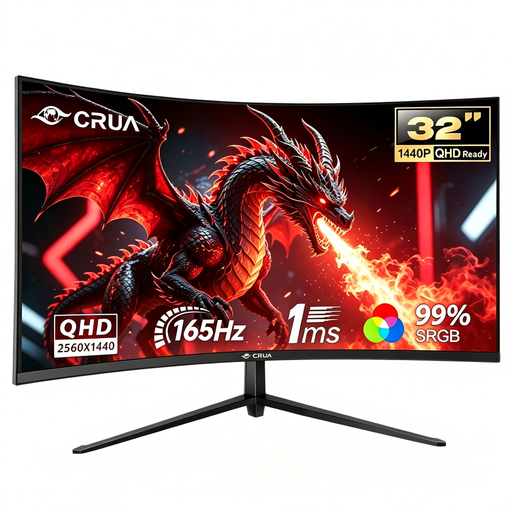 Image unavailable
A large curved QHD model for anyone looking to compare high stated refresh rates while practising.
32 inches, QHD, 165 Hz, 1500R, FreeSync and DisplayPort.
 Image unavailable
An ultrawide option for PC gaming, provided your game and HUD display correctly in the wider aspect ratio.
34 inches, 3440 × 1440, 165 Hz, VA panel and DisplayPort.
No, not automatically. Extra horizontal space can be appealing on PC, but check that the aspect ratio and HUD work well in your game. RTINGS notes that consoles don’t support ultrawide aspect ratios.
First, check your system’s output, the monitor port and cable you’re using, and your game settings. Philips specifically states that the 32M1N5500VS/01 can deliver its maximum resolution only via DisplayPort, and that your graphics card must be capable of outputting the resolution and refresh rate you want.
Bear in mind that static interface elements may stay on screen for long periods. ASUS describes OLED Care Pro on the PG32UCDM Gen3 as a feature that reduces risk. Also check the maintenance instructions and warranty terms for the model you choose, but don’t assume this makes burn-in impossible.
According to ACM ConsuWijzer, for a standard online purchase of goods you generally have a statutory cooling-off period of up to 14 days after delivery. Check the applicable exceptions and returns policy. You’re also covered by the statutory guarantee if the product doesn’t perform as you could reasonably expect under normal use. The retailer is then responsible for providing an appropriate solution. An optional extended warranty doesn’t replace your statutory rights.