
Vandaag of morgen in huis

Kwaliteit gegarandeerd

Welkomstaanbiedingen ontgrendelen: GRATIS bezorging | Tot 80% korting | Gratis 30 dagen JoyPlus-proefperiode
Download de app
As a Joybuy Product Recommendation Officer, I often see the same question from owners of Maine Coons, Ragdolls, or multi-cat households: "Which cat tree is actually sturdy enough?" A standard scratching post that wobbles the moment your 8-kilo cat jumps on it is not only frustrating but also unsafe. It doesn't protect your furniture and, worse, it could tip over.
This article is designed to help you make a durable and safe choice. We'll look at the specifications that truly matter, so you can find a stable cat tree for heavy cats that will last for years and that your cat(s) will actually use.
Before we dive into specific models, here are three key points that make the difference between a bad purchase and a solid investment.
A sturdy cat tree starts with its foundation. Look for a wide and weighted baseplate. This creates a low center of gravity and prevents the post from tipping over when your cat climbs to the top at full speed. Models that include an anti-tip kit, allowing you to secure the cat tree to the wall, offer extra peace of mind. The thickness of the posts is also an important indicator; thicker posts provide more resistance to the weight and force of large cats.
Large cats need room to stretch out completely. A tall scratching post or a cat tower for large cats of at least 150 cm allows them to stretch their muscles and follow their natural climbing instincts. Also, check the dimensions of the perches, condos, and hammocks. Are they large enough for a full-grown Maine Coon to lie in comfortably? A spacious design is crucial, especially for a cat tree for multiple cats, to prevent competition for the best spots.
The lifespan of a cat tree heavily depends on the materials used. Look at the quality of the sisal. Thick, tightly woven sisal rope lasts significantly longer than thin, loosely wrapped rope. The core of the posts is also important. Structures made with solid wood are generally more durable than those made of particle board. The fabric should be soft for comfort but also sturdy enough to withstand heavy use.
Based on the criteria above, we have selected a few models whose specifications make them suitable for larger cat breeds and multi-cat households.
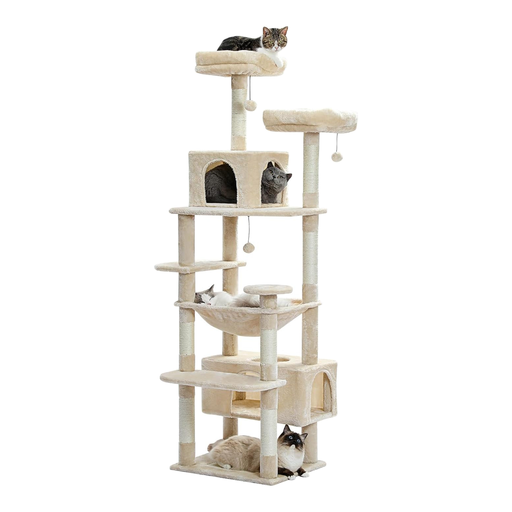
Why it stands out: With an impressive height of 184 cm and eight different levels, this is a complete play paradise. The structure is designed to accommodate multiple cats at once without them getting in each other's way.
Pros:
Who is it for? Ideal for multi-cat households or for owners of very active and large cats who love to climb high. This is a true cat tower for large cats.
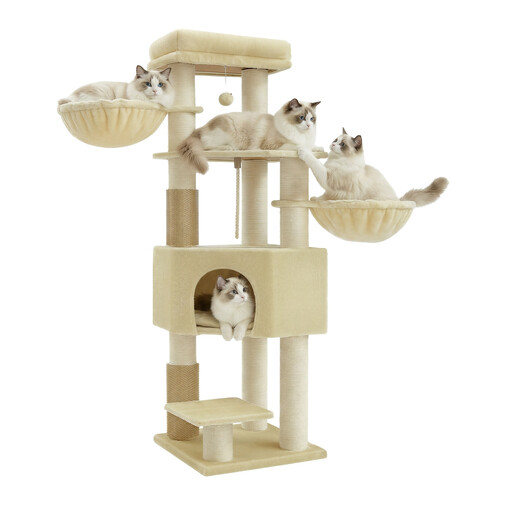
Why it stands out: This model combines robustness with smart details. The focus is on safety, with a reinforced base and an anti-tip kit, and on comfort with self-warming cushions.
Pros:
Who is it for? An excellent choice for owners seeking maximum stability and safety. The washable parts and extra brushes make it a practical option for a clean and well-kept home.
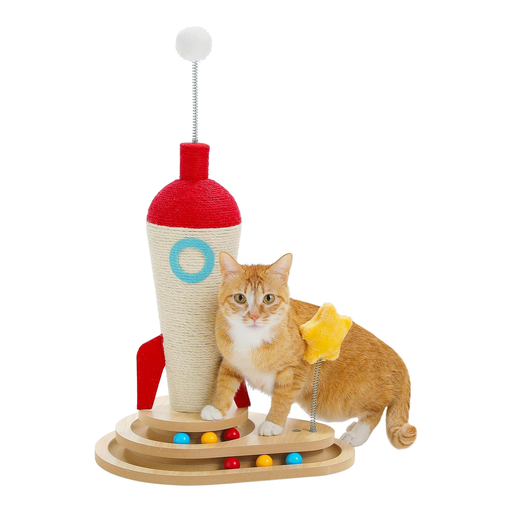
Why it stands out: This is not a traditional XXL cat tree, but a compact and multifunctional play and scratching post. Its unique rocket design combines a scratching post with an interactive toy.
Pros:
Who is it for? Perfect as a supplement to a larger cat tree, or for those looking for a compact, interactive solution that offers both scratching and playing opportunities in one.
A good cat tree is a fantastic gift for your cat. But perhaps you're looking for a gift for another family member, like a cat-loving mother-in-law? Sometimes finding the right present is just as much of a challenge.
Check out our selection of birthday gifts for your mother-in-law for more inspiration.
1. How tall should a cat tree for a large cat be? For a large cat like a Maine Coon, it's ideal if they can fully stretch out against a scratching post. A height of at least 90 cm for a single post is recommended. For a cat tower with multiple levels, a total height of 150 cm or more is desirable, as this stimulates their natural climbing behavior.
2. How can I make a cat tree extra stable? The most effective method is to use the included anti-tip kit to secure the post to a sturdy wall. Additionally, ensure the cat tree is placed on a flat, hard surface (not on a thick carpet). Regularly check that all screws are still tightened securely.
3. Does my cat need a scratching post if they also go outside? Yes. Scratching is not just for claw maintenance, but also for marking territory and stretching muscles. An indoor scratching post provides a safe, personal spot where your cat can exhibit this natural behavior, regardless of the weather outside. It also helps protect your furniture, curtains, and carpet.
