
Vandaag of morgen in huis

Kwaliteit gegarandeerd

Welkomstaanbiedingen ontgrendelen: GRATIS bezorging | Tot 80% korting | Gratis 30 dagen JoyPlus-proefperiode
Download de app
A large cat tree may seem easy to choose at first. But many buyers are tempted by a tall tower with attractive photos, without checking whether the base is wide enough, the resting platforms are large enough or the parts are secure once assembled. This can quickly cause problems, especially with large, active or multiple cats.
So don’t focus on height alone. A suitable large cat tree needs to suit the weight, behaviour and number of cats in your home. Below, you’ll find out which features you can check for yourself and which marketing claims are best treated with a little caution.
A tall cat tree provides vertical space, but a tower over 150 cm puts greater demands on the base. A narrow base may wobble when a cat jumps down from a platform. So check:
An anti-tip feature is no substitute for a level surface and correct assembly. Follow the instructions and check the screws regularly, especially during the first few weeks.
A product title may say it’s suitable for large cats, while giving no weight capacity or maximum load. Look for specific figures. Also note the difference between static load and use in motion. A stated static load generally describes a stationary weight; jumping and playing together can put different stresses on the structure.
For a cat tree used by several cats, it’s also important to have multiple resting spots. This means they won’t all have to use the same platform or cat house.
A cat tree with a hammock, baskets and toys may look well equipped, but cats also need enough vertical sisal surfaces. Check the number of sisal posts, their length and how they’re positioned at different levels.
According to the product information provided by the brands concerned, sisal posts are designed to encourage cats to scratch in designated spots. This doesn’t guarantee that a cat will stop scratching furniture. So place the cat tree near a spot where your cat already likes to scratch, and replace worn parts in good time.
A model around 160 to 170 cm tall takes up relatively little floor space while still offering several levels to climb. A tower over 200 cm provides more vertical space, but needs extra attention when it comes to securing it.
Look at the distance between the platforms. A layout with steps around 20 to 40 cm apart may be more practical than a tower with large jumps that are difficult to manage. Wide intermediate platforms and clear climbing routes are useful for kittens, older cats and cats that are less agile.
A sturdy cat tree needs more than thick upholstery. Check whether the base is reinforced and whether the supporting posts are thick enough. On paper, a model with 17 support posts and 8 sisal-covered posts has a different construction from a compact tree with a single scratching post.
Wide resting platforms are also important for a cat tree for large cats. A platform measuring 50 × 30 cm or more gives a large cat more room to turn around and lie down. Check the total static load, but always treat it as a product specification rather than a safety guarantee in itself.
Plush feels comfortable, but cat hair and dust can easily get trapped in it. Removable cushions, washable covers and surfaces that can be cleaned with a vacuum cleaner or lint roller make daily care easier.
Also look out for loose threads and dangling toys. Check them regularly and remove any part that becomes damaged or comes loose.
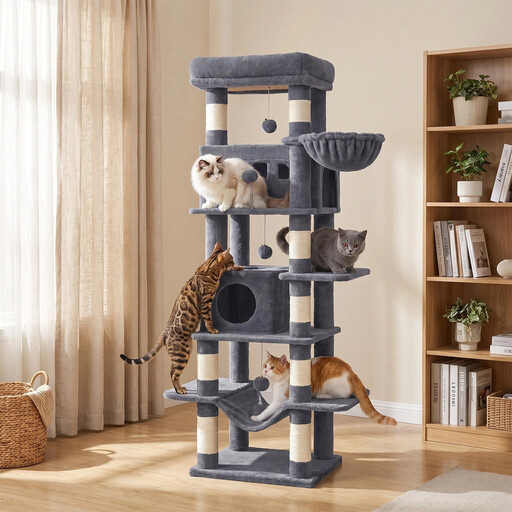
Why it suits this type of buyer: A well-designed six-tier cat tree for households looking for several places to climb, scratch and rest, without going straight for a model over two metres tall.
The product information lists 17 support posts, 8 sisal-covered posts, a double-reinforced base and an anti-tip feature. Check the assembly once it’s in place.
170 cm tall, with two cat houses, a hammock, a 30 cm basket and two removable cushions.
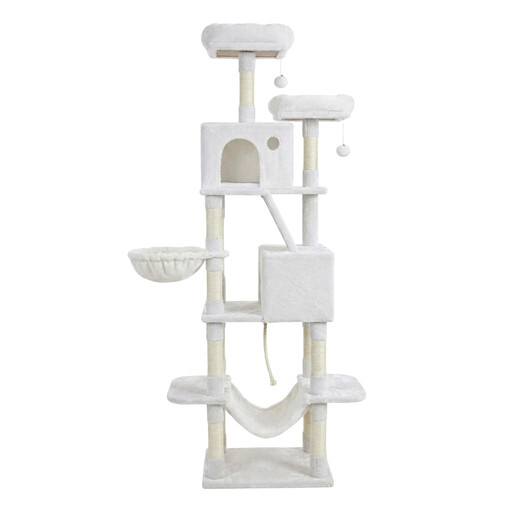
Why it suits this type of buyer: A good choice for active cats and households looking for plenty of vertical space, several resting areas and a higher stated load capacity.
The stated specifications list 13 sisal posts, a reinforced base and a total static load of up to 75 kg. Wall fixing is strongly recommended for a tall tower.
206 cm tall, with 13 scratching posts, two platforms, two cat houses, a basket and a hammock.
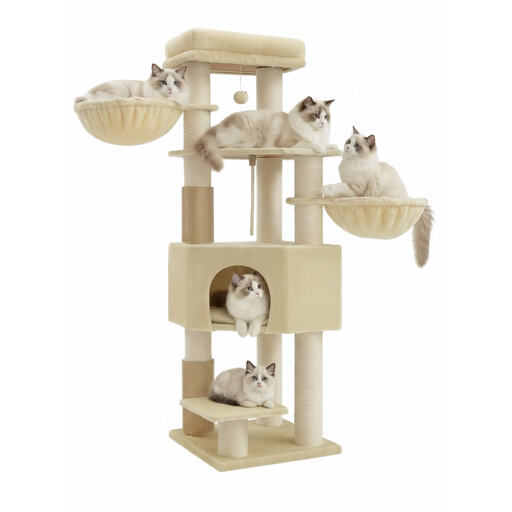
Why it suits this type of buyer: A practical choice for large cats and intensive daily use, if you can plan for maintenance and wall fixing in advance.
The product specifications list an anti-tip base, permanent wall fixing, 9 sisal posts and a maximum static load of 105 kg.
160 × 50 × 50 cm, with a large resting platform, a cave, baskets, a removable mat and a built-in brush.
We’ve put together a comprehensive, up-to-date list of products that meet these strict selection criteria and the applicable European safety requirements.
Place the stable cat tree on a level, non-slip surface, and keep doors, radiators, windows and cables in mind. For tall models, fixing the tree to a suitable wall is advisable and, according to the product information, necessary for some models.
Check monthly:
A cat tree will last longer if you replace damaged parts promptly and clean the covering regularly. Its actual lifespan depends on the materials, the number of cats, their weight and how much they play.
Don’t look at height alone. If you have several cats, choose a tree with different platforms, at least one cat house and several scratching areas. Also check the stated static load and the size of the resting platforms. This helps reduce the chances of your cats having to share the same spot all the time.
For models over around 150 cm, wall fixing is often advisable and is strongly recommended in various product instructions. Use the anti-tip kit supplied, if there is one, and check that the wall and fixings are suitable. Incorrect assembly can reduce stability.
Check a new cat tree after the first few days, then regularly – for example, once a month. If several cats use it heavily, you may need to check it more often. Pay particular attention to loose screws, fraying sisal, damaged plush sections and wobbly platforms.
