
Vandaag of morgen in huis

Kwaliteit gegarandeerd

Welkomstaanbiedingen ontgrendelen: GRATIS bezorging | Tot 80% korting | Gratis 30 dagen JoyPlus-proefperiode
Download de app
A large cat tree needs to do more than provide somewhere to scratch. Large, active cats want to climb, jump, sleep and sometimes retreat somewhere quiet. If you have more than one cat, there’s another requirement: enough space for them to enjoy without constantly getting in each other’s way.
Yet when choosing a cat tree, people often focus mainly on its height or appearance. That can lead to disappointment. A tall tower with a narrow base may wobble, soft upholstery can quickly become covered in fur, and a cat tree with just one resting spot isn’t practical for several cats.
A 170 cm-tall scratching post offers extra room to climb, but height alone doesn’t tell you how stable it is. Check the dimensions of the base, the weight of the structure and whether it has an anti-tip feature. A tall cat tree should stand on a level surface and shouldn’t move noticeably from side to side during normal use.
A multi-level cat tree may have lots of tiers, but the platforms and houses can still be too small. Check the dimensions of the resting spots. For a large cat, wide platforms and a spacious cat house matter more than the number of levels alone.
Not every scratching post with one sisal-wrapped pole offers enough scratching space. Check the number of sisal-wrapped posts, their diameter and where they’re positioned. Several sisal-wrapped posts at different heights give cats more opportunities to scratch vertically and horizontally. This may help redirect their attention from sofas and curtains to the scratching post, but every cat behaves differently.
For large cats, a sturdy scratching post with a wide base is generally a better choice than a narrow model. Check the following:
A scratching post with sisal-wrapped poles is practical if your cat likes to stretch out and scratch with its legs extended. Thicker poles offer more grip. Some product descriptions, for example, specify a diameter of 11 cm or 12,5 cm. Also check that all the posts are actually wrapped in sisal; on some cat trees, only a few of the support posts are designed for scratching.
A cat tree with a hammock is appealing to cats that like a soft place to rest, a little lower down. A cat tree with houses also provides sheltered places to relax. For several cats, a combination of:
is often more practical than one large platform at the top. Washable cushions and removable covers make everyday care easier.
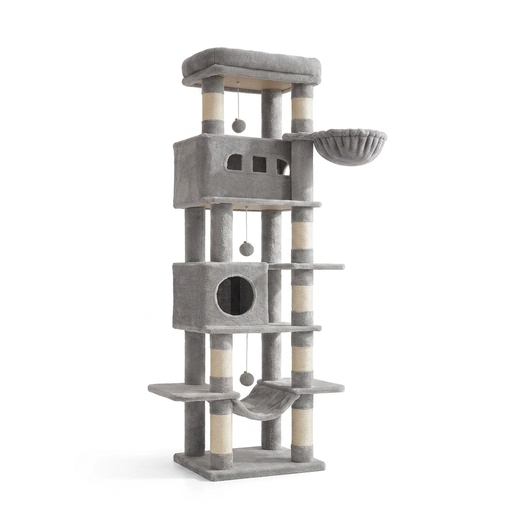
Why it suits this profile: This model combines a height of 170 cm with six levels, a hammock, houses and a basket. It gives you several features in one cat tree without having to go straight for the tallest model.
The product description mentions a reinforced double base and an anti-tip feature. Once assembled, check that all the connections are secure.
170 cm tall, with 17 support posts, eight of which are wrapped in sisal, a 30 cm basket and removable cushions.
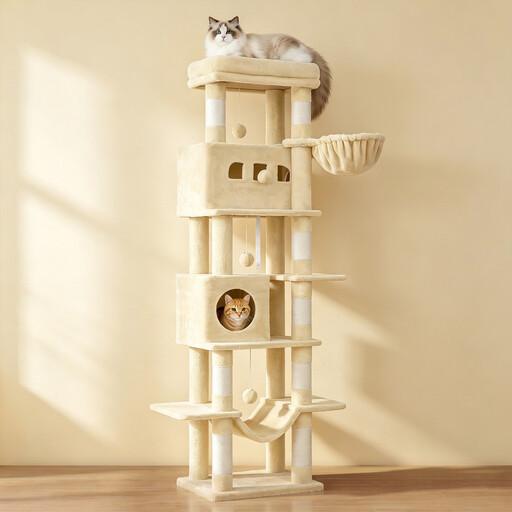
Why it suits this profile: Its six levels, two cat houses, wide basket, hammock and platform offer plenty of variety for cats that like to climb and alternate between different resting spots.
The stated double base and anti-tip lock are important features at this height. The manufacturer says it can be used by up to six cats, each weighing less than 6,8 kg.
212,5 cm tall, with eight sisal-wrapped posts, a 65×45 cm platform and two sheltered cat houses.
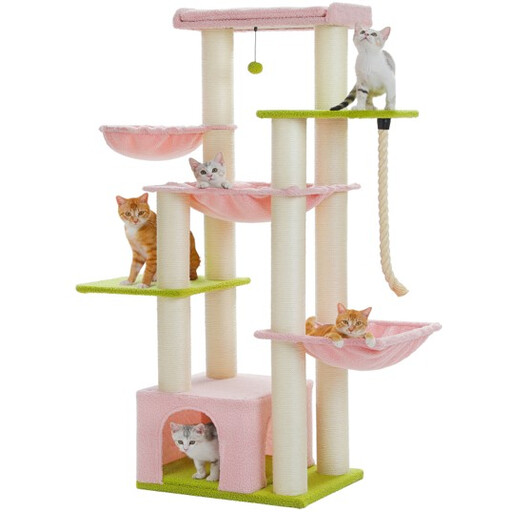
Why it suits this profile: This XXL scratching post is designed for active and larger cats that use several scratching and resting spots. The different hammocks and upper platforms are practical in a multi-cat household.
According to the product description, this model has 13 sisal-wrapped posts, each 11 cm thick, and weighs 24 kg. These are useful indicators of a heavier structure, but correct assembly is still essential.
Three hammocks, three extra-large upper platforms, a spacious cat house and a stated suitability for cats weighing up to 10 kg.
We’ve put together a complete, up-to-date list of products that meet these strict selection criteria and current European safety regulations.
Assemble the parts exactly as instructed, then tighten the connections again after a few days. Place the cat tree on a level floor, preferably against a wall if the design allows. An anti-tip strap can provide extra support.
Remove fur regularly with a vacuum cleaner or lint roller. Removable cushions and hammocks can be washed according to the product instructions. Check the sisal for loose strands, and look for cracks, loose screws or wobbly platforms. Replace any damaged parts before letting your cat use the tree again.
That depends on the space available and your cat’s behaviour. A 130 cm model may be tall enough for climbing and resting. A 170 cm-tall scratching post or taller offers more room for vertical movement, but you’ll need to pay extra attention to the base and wall fixing.
Yes, as long as it has several places to rest and scratch. Don’t just look at the stated number of cats it can accommodate; check the weight limit per cat, the dimensions of the platforms and the overall stability too. Several houses, a hammock and different levels reduce the need to share one spot.
Lifespan varies depending on the model, how intensively it’s used and how well it’s maintained. A heavy structure with thick sisal posts may last longer than a lightweight model, but sisal and upholstery are subject to wear. Regular cleaning, checking the connections and replacing damaged parts promptly can help extend its useful life.
